Loading...
King Wu of Zhou vs Mayurasharma
King Wu of Zhou leads by 20.1 pts · 2 figures compared
…
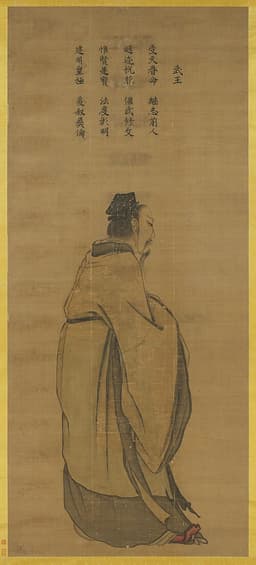
King Wu of Zhou
Emperor · Ancient
67.0Total
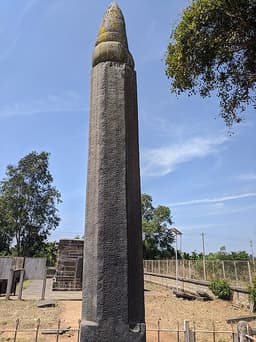
Mayurasharma
Emperor · Ancient
46.9Total
Basic Information
Born
-1076
325
Died
-1043
365
Era
Ancient
Ancient
Nationality
China
India
Occupation
Emperor
Emperor
Civilization
Eastern
Indian
Score Comparison
Military (10%)
82.0
46.7
Political (20%)
55.0
35.1
Influence (20%)
65.0
53.3
Legacy (20%)
80.0
45.8
Leadership (15%)
51.9
55.3
Strategy (15%)
65.4
38.6
TOTAL
67.0
46.9
King Wu of Zhou — Complete Timeline
1046 BC
Battle of MuyeWar
King Wu of Zhou led a coalition of tribes and states to defeat the Shang army at Muye, near the Shang capital. The Shang king Zhou committed suicide, ending the Shang dynasty and establishing the Zhou dynasty as the ruling power in China.
Zhou DynastyBattleDynastic Change
Impact: regional
Founding of the Zhou DynastyPolitical Action◆ Major
King Wu established the Zhou dynasty, with its capital at Haojing (near modern Xi'an). He implemented the feudal system, granting land to relatives and allies, which became the basis for Zhou governance for centuries.
Zhou DynastyFoundingFeudal System
Impact: regionalconstructive
Distribution of FiefsPolitical Action◆ Major
King Wu divided the conquered Shang territories into fiefs granted to his brothers, allies, and descendants of earlier sage-kings. This system of enfeoffment created a network of semi-autonomous states loyal to the Zhou king.
Zhou DynastyFeudal SystemGovernance
Impact: regionalconstructive
Mayurasharma — Complete Timeline
345 AD
Foundation of the Kadamba dynastyPolitical Action◆ Major
Mayurasharma established the Kadamba dynasty, the first native kingdom in Karnataka. He broke away from the Pallava suzerainty and founded a kingdom that ruled from Banavasi, marking the beginning of Kannada political identity.
Dynasty FoundationKarnatakaKadamba
Impact: regionalconstructive
360 AD
Performance of the Ashvamedha sacrificeCultural◆ Major
Mayurasharma performed the Ashvamedha (horse sacrifice) to assert his imperial status. This Vedic ritual was a declaration of sovereignty and was recorded in the Talagunda inscription.
AshvamedhaImperial AuthorityVedic Ritual
Impact: regionalconstructive
Expert Analysis
Origins
King Wu of Zhou, born Ji Fa in the 11th century BCE, was the son of King Wen of Zhou, a virtuous leader who expanded the Zhou state during the decline of the Shang dynasty. King Wen laid the groundwork by attracting talented advisors and building alliances. King Wu inherited this momentum, along with a strong military and political base. His early life was shaped by the oppressive rule of Shang's last king, Zhou, which fueled his ambition to overthrow the Shang.
Mayurasharma, born in the 4th century CE in the Talagunda region of present-day Karnataka, was a Brahmin scholar who initially served the Pallava dynasty. Dissatisfied with the Pallava administration, he turned to a military career. His background as a learned Brahmin gave him unique diplomatic and administrative skills, but he lacked the military lineage of King Wu.
Rise to Power
King Wu's rise was marked by the Battle of Muye (c. 1046 BCE). After his father's death, he led a coalition of tribes and states against the Shang army. The Shang king Zhou committed suicide, and King Wu entered the capital, establishing the Zhou dynasty. Key allies included his brother, the Duke of Zhou, and military strategist Jiang Ziya. King Wu's success was swift, relying on military force and strategic alliances.
Mayurasharma's rise was more gradual. He initially sought favor from the Pallava king but was humiliated, leading him to take up arms. He gathered a small army and defeated local chieftains, eventually carving out a kingdom in the forests of Karnataka. His turning point was performing the Ashvamedha sacrifice, a Vedic ritual asserting sovereignty, which solidified his rule. He scored 46.7 in military and 35.1 in political, reflecting his smaller scale of conquest.
Leadership & Governance
King Wu implemented the feudal system (fengjian), granting land to relatives and allies. This decentralized governance ensured loyalty but later led to fragmentation. He also promoted Confucian ideals of virtue, though these were formalized later. His leadership score of 51.9 indicates moderate effectiveness; he relied heavily on advisors like the Duke of Zhou.
Mayurasharma established the Kadamba dynasty, the first native kingdom in Karnataka. He adopted a Brahminical administrative model, patronizing Hinduism and Sanskrit. His governance was more localized, focusing on consolidating control over the Deccan plateau. His political score of 35.1 reflects limited institutional innovation compared to King Wu.
Triumph & Tragedy
King Wu's greatest triumph was overthrowing the Shang and founding the Zhou dynasty, which lasted 790 years. His greatest failure was his early death shortly after the conquest, leaving his young son to rule, leading to regency crises. The Duke of Zhou had to suppress rebellions, tarnishing the transition.
Mayurasharma's triumph was establishing Karnataka's first indigenous kingdom, breaking Pallava dominance. His tragedy was the limited expansion; the Kadamba kingdom remained a regional power, later subjugated by the Chalukyas. His legacy score of 45.8 reflects a modest but enduring impact.
Character & Destiny
King Wu was decisive and ambitious, but his early death cut short his potential. He scored 65.4 in strategy, showing competent planning. His character was shaped by filial piety and a sense of justice against Shang tyranny.
Mayurasharma was resilient and adaptive, transitioning from scholar to warrior. His Brahmin background gave him cultural legitimacy, but his military score of 46.7 indicates limited strategic reach. His destiny was to be a regional founder, not a pan-Indian conqueror.
Legacy
King Wu's Zhou dynasty set the template for Chinese feudalism, influencing governance for millennia. The concept of the Mandate of Heaven, used to justify his rule, became a central Chinese political philosophy. His total score of 67.0 reflects high military and legacy impact.
Mayurasharma's Kadamba dynasty left a cultural imprint in Karnataka, promoting local literature and temple architecture. However, his influence score of 53.3 and legacy of 45.8 show a narrower impact confined to South India.
Conclusion
King Wu of Zhou had a greater impact historically, scoring 67.0 overall versus Mayurasharma's 46.9. King Wu's establishment of the Zhou dynasty and the Mandate of Heaven concept shaped Chinese civilization for centuries. Mayurasharma, while important for Karnataka's identity, achieved regional significance. The 20.1-point gap reflects King Wu's broader influence on political philosophy and governance systems.
Rankings
🥇
King Wu of ZhouLeader
Mil: 82.0Pol: 55.0Inf: 65.0
67.0
🥈
Mayurasharma
Mil: 46.7Pol: 35.1Inf: 53.3
46.9
+20.1 behind
How This Comparison Works
Algorithm
Each figure is scored on 6 dimensions (0—100 scale) based on structured historical data: Military (10%), Political (20%), Influence (20%), Legacy (20%), Leadership (15%), Strategy (15%). The weighted total produces the final ranking.
Data Sources
Scores are computed from structured sub-indicators in the database. Scale factors adjust for era (Ancient ×0.85, Modern ×1.0) and civilization size (Eastern ×1.05, Other ×0.80) to account for differences in population and military scale.
Maximum 3 Figures
Comparisons are limited to 2—3 figures to ensure readability and statistical meaningfulness.
Error Margins
±5 points per dimension — Sub-scores are derived from historical records with inherent uncertainty. Two figures within 5 points on a dimension should be considered roughly equivalent in that area.
Total Score Accuracy
±3 points overall — The weighted combination of 6 dimensions produces a total score with approximately ±3 points of uncertainty. Differences of less than 3 points are not statistically significant— the figures are effectively tied.
Known Limitations
- Historical records are incomplete and uneven across civilizations
- Figures from oral-tradition societies may be underrepresented
- Occupation labels can misclassify multi-role figures
- Scores measure capability and impact, not moral character
- Quantitative scoring is a comparison tool, not absolute truth
Capability Radar
Military (10%) — Battles & Warfare
Battles
60
25
Win Rate
85
30
Expansion
70
30
Political (20%) — Governance & Reform
Reform
80
35
Diplomacy
75
30
Economy
60
25
Influence (20%) — Cultural & Global Reach
Cultural
85
40
Global
70
20
Legacy (20%) — Historical Impact
Historical
90
45
Longevity
95
40
Leadership (15%) — Power & Stability
Tenure
15
40
Stability
50
30
Strategy (15%) — Tactics & Innovation
Strategy
75
25
Tactics
70
20
Reform
65
15
Similar Comparisons
Comments & Discussion
No comments yet. Be the first to share your thoughts!