Loading...
This comparison has not been analyzed yet.
One-time AI generation (~1 minute). Scores and timeline are already available below.
King Seongjong of Joseon vs Simeon I
Simeon I leads by 16.3 pts · 2 figures compared
…

King Seongjong of Joseon
Emperor · Medieval
53.8Total
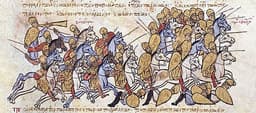
Simeon I
Emperor · Medieval
70.1Total
Basic Information
Born
1457
864
Died
1494
927
Era
Medieval
Medieval
Nationality
Korea
Bulgaria
Occupation
Emperor
Emperor
Civilization
Eastern
Western
Score Comparison
Military (10%)
21.2
72.0
Political (20%)
60.0
65.0
Influence (20%)
57.2
82.0
Legacy (20%)
54.0
55.0
Leadership (15%)
72.0
79.8
Strategy (15%)
41.0
69.1
TOTAL
53.8
70.1
King Seongjong of Joseon — Complete Timeline
1470 AD
Promotion of Confucian educationCultural◆ Major
Seongjong expanded the national Confucian academy (Seonggyungwan) and local schools, increasing access to education based on Confucian classics. This fostered a generation of scholar-officials who shaped Joseon's bureaucracy.
EducationConfucianismCultural Policy
Impact: nationalconstructive
1475 AD
Establishment of the Office of Special CounselorsReform
Seongjong strengthened the Office of Special Counselors (Hongmungwan), which served as a royal library and advisory body. This institution promoted Confucian scholarship and played a key role in policy debates.
Institutional ReformConfucianism
Impact: nationalconstructive
1485 AD
Compilation of the Grand Code for State AdministrationReform
Under King Seongjong's direction, scholars completed the Grand Code for State Administration (Gyeongguk Daejeon), a comprehensive legal code that systematized Joseon's government structure and laws. It remained the basis of Joseon law for centuries.
Legal ReformGovernanceJoseon Dynasty
Impact: nationalconstructive
Simeon I — Complete Timeline
893 AD
Establishment of the Preslav Literary SchoolCultural◆ Major
Under Simeon I's patronage, the Preslav Literary School flourished, producing translations of Greek religious texts and original works in Old Church Slavonic. This cultural golden age advanced Slavic literature and liturgy.
Cultural Golden AgeLiteratureSlavic Language
Impact: regionalconstructive
913 AD
Proclamation as Emperor (Tsar)Political Action◆ Major
Simeon I was crowned 'Emperor of the Bulgarians and the Romans' by the Patriarch of Constantinople, though the Byzantine court later disputed this. This act elevated Bulgaria to imperial status and challenged Byzantine supremacy.
CoronationImperial TitleByzantine Relations
Impact: regional
917 AD
Battle of AchelousWar
Simeon I's Bulgarian army decisively defeated the Byzantine forces at the Achelous River. This victory allowed Simeon to claim the title 'Tsar of the Bulgarians and the Romans' and established Bulgaria as a major power in the Balkans.
BattleByzantine-Bulgarian WarTsar Title
Impact: regional
924 AD
Siege of ConstantinopleWar◆ Major
Simeon I besieged Constantinople, the Byzantine capital, but failed to capture it. The siege ended with a peace treaty that recognized Simeon's imperial title but did not grant him control of the city.
SiegeByzantine EmpirePeace Treaty
Impact: regional
This comparison has not been analyzed yet.
One-time AI generation (~1 minute). Scores and timeline are already available below.
Rankings
🥇
Simeon ILeader
Mil: 72.0Pol: 65.0Inf: 82.0
70.1
🥈
King Seongjong of Joseon
Mil: 21.2Pol: 60.0Inf: 57.2
53.8
+16.3 behind
How This Comparison Works
Algorithm
Each figure is scored on 6 dimensions (0—100 scale) based on structured historical data: Military (10%), Political (20%), Influence (20%), Legacy (20%), Leadership (15%), Strategy (15%). The weighted total produces the final ranking.
Data Sources
Scores are computed from structured sub-indicators in the database. Scale factors adjust for era (Ancient ×0.85, Modern ×1.0) and civilization size (Eastern ×1.05, Other ×0.80) to account for differences in population and military scale.
Maximum 3 Figures
Comparisons are limited to 2—3 figures to ensure readability and statistical meaningfulness.
Error Margins
±5 points per dimension — Sub-scores are derived from historical records with inherent uncertainty. Two figures within 5 points on a dimension should be considered roughly equivalent in that area.
Total Score Accuracy
±3 points overall — The weighted combination of 6 dimensions produces a total score with approximately ±3 points of uncertainty. Differences of less than 3 points are not statistically significant— the figures are effectively tied.
Known Limitations
- Historical records are incomplete and uneven across civilizations
- Figures from oral-tradition societies may be underrepresented
- Occupation labels can misclassify multi-role figures
- Scores measure capability and impact, not moral character
- Quantitative scoring is a comparison tool, not absolute truth
Capability Radar
Military (10%) — Battles & Warfare
Battles
10
85
Win Rate
10
80
Expansion
10
85
Political (20%) — Governance & Reform
Reform
85
75
Diplomacy
60
70
Economy
65
75
Influence (20%) — Cultural & Global Reach
Cultural
55
80
Global
30
60
Legacy (20%) — Historical Impact
Historical
60
75
Longevity
55
70
Leadership (15%) — Power & Stability
Tenure
70
80
Stability
75
70
Strategy (15%) — Tactics & Innovation
Strategy
10
85
Tactics
10
75
Reform
30
70
Similar Comparisons
Comments & Discussion
No comments yet. Be the first to share your thoughts!