Loading...
This comparison has not been analyzed yet.
One-time AI generation (~1 minute). Scores and timeline are already available below.
King Zhuang of Chu vs Wu Ding of Shang
Wu Ding of Shang leads by 0.5 pts · 2 figures compared
…
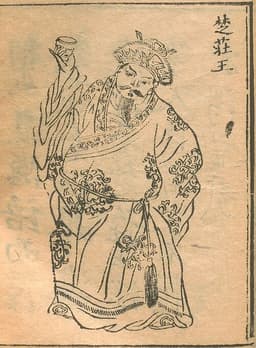
King Zhuang of Chu
Emperor · Ancient
59.4Total

Wu Ding of Shang
Emperor · Ancient
59.9Total
Basic Information
Born
-613
-1170
Died
-591
-1110
Era
Ancient
Ancient
Nationality
China
Shang China
Occupation
Emperor
Emperor
Civilization
Eastern
Eastern
Score Comparison
Military (10%)
74.0
74.0
Political (20%)
60.0
45.0
Influence (20%)
58.0
56.7
Legacy (20%)
50.0
52.0
Leadership (15%)
66.0
80.0
Strategy (15%)
61.2
65.4
TOTAL
59.4
59.9
King Zhuang of Chu — Complete Timeline
606 BC
Inquiry about the Nine Tripod CauldronsPolitical Action◆ Major
King Zhuang of Chu, during a campaign against the Rong tribes, asked the Zhou envoy about the size and weight of the Nine Tripod Cauldrons, symbols of royal authority. This act was seen as a challenge to Zhou legitimacy and a claim to supremacy.
Spring and AutumnSymbolismPower Play
Impact: regional
600 BC
Annexation of Smaller StatesWar◆ Major
King Zhuang of Chu annexed several smaller states, including Chen, Cai, and Xu, expanding Chu's territory significantly. These conquests brought Chu's borders to the Yellow River and increased its population and resources.
Spring and AutumnConquestExpansion
Impact: regionaldestructive
Reforms in Chu AdministrationReform
King Zhuang implemented administrative reforms, including the appointment of capable officials like Sunshu Ao, who improved irrigation and agriculture. These reforms strengthened Chu's economy and military, supporting its hegemonic ambitions.
Spring and AutumnReformChu State
Impact: regionalprogressive
597 BC
Battle of BiWar
King Zhuang of Chu defeated the state of Jin at the Battle of Bi, a major engagement in the struggle for hegemony. The victory established Chu as the dominant power in the Central Plains and marked the peak of Chu's influence.
Spring and AutumnBattleHegemon
Impact: regional
Wu Ding of Shang — Complete Timeline
1200 BC
Campaign against the GuifangWar◆ Major
Wu Ding launched a major military campaign against the Guifang, a northern tribal confederation. Oracle bone inscriptions record the mobilization of thousands of troops and the capture of many prisoners, expanding Shang territory and securing the northern frontier.
Military CampaignTerritorial ExpansionOracle Bone Records
Impact: regional
Campaign against the TufangWar◆ Major
Wu Ding conducted repeated campaigns against the Tufang, a powerful western tribe. Oracle bones detail the mustering of armies, the appointment of generals, and the offering of sacrifices for victory, reflecting sustained military pressure on Shang borders.
Military CampaignBorder DefenseOracle Bone Records
Impact: regional
Appointment of Fu Hao as military commanderPolitical Action◆ Major
Wu Ding appointed his consort Fu Hao to lead military campaigns, including against the Qiang and Yi peoples. Oracle bones record her command of thousands of troops, making her one of the earliest documented female military leaders in Chinese history.
Female LeadershipMilitary CommandOracle Bone Records
Impact: nationalconstructive
Peak of oracle bone divinationCultural◆ Major
Under Wu Ding, the practice of oracle bone divination reached its zenith. Thousands of inscribed bones and shells survive, recording royal inquiries about warfare, harvests, weather, and rituals, providing the earliest substantial corpus of Chinese writing.
WritingDivinationCultural Record
Impact: globalconstructive
Construction of the tomb of Fu HaoCultural◆ Major
Wu Ding ordered the construction of a large tomb for Fu Hao at Yinxu. The tomb, discovered intact in 1976, contained over 1,600 artifacts including bronze vessels, jade, and weapons, providing a rich archaeological record of Shang material culture.
ArchaeologyBurialMaterial Culture
Impact: global
This comparison has not been analyzed yet.
One-time AI generation (~1 minute). Scores and timeline are already available below.
Rankings
🥇
Wu Ding of ShangLeader
Mil: 74.0Pol: 45.0Inf: 56.7
59.9
🥈
King Zhuang of Chu
Mil: 74.0Pol: 60.0Inf: 58.0
59.4
+0.5 behind
How This Comparison Works
Algorithm
Each figure is scored on 6 dimensions (0—100 scale) based on structured historical data: Military (10%), Political (20%), Influence (20%), Legacy (20%), Leadership (15%), Strategy (15%). The weighted total produces the final ranking.
Data Sources
Scores are computed from structured sub-indicators in the database. Scale factors adjust for era (Ancient ×0.85, Modern ×1.0) and civilization size (Eastern ×1.05, Other ×0.80) to account for differences in population and military scale.
Maximum 3 Figures
Comparisons are limited to 2—3 figures to ensure readability and statistical meaningfulness.
Error Margins
±5 points per dimension — Sub-scores are derived from historical records with inherent uncertainty. Two figures within 5 points on a dimension should be considered roughly equivalent in that area.
Total Score Accuracy
±3 points overall — The weighted combination of 6 dimensions produces a total score with approximately ±3 points of uncertainty. Differences of less than 3 points are not statistically significant— the figures are effectively tied.
Known Limitations
- Historical records are incomplete and uneven across civilizations
- Figures from oral-tradition societies may be underrepresented
- Occupation labels can misclassify multi-role figures
- Scores measure capability and impact, not moral character
- Quantitative scoring is a comparison tool, not absolute truth
Capability Radar
Military (10%) — Battles & Warfare
Battles
75
75
Win Rate
80
80
Expansion
80
80
Political (20%) — Governance & Reform
Reform
65
70
Diplomacy
75
60
Economy
70
65
Influence (20%) — Cultural & Global Reach
Cultural
60
85
Global
50
60
Legacy (20%) — Historical Impact
Historical
70
80
Longevity
55
75
Leadership (15%) — Power & Stability
Tenure
70
85
Stability
65
70
Strategy (15%) — Tactics & Innovation
Strategy
75
75
Tactics
70
70
Reform
60
65
Similar Comparisons
Comments & Discussion
No comments yet. Be the first to share your thoughts!