Loading...
King Zhuang of Chu vs Napoleon Bonaparte
Napoleon Bonaparte leads by 11.5 pts · 2 figures compared
…
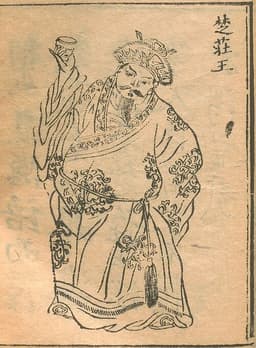
King Zhuang of Chu
Emperor · Ancient
59.4Total

Napoleon Bonaparte
General · Modern
70.9Total
Basic Information
Born
-613
1769
Died
-591
1821
Era
Ancient
Modern
Nationality
China
France
Occupation
Emperor
General
Civilization
Eastern
Western
Score Comparison
Military (10%)
74.0
94.0
Political (20%)
60.0
72.0
Influence (20%)
58.0
40.0
Legacy (20%)
50.0
80.0
Leadership (15%)
66.0
78.0
Strategy (15%)
61.2
90.0
TOTAL
59.4
70.9
King Zhuang of Chu — Complete Timeline
606 BC
Inquiry about the Nine Tripod CauldronsPolitical Action◆ Major
King Zhuang of Chu, during a campaign against the Rong tribes, asked the Zhou envoy about the size and weight of the Nine Tripod Cauldrons, symbols of royal authority. This act was seen as a challenge to Zhou legitimacy and a claim to supremacy.
Spring and AutumnSymbolismPower Play
Impact: regional
600 BC
Annexation of Smaller StatesWar◆ Major
King Zhuang of Chu annexed several smaller states, including Chen, Cai, and Xu, expanding Chu's territory significantly. These conquests brought Chu's borders to the Yellow River and increased its population and resources.
Spring and AutumnConquestExpansion
Impact: regionaldestructive
Reforms in Chu AdministrationReform
King Zhuang implemented administrative reforms, including the appointment of capable officials like Sunshu Ao, who improved irrigation and agriculture. These reforms strengthened Chu's economy and military, supporting its hegemonic ambitions.
Spring and AutumnReformChu State
Impact: regionalprogressive
597 BC
Battle of BiWar
King Zhuang of Chu defeated the state of Jin at the Battle of Bi, a major engagement in the struggle for hegemony. The victory established Chu as the dominant power in the Central Plains and marked the peak of Chu's influence.
Spring and AutumnBattleHegemon
Impact: regional
Napoleon Bonaparte — Complete Timeline
1799 AD
Coup of 18 BrumaireOther◆ Major
Napoleon Bonaparte, with support from his brother Lucien and key political figures, overthrew the Directory in a bloodless coup. He established the Consulate with himself as First Consul, effectively becoming the ruler of France. This event ended the French Revolution's most unstable period.
French RevolutionCoupRise to Power
Impact: regional
1804 AD
Promulgation of the Napoleonic CodeOther◆ Major
Napoleon enacted the Civil Code of the French, known as the Napoleonic Code, a comprehensive set of laws that replaced the fragmented feudal legal systems. The code established legal equality, protected property rights, and secularized law. It became the basis for legal systems in many European and world countries.
Legal ReformNapoleonic CodeCivil Law
Impact: globalconstructive
1805 AD
Battle of AusterlitzWar◆ Major
Napoleon's Grande Arm
Napoleonic WarsBattleDecisive Victory
Impact: global
1812 AD
Invasion of RussiaWar◆ Major
Napoleon led the Grande Arm
Napoleonic WarsInvasionDisaster
Impact: globaldestructive
1815 AD
Battle of WaterlooWar◆ Major
Napoleon's French army was defeated by the combined forces of the Duke of Wellington's Anglo-Allied army and Gebhard Leberecht von Bl
Napoleonic WarsBattleFinal Defeat
Impact: globaldestructive
Expert Analysis
king-zhuang-of-chu-vs-napoleon-bonaparte
# The Emperor and the Hegemon: Napoleon and King Zhuang of Chu
On a June morning in 1815, Napoleon Bonaparte stood on a muddy ridge near Waterloo, watching his Imperial Guard march toward certain destruction. Twenty-three centuries earlier and half a world away, King Zhuang of Chu sat beneath a ceremonial canopy near the Yellow River, calmly asking a Zhou envoy about the weight of sacred bronze tripods—a question that would echo through Chinese history as the ultimate challenge to established order. Both men sought to reshape the world they inherited. One built an empire that collapsed in a single day. The other built a kingdom that endured for centuries. What explains the difference?
Origins
Napoleon was born in 1769 on the Mediterranean island of Corsica, a place that had become French only months before his birth. His family belonged to the minor nobility, but they were poor, proud, and resentful of French domination. Young Napoleon spoke Italian before French, and his early letters seethed with Corsican nationalism. He was an outsider in every sense—short, intense, and burning with ambition to prove himself. The French Revolution, which erupted when he was twenty, shattered the old order and created opportunities unimaginable under the ancien régime. A talented artillery officer could become emperor. Napoleon seized that possibility with both hands.
King Zhuang of Chu was born in 613 BCE into an entirely different world. Chu was a semi-barbarian state in the Yangtze River valley, regarded by the central Chinese kingdoms as uncouth and dangerous. Its rulers claimed the title of king—a direct challenge to the Zhou dynasty's nominal authority—while the Zhou themselves sat powerless in their eastern capital. Zhuang inherited a kingdom that was already powerful but restless, surrounded by smaller states that paid tribute only when forced. His early years were shadowed by a regent who held real power, and the young king spent his youth watching, learning, and waiting.
The differences in their origins shaped everything that followed. Napoleon rose in a world of revolutionary upheaval, where merit could overcome birth. Zhuang ruled in a world of hereditary hierarchy, where legitimacy required bloodline but power required cunning.
Rise to Power
Napoleon's ascent was meteoric. At age twenty-four, he drove the British out of Toulon and was promoted to brigadier general. At twenty-six, he crushed a royalist uprising in Paris with a "whiff of grapeshot" and became commander of the Army of Italy. In 1796, he led that ragged army across the Alps and defeated the Austrians in a campaign of breathtaking speed and audacity. By 1799, he was First Consul; by 1804, Emperor of the French. Each step was earned through victory, but each victory fed a hunger that could never be satisfied.
King Zhuang's path was slower and more deliberate. He began by eliminating his regent and consolidating power at court. He appointed capable ministers like Sunshu Ao, who reformed administration and built irrigation systems that would feed Chu's armies for generations. In 606 BCE, during a campaign against the Rong tribes, Zhuang marched his army to the outskirts of the Zhou capital. The Zhou king, terrified, sent an envoy with gifts. Zhuang asked about the Nine Tripod Cauldrons—the sacred bronze vessels that symbolized Zhou authority over all China. How heavy were they? The envoy evaded the question, saying that virtue mattered more than weight. Zhuang laughed and withdrew, but the message was clear: the old order was dying.
Leadership & Governance
Napoleon governed through force of personality and institutional genius. His Napoleonic Code reformed French law, establishing principles of equality before the law and protection of property that spread across Europe. He built schools, roads, and a centralized bureaucracy. But his system depended entirely on him. When he lost, it collapsed.
King Zhuang governed through balance and patience. He annexed smaller states like Chen, Cai, and Xu, but he did not destroy them—he absorbed their elites into Chu's administration. He promoted capable men regardless of birth, a radical idea in ancient China. His victory at the Battle of Bi in 597 BCE broke Jin's dominance and established Chu as the paramount power in the central plains. Yet Zhuang did not press his advantage. He knew that overreach destroyed empires.
Triumph & Tragedy
Napoleon's greatest triumph was Austerlitz in 1805, where he destroyed an Austro-Russian army with a masterpiece of deception and timing. His greatest tragedy was the invasion of Russia in 1812—600,000 men marched east; fewer than 40,000 returned. He never recovered.
King Zhuang's greatest triumph was the Battle of Bi, where his forces outmaneuvered the vaunted Jin army and secured Chu's hegemony. His tragedy—if it can be called that—was that he died in 591 BCE, probably in his early forties, before he could consolidate his achievements fully. He left a strong kingdom but no clear successor.
Character & Destiny
Napoleon was driven by an insatiable need to prove himself. "I am not a man," he once said, "but a thing." He could not stop. Victory demanded more victory. He mistrusted everyone, including his own family. His paranoia grew with his power, and his judgment deteriorated.
King Zhuang was driven by a different logic. He was ruthless when necessary—he executed his regent without hesitation—but he understood that power required legitimacy. He asked about the tripods but did not seize them. He defeated Jin but did not destroy it. He knew that the greatest victory was the one that did not need to be won again.
Legacy
Napoleon's legacy is everywhere. His legal code, his administrative system, his military innovations—they shaped modern Europe. But his name is also synonymous with hubris and catastrophic ambition. He is remembered as a genius who destroyed himself.
King Zhuang's legacy is more subtle. He is revered as one of the Five Hegemons, the model of a wise and powerful ruler. His questions about the tripods became proverbial. His kingdom, Chu, survived for centuries after his death. He is remembered as a builder, not a destroyer.
Conclusion
Both men faced the same fundamental question: how do you transform ambition into lasting achievement? Napoleon answered by reaching for everything and grasping nothing. King Zhuang answered by reaching for what he could hold and building foundations for those who came after. The difference was not in talent—both were extraordinary. It was in wisdom. Napoleon saw history as something to conquer. King Zhuang saw it as something to join. One became a warning. The other became a model. The choice between them is the choice between fire and stone.
Rankings
🥇
Napoleon BonaparteLeader
Mil: 94.0Pol: 72.0Inf: 40.0
70.9
🥈
King Zhuang of Chu
Mil: 74.0Pol: 60.0Inf: 58.0
59.4
+11.5 behind
How This Comparison Works
Algorithm
Each figure is scored on 6 dimensions (0—100 scale) based on structured historical data: Military (10%), Political (20%), Influence (20%), Legacy (20%), Leadership (15%), Strategy (15%). The weighted total produces the final ranking.
Data Sources
Scores are computed from structured sub-indicators in the database. Scale factors adjust for era (Ancient ×0.85, Modern ×1.0) and civilization size (Eastern ×1.05, Other ×0.80) to account for differences in population and military scale.
Maximum 3 Figures
Comparisons are limited to 2—3 figures to ensure readability and statistical meaningfulness.
Error Margins
±5 points per dimension — Sub-scores are derived from historical records with inherent uncertainty. Two figures within 5 points on a dimension should be considered roughly equivalent in that area.
Total Score Accuracy
±3 points overall — The weighted combination of 6 dimensions produces a total score with approximately ±3 points of uncertainty. Differences of less than 3 points are not statistically significant— the figures are effectively tied.
Known Limitations
- Historical records are incomplete and uneven across civilizations
- Figures from oral-tradition societies may be underrepresented
- Occupation labels can misclassify multi-role figures
- Scores measure capability and impact, not moral character
- Quantitative scoring is a comparison tool, not absolute truth
Capability Radar
Military (10%) — Battles & Warfare
Battles
75
95
Win Rate
80
90
Expansion
80
95
Political (20%) — Governance & Reform
Reform
65
95
Diplomacy
75
80
Economy
70
85
Influence (20%) — Cultural & Global Reach
Cultural
60
85
Global
50
90
Legacy (20%) — Historical Impact
Historical
70
95
Longevity
55
90
Leadership (15%) — Power & Stability
Tenure
70
85
Stability
65
70
Strategy (15%) — Tactics & Innovation
Strategy
75
95
Tactics
70
98
Reform
60
92
Similar Comparisons
Comments & Discussion
红旗猎猎6/17/2026
拿破仑算什么天才?楚庄王一鸣惊人等了三年,那是真耐心。拿破仑百日王朝就完蛋,庄王问鼎中原一步步来。欧洲人总以为快速就是伟大,我们中国人才懂慢功出细活。法军打仗像炮仗,楚军才是真功夫。|
BaguetteBasher6/17/2026
Let's be real—Napoleon's biggest mistake wasn't invading Russia, it was not studying Chu's logistics. Zhuang's army fed itself along rivers while Napoleon's marched to Moscow on empty stomachs. Waterloo was just the dessert to that main course disaster. Give me a general who reads supply tables over one who reads battle plans any day.|
LatinScribbler6/17/2026
Classics scholar here: Napoleon conquering Europe was like an ambitious clerk climbing the ladder—impressive, but provincial. Zhuang's "inquiry about the tripods" wasn't just a power move; it was a philosophical challenge to the Mandate of Heaven itself. One man fought for a constitution, the other for cosmic legitimacy. The difference? One burns out, the other echoes through millennia.|
火锅论道6/17/2026
我是被历史漫画带偏的普通爱好者。拿破仑和庄王,一个爱秀军装一个爱秀道理。拿破仑赢了奥斯特里茨就飘了,庄王赢了邲之战还学着谦虚。欧洲人把打仗当艺术,中国人当哲学。结果呢?拿破仑坟头草三丈高,庄王名字还活在成语里。谁赢了?|