Loading...
Klaus Iohannis vs Thabo Mbeki
Thabo Mbeki leads by 6.6 pts · 2 figures compared
…

Klaus Iohannis
Politician · Modern
50.3Total
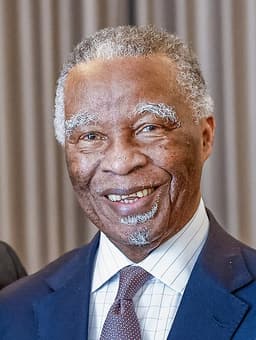
Thabo Mbeki
Politician · Modern
56.9Total
Basic Information
Born
1959
1942
Died
—
—
Era
Modern
Modern
Nationality
Romania
South Africa
Occupation
Politician
Politician
Civilization
Western
Other
Score Comparison
Military (10%)
23.2
40.8
Political (20%)
68.0
65.0
Influence (20%)
53.3
56.7
Legacy (20%)
40.0
56.0
Leadership (15%)
72.0
72.0
Strategy (15%)
36.7
40.5
TOTAL
50.3
56.9
Klaus Iohannis — Complete Timeline
2014 AD
Elected President of RomaniaPolitical Action◆ Major
Iohannis won the Romanian presidential election as an independent, defeating Prime Minister Victor Ponta. He was the first ethnic German to hold the office since World War II.
ElectionPresidentEthnic German
Impact: nationalconstructive
2015 AD
Anti-Corruption StancePolitical Action◆ Major
Iohannis supported anti-corruption efforts, including the work of the National Anticorruption Directorate. He called for the resignation of Prime Minister Ponta after a deadly nightclub fire, leading to a government change.
Anti-CorruptionJusticeGovernment Change
Impact: nationalconstructive
2019 AD
Re-elected President of RomaniaPolitical Action◆ Major
Iohannis won re-election in a landslide victory against former Prime Minister Viorica D
ElectionRe-electionLandslide
Impact: nationalconstructive
2022 AD
Support for Ukraine and NATOPolitical Action◆ Major
Iohannis condemned Russia's invasion of Ukraine and supported NATO's reinforcement of its eastern flank. Romania hosted allied troops and facilitated grain exports from Ukraine.
UkraineNATOSecurity
Impact: regionalconstructive
Thabo Mbeki — Complete Timeline
1999 AD
Election as PresidentPolitical Action
Thabo Mbeki was elected President of South Africa in the country's second fully democratic elections, succeeding Nelson Mandela. He represented the ANC and promised to continue Mandela's legacy of reconciliation while focusing on economic growth and transformation.
PresidencyANCSuccession
Impact: nationalprogressive
Launch of the African RenaissanceCultural◆ Major
Mbeki championed the concept of an 'African Renaissance', promoting economic integration, democracy, and conflict resolution across the continent. This led to the establishment of the New Partnership for Africa's Development (NEPAD) and the African Peer Review Mechanism.
African RenaissanceNEPADPan-Africanism
Impact: regionalprogressive
2000 AD
HIV/AIDS DenialismPolitical Action◆ Major
Mbeki questioned the link between HIV and AIDS, and his government delayed the rollout of antiretroviral drugs. This policy, influenced by dissident scientists, led to hundreds of thousands of preventable deaths and drew widespread international condemnation.
HIV/AIDSDenialismPublic Health Crisis
Impact: nationaltragic
Zimbabwe InterventionPolitical Action◆ Major
Mbeki pursued a policy of 'quiet diplomacy' towards Robert Mugabe's Zimbabwe, refusing to condemn human rights abuses and land seizures. This approach was criticized as ineffective and complicit, failing to prevent Zimbabwe's economic collapse and political crisis.
ZimbabweQuiet DiplomacyMugabe
Impact: regional
2008 AD
Recall from PresidencyPolitical Action◆ Major
Mbeki was recalled by the ANC's National Executive Committee, effectively forcing his resignation as President. This followed a power struggle with Jacob Zuma, who had defeated Mbeki for the ANC presidency in 2007. Mbeki's departure marked a shift in ANC leadership.
RecallANC Power StruggleZuma
Impact: national
Expert Analysis
Origins
Klaus Iohannis was born on June 13, 1959, in Sibiu, Romania, into the ethnic German minority. His father was a technician, his mother a nurse. He studied physics at Babeș-Bolyai University, later teaching at a high school. His background as a physics teacher and mayor shaped his technocratic approach.
Thabo Mbeki was born on June 18, 1942, in Idutywa, South Africa, into a politically active Xhosa family. His father, Govan Mbeki, was a prominent ANC and SACP member. Mbeki was expelled from school for political activism, completed his A-levels in Lesotho, and earned a master's in economics from the University of Sussex. His exile and education forged a pan-Africanist vision.
Rise to Power
Iohannis entered politics in 2000 as mayor of Sibiu, gaining popularity for urban development and financial transparency. He joined the National Liberal Party in 2013. In 2014, he ran for president as an independent, defeating Prime Minister Victor Ponta in a runoff with 54.5% of the vote. He was the first ethnic German and first Protestant to hold the office. His campaign focused on anti-corruption and judicial reform.
Mbeki rose through ANC ranks in exile, serving as Oliver Tambo's personal assistant. After the ANC's unbanning, he returned to South Africa and became deputy president under Nelson Mandela in 1994. He succeeded Mandela as president in 1999 after the ANC won the election with 66.4% of the vote. His rise was marked by intellectual leadership, particularly his vision for an 'African Renaissance'.
Leadership & Governance
Iohannis governed as a centrist, prioritizing anti-corruption and rule of law. He publicly supported the National Anticorruption Directorate (DNA), which prosecuted hundreds of officials. In 2017, he called for the resignation of Prime Minister Sorin Grindeanu over efforts to weaken anti-corruption laws. He maintained a constitutional role, avoiding direct legislative control. His style was reserved, relying on public appeals and vetoes.
Mbeki pursued a top-down, managerial governance style. He drove economic growth through privatization and fiscal discipline, achieving 5% GDP growth in the mid-2000s. He championed the African Renaissance and NEPAD, seeking foreign investment. However, his HIV/AIDS denialism led to delayed antiretroviral rollout, resulting in an estimated 330,000 premature deaths. He also pursued 'quiet diplomacy' toward Zimbabwe, failing to condemn Mugabe's abuses.
Triumph & Tragedy
Iohannis's triumph was his re-election in 2019 with 66.1% of the vote, the highest margin since the revolution. He navigated Romania's EU presidency in 2019 effectively. His tragedy is the persistent political instability: his anti-corruption stance caused repeated conflicts with parliament, and his influence waned as corruption resurfaced.
Mbeki's triumph was his role in South Africa's post-apartheid consolidation and economic growth. He mediated conflicts in Burundi and Ivory Coast. His tragedy is the HIV/AIDS crisis: his denialism and delayed treatment cost lives and damaged his legacy. He also weakened the ANC's internal democracy, leading to his recall in 2008 after a power struggle with Jacob Zuma.
Character & Destiny
Iohannis is methodical and cautious, a technocrat who avoids populism. His ethnic German background gave him outsider status, enabling anti-corruption credibility. His destiny was shaped by Romania's EU integration, where his stability contrasted with political turbulence. He scored 72.0 in leadership, reflecting principled governance, but 36.7 in strategy, indicating limited long-term vision.
Mbeki is intellectual and aloof, often described as 'philosopher king'. His pan-Africanism drove continental initiatives, but his rigid thinking led to HIV/AIDS denialism. His recall by the ANC revealed his disconnect from party grassroots. He scored 72.0 in leadership but 40.5 in strategy, showing vision without execution. His legacy score of 56.0 reflects mixed outcomes.
Legacy
Iohannis's legacy is the strengthening of anti-corruption institutions in Romania, though progress remains fragile. He is seen as a guardian of democratic norms during a period of populist challenges. His influence score of 53.3 reflects limited global impact. He will be remembered as a steady hand in a turbulent era.
Mbeki's legacy is the African Renaissance concept, which influenced continental policy, and his economic reforms that boosted growth. However, the HIV/AIDS tragedy overshadows these achievements. His quiet diplomacy on Zimbabwe is criticized as enabling Mugabe. He is remembered as a complex figure: visionary yet flawed. His total score of 56.9 exceeds Iohannis's 50.3, reflecting broader impact despite failures.
Conclusion
Thabo Mbeki had greater impact than Klaus Iohannis, despite his severe failures. Mbeki's role in South Africa's transition and his pan-African vision shaped continental politics, while Iohannis's influence remained within Romania. The HIV/AIDS denialism is a catastrophic mark, but his economic and diplomatic contributions outweigh Iohannis's narrower anti-corruption focus. Mbeki's legacy score of 56.0 versus Iohannis's 40.0 underscores this. Iohannis achieved stability but lacked transformative power. Mbeki, for all his errors, aimed higher and left a deeper imprint.
Rankings
🥇
Thabo MbekiLeader
Mil: 40.8Pol: 65.0Inf: 56.7
56.9
🥈
Klaus Iohannis
Mil: 23.2Pol: 68.0Inf: 53.3
50.3
+6.6 behind
How This Comparison Works
Algorithm
Each figure is scored on 6 dimensions (0—100 scale) based on structured historical data: Military (10%), Political (20%), Influence (20%), Legacy (20%), Leadership (15%), Strategy (15%). The weighted total produces the final ranking.
Data Sources
Scores are computed from structured sub-indicators in the database. Scale factors adjust for era (Ancient ×0.85, Modern ×1.0) and civilization size (Eastern ×1.05, Other ×0.80) to account for differences in population and military scale.
Maximum 3 Figures
Comparisons are limited to 2—3 figures to ensure readability and statistical meaningfulness.
Error Margins
±5 points per dimension — Sub-scores are derived from historical records with inherent uncertainty. Two figures within 5 points on a dimension should be considered roughly equivalent in that area.
Total Score Accuracy
±3 points overall — The weighted combination of 6 dimensions produces a total score with approximately ±3 points of uncertainty. Differences of less than 3 points are not statistically significant— the figures are effectively tied.
Known Limitations
- Historical records are incomplete and uneven across civilizations
- Figures from oral-tradition societies may be underrepresented
- Occupation labels can misclassify multi-role figures
- Scores measure capability and impact, not moral character
- Quantitative scoring is a comparison tool, not absolute truth
Capability Radar
Military (10%) — Battles & Warfare
Battles
24
23
Win Rate
27
26
Expansion
30
25
Political (20%) — Governance & Reform
Reform
55
70
Diplomacy
60
75
Economy
50
60
Influence (20%) — Cultural & Global Reach
Cultural
30
55
Global
30
60
Legacy (20%) — Historical Impact
Historical
30
60
Longevity
20
50
Leadership (15%) — Power & Stability
Tenure
60
65
Stability
65
55
Strategy (15%) — Tactics & Innovation
Strategy
33
31
Tactics
37
33
Reform
36
39
Similar Comparisons
Comments & Discussion
No comments yet. Be the first to share your thoughts!