Loading...
Klaus Iohannis vs Tunku Abdul Rahman
Tunku Abdul Rahman leads by 3.3 pts · 2 figures compared
…

Klaus Iohannis
Politician · Modern
50.3Total
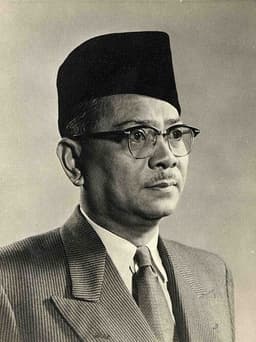
Tunku Abdul Rahman
Politician · Modern
53.6Total
Basic Information
Born
1959
1903
Died
—
1990
Era
Modern
Modern
Nationality
Romania
Malaysia
Occupation
Politician
Politician
Civilization
Western
Eastern
Score Comparison
Military (10%)
23.2
12.5
Political (20%)
68.0
65.0
Influence (20%)
53.3
58.3
Legacy (20%)
40.0
56.0
Leadership (15%)
72.0
72.0
Strategy (15%)
36.7
31.9
TOTAL
50.3
53.6
Klaus Iohannis — Complete Timeline
2014 AD
Elected President of RomaniaPolitical Action◆ Major
Iohannis won the Romanian presidential election as an independent, defeating Prime Minister Victor Ponta. He was the first ethnic German to hold the office since World War II.
ElectionPresidentEthnic German
Impact: nationalconstructive
2015 AD
Anti-Corruption StancePolitical Action◆ Major
Iohannis supported anti-corruption efforts, including the work of the National Anticorruption Directorate. He called for the resignation of Prime Minister Ponta after a deadly nightclub fire, leading to a government change.
Anti-CorruptionJusticeGovernment Change
Impact: nationalconstructive
2019 AD
Re-elected President of RomaniaPolitical Action◆ Major
Iohannis won re-election in a landslide victory against former Prime Minister Viorica D
ElectionRe-electionLandslide
Impact: nationalconstructive
2022 AD
Support for Ukraine and NATOPolitical Action◆ Major
Iohannis condemned Russia's invasion of Ukraine and supported NATO's reinforcement of its eastern flank. Romania hosted allied troops and facilitated grain exports from Ukraine.
UkraineNATOSecurity
Impact: regionalconstructive
Tunku Abdul Rahman — Complete Timeline
1951 AD
Formation of the Alliance Party (1951)Political Action◆ Major
Tunku Abdul Rahman became the leader of the United Malays National Organisation (UMNO) and formed the Alliance Party with the Malayan Chinese Association (MCA) and Malayan Indian Congress (MIC). This multi-racial coalition became the foundation for Malayan independence.
Political CoalitionIndependence MovementMulti-Racial Politics
Impact: nationalconstructive
1956 AD
Negotiation of Merdeka (1956-1957)Political Action◆ Major
Tunku Abdul Rahman led a delegation to London to negotiate Malayan independence from Britain. The talks resulted in the Merdeka Agreement, setting August 31, 1957, as Independence Day. He became the first Prime Minister of independent Malaya.
IndependenceNegotiationMerdeka
Impact: nationalconstructive
1963 AD
Formation of Malaysia (1963)Political Action◆ Major
Tunku Abdul Rahman proposed and oversaw the formation of Malaysia, merging Malaya with Singapore, Sabah, and Sarawak. This expanded federation aimed to create a stronger, multi-ethnic nation, though it faced opposition from Indonesia and the Philippines.
FederationNation BuildingMalaysia Formation
Impact: regionalconstructive
1970 AD
Resignation as Prime Minister (1970)Political Action◆ Major
Following the May 13, 1969 racial riots in Kuala Lumpur, Tunku Abdul Rahman resigned as Prime Minister. He was succeeded by Abdul Razak Hussein. His resignation marked the end of an era and led to a shift in Malaysian political and economic policies.
ResignationPolitical TransitionPost-Riots
Impact: nationaltragic
Expert Analysis
Origins
Klaus Iohannis was born on June 13, 1959, in Sibiu, Romania, into an ethnic German family. He studied physics at the University of Cluj-Napoca and later became a physics teacher. His background as a provincial mayor shaped his technocratic approach. Tunku Abdul Rahman was born on February 8, 1903, in Alor Setar, Kedah, into Malay royalty. He studied law at Cambridge University and was called to the Bar at Inner Temple. His aristocratic lineage and legal training positioned him for nationalist leadership.
Rise to Power
Iohannis entered politics as mayor of Sibiu in 2000, serving for 14 years. He gained prominence for efficient administration and tourism development. In 2014, he ran for president as an independent, defeating Prime Minister Victor Ponta with 54.5% of the vote. His victory was a shock to the established parties. Tunku Abdul Rahman became president of UMNO in 1951 and formed the Alliance Party. He led negotiations for independence, culminating in the Merdeka Agreement of 1957. He became Malaysia's first prime minister at age 54.
Leadership & Governance
Iohannis advocated for anti-corruption and rule of law. He supported the National Anticorruption Directorate (DNA) and called for the resignation of Prime Minister Victor Ponta over corruption allegations. His leadership style was cautious and consensus-building, but criticized as passive during political crises. Tunku Abdul Rahman championed multiracial cooperation through the Alliance Party. He promoted economic development and stability, but his governance faced challenges from ethnic tensions. His approach to racial harmony was pragmatic, but failed to prevent the 1969 riots.
Triumph & Tragedy
Iohannis's triumphs include winning a second term with 66% of the vote in 2019, reflecting public support for his anti-corruption stance. He also navigated Romania's response to Russia's invasion of Ukraine, hosting NATO troops. His tragedy is that corruption persisted despite his efforts, and his political score of 68.0 reflects limited transformative impact. Tunku Abdul Rahman's triumph was securing Malayan independence and forming Malaysia in 1963, expanding the federation. His tragedy was the May 13, 1969 racial riots, which led to his resignation and a shift toward Malay dominance. Legacy score of 56.0 shows enduring impact but with a flawed end.
Character & Destiny
Iohannis is reserved and methodical, often described as technocratic. His low military score of 23.2 indicates a focus on civilian governance. His character led to stability but also inertia. Tunku Abdul Rahman was charismatic and diplomatic, scoring 65.0 in politics. His genial personality helped forge alliances but also contributed to indecisiveness on racial issues. His destiny was shaped by the forces of nationalism he helped unleash.
Legacy
Iohannis's legacy is tied to anti-corruption and European integration. He strengthened Romania's NATO role but achieved limited domestic reform. His total score of 50.3 reflects moderate impact. Tunku Abdul Rahman is revered as the Father of Malaysia. His legacy includes the formation of Malaysia and a multiracial political framework, though later policies moved away from his ideals. His total score of 53.6 edges out Iohannis.
Conclusion
Tunku Abdul Rahman had greater historical impact. His role in founding a nation and navigating independence surpasses Iohannis's contributions as a modern reformer. Despite his flaws, Rahman's legacy is foundational, while Iohannis's influence is more transient. The 3.3-point score gap understates Rahman's transformative effect on Southeast Asian history.
Rankings
🥇
Tunku Abdul RahmanLeader
Mil: 12.5Pol: 65.0Inf: 58.3
53.6
🥈
Klaus Iohannis
Mil: 23.2Pol: 68.0Inf: 53.3
50.3
+3.3 behind
How This Comparison Works
Algorithm
Each figure is scored on 6 dimensions (0—100 scale) based on structured historical data: Military (10%), Political (20%), Influence (20%), Legacy (20%), Leadership (15%), Strategy (15%). The weighted total produces the final ranking.
Data Sources
Scores are computed from structured sub-indicators in the database. Scale factors adjust for era (Ancient ×0.85, Modern ×1.0) and civilization size (Eastern ×1.05, Other ×0.80) to account for differences in population and military scale.
Maximum 3 Figures
Comparisons are limited to 2—3 figures to ensure readability and statistical meaningfulness.
Error Margins
±5 points per dimension — Sub-scores are derived from historical records with inherent uncertainty. Two figures within 5 points on a dimension should be considered roughly equivalent in that area.
Total Score Accuracy
±3 points overall — The weighted combination of 6 dimensions produces a total score with approximately ±3 points of uncertainty. Differences of less than 3 points are not statistically significant— the figures are effectively tied.
Known Limitations
- Historical records are incomplete and uneven across civilizations
- Figures from oral-tradition societies may be underrepresented
- Occupation labels can misclassify multi-role figures
- Scores measure capability and impact, not moral character
- Quantitative scoring is a comparison tool, not absolute truth
Capability Radar
Military (10%) — Battles & Warfare
Battles
24
15
Win Rate
27
14
Expansion
30
23
Political (20%) — Governance & Reform
Reform
55
70
Diplomacy
60
75
Economy
50
60
Influence (20%) — Cultural & Global Reach
Cultural
30
55
Global
30
55
Legacy (20%) — Historical Impact
Historical
30
60
Longevity
20
50
Leadership (15%) — Power & Stability
Tenure
60
65
Stability
65
55
Strategy (15%) — Tactics & Innovation
Strategy
33
25
Tactics
37
27
Reform
36
27
Similar Comparisons
Comments & Discussion
No comments yet. Be the first to share your thoughts!