Loading...
This comparison has not been analyzed yet.
One-time AI generation (~1 minute). Scores and timeline are already available below.
Kulottunga I vs Richard of Cornwall
Kulottunga I leads by 20.7 pts · 2 figures compared
…
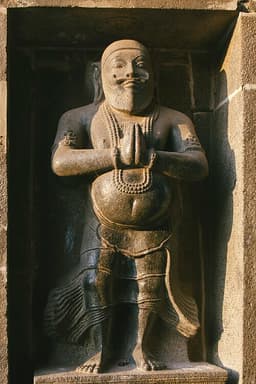
Kulottunga I
Emperor · Medieval
66.1Total

Richard of Cornwall
Emperor · Medieval
45.4Total
Basic Information
Born
1025
1209
Died
1122
1272
Era
Medieval
Medieval
Nationality
India
Holy Roman Empire
Occupation
Emperor
Emperor
Civilization
Indian
Western
Score Comparison
Military (10%)
78.0
50.0
Political (20%)
72.0
40.8
Influence (20%)
56.7
51.8
Legacy (20%)
58.0
40.0
Leadership (15%)
82.0
55.3
Strategy (15%)
65.4
30.3
TOTAL
66.1
45.4
Kulottunga I — Complete Timeline
1070 AD
Loss of control over Sri LankaWar◆ Major
During Kulottunga I's reign, the Chola hold over Sri Lanka weakened. The Sinhalese king Vijayabahu I expelled Chola forces from the island, ending Chola rule there after several decades.
Sri LankaCholaLoss of Territory
Impact: regionaldestructive
Accession to the Chola thronePolitical Action◆ Major
Kulottunga I became the Chola emperor, succeeding his cousin Adhirajendra. He was a descendant of both the Chola and Chalukya dynasties, and his accession united the two kingdoms under his rule, marking the beginning of the Chalukya-Chola period.
Chola DynastyChalukya DynastySuccession
Impact: regionalconstructive
1075 AD
War with the Western ChalukyasWar◆ Major
Kulottunga I fought a series of wars against the Western Chalukya king Vikramaditya VI. The conflict was over control of the Vengi region and resulted in a stalemate, with neither side achieving decisive victory.
Western ChalukyaVengiWar
Impact: regional
1080 AD
Administrative reforms and temple patronageReform
Kulottunga I implemented administrative reforms, including land revenue assessments and temple patronage. He granted lands to Brahmins and temples, particularly at Chidambaram and Kanchipuram, which strengthened his rule and religious legitimacy.
AdministrationTemple PatronageLand Grants
Impact: nationalconstructive
1096 AD
Campaign in KalingaWar
Kulottunga I led a military campaign into Kalinga (modern Odisha). The Chola army defeated the Kalinga forces and extracted tribute, extending Chola influence into the region.
KalingaMilitary CampaignTribute
Impact: regional
Richard of Cornwall — Complete Timeline
1257 AD
Elected King of GermanyPolitical Action◆ Major
Richard of Cornwall was elected King of Germany by a faction of prince-electors, opposing Alfonso X of Castile. This election was part of the Great Interregnum, with Richard receiving support from the English crown and the Papacy.
ElectionGreat InterregnumEnglish Influence
Impact: regional
Crowned King of GermanyPolitical Action◆ Major
Richard of Cornwall was crowned King of Germany in Aachen by the Archbishop of Cologne. His coronation was contested by Alfonso X, and Richard's authority was largely confined to the Rhineland and parts of southern Germany.
CoronationGreat InterregnumRival Claimant
Impact: regional
1262 AD
Returned to EnglandPolitical Action
Richard of Cornwall returned to England after spending several years in Germany. His departure weakened his influence in the Holy Roman Empire, and he never returned, leaving the German throne contested until the end of the Great Interregnum.
ReturnEnglandGreat Interregnum
Impact: regional
1272 AD
Died in EnglandOther◆ Major
Richard of Cornwall died at Berkhamsted Castle in England. His death ended his claim to the German throne, and he was succeeded by Rudolf of Habsburg, who ended the Great Interregnum.
DeathGreat InterregnumEnd of Claim
Impact: regional
This comparison has not been analyzed yet.
One-time AI generation (~1 minute). Scores and timeline are already available below.
Rankings
🥇
Kulottunga ILeader
Mil: 78.0Pol: 72.0Inf: 56.7
66.1
🥈
Richard of Cornwall
Mil: 50.0Pol: 40.8Inf: 51.8
45.4
+20.7 behind
How This Comparison Works
Algorithm
Each figure is scored on 6 dimensions (0—100 scale) based on structured historical data: Military (10%), Political (20%), Influence (20%), Legacy (20%), Leadership (15%), Strategy (15%). The weighted total produces the final ranking.
Data Sources
Scores are computed from structured sub-indicators in the database. Scale factors adjust for era (Ancient ×0.85, Modern ×1.0) and civilization size (Eastern ×1.05, Other ×0.80) to account for differences in population and military scale.
Maximum 3 Figures
Comparisons are limited to 2—3 figures to ensure readability and statistical meaningfulness.
Error Margins
±5 points per dimension — Sub-scores are derived from historical records with inherent uncertainty. Two figures within 5 points on a dimension should be considered roughly equivalent in that area.
Total Score Accuracy
±3 points overall — The weighted combination of 6 dimensions produces a total score with approximately ±3 points of uncertainty. Differences of less than 3 points are not statistically significant— the figures are effectively tied.
Known Limitations
- Historical records are incomplete and uneven across civilizations
- Figures from oral-tradition societies may be underrepresented
- Occupation labels can misclassify multi-role figures
- Scores measure capability and impact, not moral character
- Quantitative scoring is a comparison tool, not absolute truth
Capability Radar
Military (10%) — Battles & Warfare
Battles
75
20
Win Rate
80
25
Expansion
80
10
Political (20%) — Governance & Reform
Reform
70
15
Diplomacy
75
45
Economy
80
50
Influence (20%) — Cultural & Global Reach
Cultural
70
20
Global
55
20
Legacy (20%) — Historical Impact
Historical
65
25
Longevity
60
15
Leadership (15%) — Power & Stability
Tenure
85
40
Stability
75
30
Strategy (15%) — Tactics & Innovation
Strategy
75
20
Tactics
70
15
Reform
65
5
Similar Comparisons
Comments & Discussion
No comments yet. Be the first to share your thoughts!