Loading...
Laurent de Gouvion Saint-Cyr vs Nikolai Vatutin
Nikolai Vatutin leads by 1.2 pts · 2 figures compared
…

Laurent de Gouvion Saint-Cyr
General · Modern
55.8Total
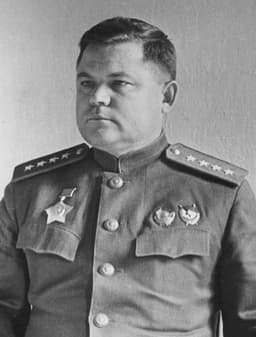
Nikolai Vatutin
General · Modern
57.0Total
Basic Information
Born
1764
1901
Died
1830
1944
Era
Modern
Modern
Nationality
France
USSR
Occupation
General
General
Civilization
Western
Western
Score Comparison
Military (10%)
70.0
72.0
Political (20%)
68.0
42.2
Influence (20%)
55.7
57.2
Legacy (20%)
47.5
50.0
Leadership (15%)
48.8
61.1
Strategy (15%)
55.0
75.0
TOTAL
55.8
57.0
Laurent de Gouvion Saint-Cyr — Complete Timeline
1799 AD
Battle of NoviWar◆ Major
Saint-Cyr commanded a division at Novi. His forces held the French right flank against Russian attacks, but the French army was defeated by Suvorov's forces.
French Revolutionary WarsBattleDefeat
Impact: regional
1812 AD
Battle of PolotskWar◆ Major
Saint-Cyr commanded the VI Corps at Polotsk. He defeated a Russian army under Wittgenstein, securing the French northern flank during the invasion of Russia.
Napoleonic WarsBattleVictory
Impact: regional
1813 AD
Battle of DresdenWar◆ Major
Saint-Cyr commanded the XIV Corps at Dresden. He held the city against Allied attacks, but was later cut off and forced to surrender after Napoleon's withdrawal.
Napoleonic WarsBattleSiegeSurrender
Impact: regional
1815 AD
Minister of WarPolitical Action◆ Major
Saint-Cyr served as Minister of War under Louis XVIII. He reorganized the French army after the Hundred Days, reducing its size and implementing Bourbon loyalist policies.
MinistryReorganizationBourbon Restoration
Impact: nationalconstructive
1817 AD
Governor of the InvalidesPolitical Action
Saint-Cyr was appointed Governor of the H
GovernorshipInvalidesVeterans
Nikolai Vatutin — Complete Timeline
1943 AD
Battle of KurskWar◆ Major
Vatutin commanded the Voronezh Front during the Battle of Kursk. His forces defended the southern sector against the German offensive, then participated in the counteroffensive that recaptured Kharkov and pushed German forces back.
World War IIEastern FrontBattle of Kursk
Impact: regional
Battle of the DnieperWar◆ Major
Vatutin led the 1st Ukrainian Front in crossing the Dnieper River and liberating Kiev on November 6, 1943. This operation broke the German defensive line and established a strategic bridgehead for further advances into Ukraine.
World War IIEastern FrontLiberation of Kiev
Impact: regional
1944 AD
Mortally wounded by Ukrainian insurgentsOther◆ Major
On February 29, 1944, Vatutin was ambushed and shot by Ukrainian Insurgent Army (UPA) partisans near Rovno. He died of his wounds on April 15, 1944, becoming the highest-ranking Soviet general killed in action during World War II.
DeathWorld War IIUkrainian Insurgency
Impact: nationaltragic
Expert Analysis
Origins
Laurent de Gouvion Saint-Cyr (born 1764) was a French painter turned soldier, joining the Revolutionary Army in 1792. His artistic background gave him a keen eye for terrain. Nikolai Vatutin (born 1901) was a Soviet peasant's son who rose through the Red Army's ranks, attending the Frunze Military Academy in the 1920s. Both came from modest backgrounds but took different paths: Saint-Cyr through revolutionary chaos, Vatutin through Stalin's purges.
Rise to Power
Saint-Cyr rose rapidly during the French Revolutionary Wars, becoming a general by 1794. He distinguished himself at the Battle of Novi (1799) where his division held the right flank against Suvorov's Russians, though the French lost. Under Napoleon, he earned his marshal's baton after Polotsk (1812) where his VI Corps defeated Wittgenstein, securing the northern flank. Vatutin's rise came during World War II: he commanded the Voronezh Front at Kursk (1943), repelling the German offensive, then led the 1st Ukrainian Front in crossing the Dnieper and liberating Kiev (November 6, 1943).
Leadership & Governance
Saint-Cyr was a defensive specialist, methodical and cautious. At Dresden (1813), his XIV Corps held the city against Allied attacks until Napoleon's withdrawal forced his surrender. As Minister of War under Louis XVIII (1815-1819), he reorganized the French army, reducing its size and implementing Bourbon reforms. Vatutin was an offensive strategist, scoring 75.0 in strategy versus Saint-Cyr's 55.0. At Kursk, he orchestrated the defense of the southern sector, then led the counteroffensive. His leadership score of 61.1 reflects his ability to motivate troops, but his political score of 42.2 shows his vulnerability to Stalin's intrigues.
Triumph & Tragedy
Saint-Cyr's greatest triumph was Polotsk (1812), where he defeated a larger Russian force, earning his marshalate. His tragedy came at Dresden (1813): after holding the city, he was cut off by the Allied advance and forced to surrender, ending his active career. Vatutin's triumph was the liberation of Kiev (1943), a major strategic victory that broke the German Dnieper line. His tragedy was his death: on February 29, 1944, he was ambushed and mortally wounded by Ukrainian Insurgent Army (UPA) partisans near Rovno, dying on April 15, 1944. He never saw the war's end.
Character & Destiny
Saint-Cyr was cold and aloof, earning few friends but respected for his competence. His defensive mindset suited the Napoleonic wars but limited his ambition. Vatutin was aggressive and innovative, but his political naivety left him exposed. Stalin trusted him, yet he died at the hands of partisans—a fate that reflected the chaotic Eastern Front. Both men were products of their times: Saint-Cyr of revolutionary France, Vatutin of Stalin's Soviet Union.
Legacy
Saint-Cyr's legacy is mixed: his military achievements are overshadowed by Napoleon's other marshals, and his peacetime reforms were reversed. He scores 47.5 in legacy. Vatutin is remembered as a key architect of Soviet victories at Kursk and Kiev, but his early death limited his post-war influence. He scores 50.0 in legacy. Neither achieved lasting fame, but Vatutin's contributions to the defeat of Nazi Germany arguably had greater historical impact.
Conclusion
While Saint-Cyr was a capable defensive commander, Vatutin's role in turning the tide on the Eastern Front gives him the edge. Vatutin's total score of 57.0 versus Saint-Cyr's 55.8 reflects this, but the gap is narrow. However, Vatutin's offensive brilliance at Kursk and Kiev directly contributed to the defeat of Nazi Germany, a world-historical event. Saint-Cyr's defensive victories, though impressive, were part of a losing cause. Thus, Vatutin had greater impact on the course of history.
Rankings
🥇
Nikolai VatutinLeader
Mil: 72.0Pol: 42.2Inf: 57.2
57.0
🥈
Laurent de Gouvion Saint-Cyr
Mil: 70.0Pol: 68.0Inf: 55.7
55.8
+1.2 behind
How This Comparison Works
Algorithm
Each figure is scored on 6 dimensions (0—100 scale) based on structured historical data: Military (10%), Political (20%), Influence (20%), Legacy (20%), Leadership (15%), Strategy (15%). The weighted total produces the final ranking.
Data Sources
Scores are computed from structured sub-indicators in the database. Scale factors adjust for era (Ancient ×0.85, Modern ×1.0) and civilization size (Eastern ×1.05, Other ×0.80) to account for differences in population and military scale.
Maximum 3 Figures
Comparisons are limited to 2—3 figures to ensure readability and statistical meaningfulness.
Error Margins
±5 points per dimension — Sub-scores are derived from historical records with inherent uncertainty. Two figures within 5 points on a dimension should be considered roughly equivalent in that area.
Total Score Accuracy
±3 points overall — The weighted combination of 6 dimensions produces a total score with approximately ±3 points of uncertainty. Differences of less than 3 points are not statistically significant— the figures are effectively tied.
Known Limitations
- Historical records are incomplete and uneven across civilizations
- Figures from oral-tradition societies may be underrepresented
- Occupation labels can misclassify multi-role figures
- Scores measure capability and impact, not moral character
- Quantitative scoring is a comparison tool, not absolute truth
Capability Radar
Military (10%) — Battles & Warfare
Battles
65
85
Win Rate
60
80
Expansion
50
75
Political (20%) — Governance & Reform
Reform
50
30
Diplomacy
45
35
Economy
40
20
Influence (20%) — Cultural & Global Reach
Cultural
35
30
Global
30
35
Legacy (20%) — Historical Impact
Historical
45
55
Longevity
30
40
Leadership (15%) — Power & Stability
Tenure
55
40
Stability
50
25
Strategy (15%) — Tactics & Innovation
Strategy
70
85
Tactics
75
88
Reform
55
70
Similar Comparisons
Comments & Discussion
No comments yet. Be the first to share your thoughts!