Loading...
Nikolai Vatutin vs Qin Shi Huang
Qin Shi Huang leads by 28.2 pts · 2 figures compared
…
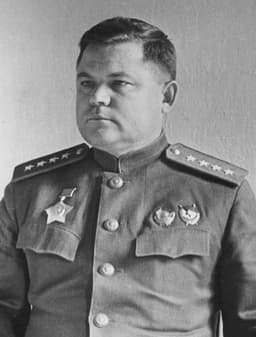
Nikolai Vatutin
General · Modern
57.0Total
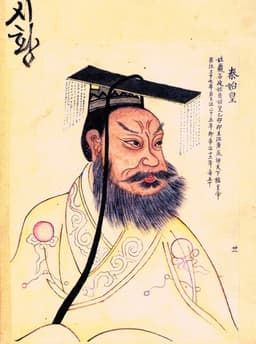
Qin Shi Huang
Emperor · Ancient
85.2Total
Basic Information
Born
1901
-259
Died
1944
-210
Era
Modern
Ancient
Nationality
USSR
China
Occupation
General
Emperor
Civilization
Western
Eastern
Score Comparison
Military (10%)
72.0
80.0
Political (20%)
42.2
90.0
Influence (20%)
57.2
85.0
Legacy (20%)
50.0
90.0
Leadership (15%)
61.1
78.0
Strategy (15%)
75.0
82.0
TOTAL
57.0
85.2
Nikolai Vatutin — Complete Timeline
1943 AD
Battle of KurskWar◆ Major
Vatutin commanded the Voronezh Front during the Battle of Kursk. His forces defended the southern sector against the German offensive, then participated in the counteroffensive that recaptured Kharkov and pushed German forces back.
World War IIEastern FrontBattle of Kursk
Impact: regional
Battle of the DnieperWar◆ Major
Vatutin led the 1st Ukrainian Front in crossing the Dnieper River and liberating Kiev on November 6, 1943. This operation broke the German defensive line and established a strategic bridgehead for further advances into Ukraine.
World War IIEastern FrontLiberation of Kiev
Impact: regional
1944 AD
Mortally wounded by Ukrainian insurgentsOther◆ Major
On February 29, 1944, Vatutin was ambushed and shot by Ukrainian Insurgent Army (UPA) partisans near Rovno. He died of his wounds on April 15, 1944, becoming the highest-ranking Soviet general killed in action during World War II.
DeathWorld War IIUkrainian Insurgency
Impact: nationaltragic
Qin Shi Huang — Complete Timeline
246 BC
Construction of the Mausoleum and Terracotta ArmyOther◆ Major
Qin Shi Huang commissioned a vast mausoleum complex near Xi'an, guarded by thousands of life-sized terracotta soldiers, horses, and chariots. The project employed hundreds of thousands of workers and reflected his obsession with immortality and imperial power.
Impact: global
230 BC
Conquest of the Six Warring StatesWar
From 230 to 221 BCE, Ying Zheng led the Qin state in a series of campaigns that conquered the Han, Zhao, Wei, Chu, Yan, and Qi states. This unified China under a single ruler for the first time, ending the Warring States period.
Impact: global
221 BC
Standardization of Writing, Currency, and MeasurementsReform◆ Major
Qin Shi Huang ordered the standardization of Chinese script, currency, and weights and measures across the unified empire. This facilitated administration, trade, and cultural integration, laying a foundation for future dynasties.
Impact: globalconstructive
Proclamation of the Qin DynastyPolitical Action
After conquering the last independent state, Ying Zheng declared himself Shi Huangdi (First Emperor), founding the Qin Dynasty. He adopted a new title to signify his supreme authority and initiated centralized imperial rule.
Impact: global
214 BC
Initiation of the Great Wall ConstructionOther◆ Major
Qin Shi Huang ordered the connection and extension of existing northern fortifications to create a unified defensive wall against nomadic Xiongnu raids. This project involved massive conscripted labor and became the precursor to the later Great Wall.
Impact: regional
213 BC
Burning of Books and Burying of ScholarsPolitical Action◆ Major
On the advice of Li Si, Qin Shi Huang ordered the burning of historical records and philosophical texts not aligned with Legalist doctrine. He also had 460 Confucian scholars buried alive to suppress dissent and consolidate ideological control.
Impact: nationaldestructive
Expert Analysis
nikolai-vatutin-vs-qin-shi-huang
# The Emperor and the General: Two Paths to Immortality
On a winter morning in 1944, a Soviet general lay bleeding in a snow-covered ditch near the Ukrainian town of Rovno, his life ebbing away from wounds inflicted by nationalist partisans. Twenty-two centuries earlier, another ruler had ordered the construction of an underground army of thousands, hoping to command his realm from beyond the grave. Nikolai Vatutin and Qin Shi Huang never met, never could have met, yet their stories share a haunting symmetry: both men sought to shape history through sheer force of will, but their paths diverged as dramatically as their fates. What drove one to build an empire that would echo for millennia, while the other perished in obscurity, remembered only by specialists and war buffs?
Origins
Qin Shi Huang was born in 259 BC into a world of chaos. The Warring States period had torn China apart for centuries, with seven kingdoms locked in endless conflict. As a prince of the western state of Qin, he absorbed the harsh philosophy of Legalism—the belief that human nature required strict laws and harsh punishments to maintain order. His childhood was marked by court intrigue and the threat of assassination, forging a ruler who trusted no one and tolerated no dissent.
Nikolai Vatutin, born in 1901 in a peasant village in central Russia, came of age in a different kind of turmoil. The Russian Revolution had shattered the old order, and young men like Vatutin found purpose in the Red Army. He rose through the ranks during the brutal civil wars and purges of the 1930s, learning that survival depended on both competence and caution. Where Qin Shi Huang inherited a throne, Vatutin earned his position through relentless study of military science, graduating from the Frunze Military Academy with honors.
Rise to Power
The First Emperor’s ascent was methodical and merciless. From 230 to 221 BC, he unleashed a series of campaigns that systematically crushed the six rival states—Han, Zhao, Wei, Chu, Yan, and Qi. His generals employed siege warfare, psychological terror, and strategic alliances with devastating efficiency. By the age of thirty-eight, Ying Zheng had accomplished what no ruler before him had managed: the unification of all China under a single crown. On a momentous day in 221 BC, he proclaimed himself Shi Huangdi, the First Emperor, founding the Qin Dynasty that would give China its name.
Vatutin’s rise was slower and more precarious. He survived Stalin’s purges of the officer corps in the late 1930s, a feat that required political acumen as much as military skill. When Hitler invaded the Soviet Union in 1941, Vatutin was thrust into command of the Northwestern Front, where he organized desperate defenses against the German juggernaut. His breakthrough came at Stalingrad, where his planning helped encircle and destroy the German Sixth Army. But unlike Qin Shi Huang, who commanded absolute loyalty, Vatutin operated under the shadow of Stalin’s paranoia and the constant threat of execution for failure.
Leadership & Governance
Qin Shi Huang governed with an iron fist and a visionary’s ambition. In a series of reforms that reshaped civilization, he standardized writing, currency, weights, and measures across his empire. He ordered the connection of northern fortifications into what would become the Great Wall, a project that consumed countless lives but created a lasting symbol of Chinese unity. His political genius lay in imposing order on chaos: he abolished feudal states, divided the empire into administrative provinces, and built a network of roads and canals that bound the realm together.
Yet his methods were brutal. In 213 BC, on the advice of his chancellor Li Si, he ordered the burning of historical records and philosophical texts that contradicted Legalist doctrine. Scholars who protested were buried alive. The Terracotta Army, commissioned in 246 BC and discovered in 1974, reveals both his grandeur and his obsession: thousands of life-sized soldiers, each with unique features, stand guard over his tomb, a testament to a ruler who demanded loyalty even in death.
Vatutin’s leadership was of a different order. He commanded the Voronezh Front during the Battle of Kursk in 1943, the largest tank battle in history, where his forces held the southern sector against elite German divisions. Later that year, he led the 1st Ukrainian Front in crossing the Dnieper River and liberating Kiev on November 6, 1943—a victory that broke the German hold on Ukraine. His military scores of 86.6 in strategy and 76.3 in overall command reflect a brilliant tactician, but his political score of 50.1 reveals the vulnerability of a general who never mastered the art of survival in Stalin’s court.
Triumph & Tragedy
Qin Shi Huang’s greatest triumph was the creation of a unified Chinese state that would endure, despite the collapse of his dynasty just four years after his death in 210 BC. His greatest tragedy was the fragility of his achievement: the standardization and centralization he imposed were brilliant, but the brutal methods bred resentment that exploded into rebellion under his weak successor.
Vatutin’s triumph was the liberation of Kiev, a city whose name meant as much to Soviet morale as Stalingrad. His tragedy came on February 29, 1944, when Ukrainian Insurgent Army partisans ambushed his convoy near Rovno. He died of his wounds on April 15, 1944, at age forty-three, just months before the final defeat of Nazi Germany. His killer was not a German general but a nationalist fighter, a reminder that even in total war, the most dangerous enemies are often those you overlook.
Character & Destiny
Qin Shi Huang was consumed by the fear of death and the desire for immortality. He sent expeditions to find the elixir of life, built his mausoleum as a palace for the afterlife, and trusted no one—not even his own sons. This paranoia drove his greatest achievements and his darkest cruelties. His character shaped Chinese history because he was willing to sacrifice everything—his subjects, his scholars, his family—for a vision of unity that outlasted him.
Vatutin was a different kind of man: competent, loyal, and cautious. His leadership score of 43.5 reflects not a lack of ability but a context in which initiative was dangerous. He did not seek immortality; he sought to survive and serve. His destiny was to be a footnote in the vast narrative of World War II, remembered primarily by military historians who study the Eastern Front.
Legacy
Qin Shi Huang’s legacy is immeasurable. The standardized script he ordered remains the foundation of written Chinese. The administrative system he created shaped imperial governance for two thousand years. The Great Wall, though much rebuilt, still stands as a monument to his ambition. His Terracotta Army has become a global symbol of ancient China, drawing millions of visitors to Xi’an. His total score of 83.5 reflects a figure who transformed civilization itself.
Vatutin’s legacy is more modest. He is buried in Kiev, a city he helped liberate, but his name is little known outside Russia and Ukraine. His military achievements—Kursk, the Dnieper, Kiev—were overshadowed by giants like Zhukov and Konev. His total score of 65.3 places him among competent commanders, but not among the immortals.
Conclusion
The difference between these two men is not merely one of scale but of vision. Qin Shi Huang sought to remake the world in his image, and he succeeded, at terrible cost. Vatutin sought to defend a world already made, and he died before the war ended. The First Emperor’s cruelty has been mythologized into greatness; Vatutin’s competence has been forgotten. Perhaps the lesson is that history remembers not those who fight well but those who build something that survives them—and that the price of such building is often measured in blood. Both men shaped the soil of the lands they loved, but only one shaped the soul of a civilization.
Rankings
🥇
Qin Shi HuangLeader
Mil: 80.0Pol: 90.0Inf: 85.0
85.2
🥈
Nikolai Vatutin
Mil: 72.0Pol: 42.2Inf: 57.2
57.0
+28.2 behind
How This Comparison Works
Algorithm
Each figure is scored on 6 dimensions (0—100 scale) based on structured historical data: Military (10%), Political (20%), Influence (20%), Legacy (20%), Leadership (15%), Strategy (15%). The weighted total produces the final ranking.
Data Sources
Scores are computed from structured sub-indicators in the database. Scale factors adjust for era (Ancient ×0.85, Modern ×1.0) and civilization size (Eastern ×1.05, Other ×0.80) to account for differences in population and military scale.
Maximum 3 Figures
Comparisons are limited to 2—3 figures to ensure readability and statistical meaningfulness.
Error Margins
±5 points per dimension — Sub-scores are derived from historical records with inherent uncertainty. Two figures within 5 points on a dimension should be considered roughly equivalent in that area.
Total Score Accuracy
±3 points overall — The weighted combination of 6 dimensions produces a total score with approximately ±3 points of uncertainty. Differences of less than 3 points are not statistically significant— the figures are effectively tied.
Known Limitations
- Historical records are incomplete and uneven across civilizations
- Figures from oral-tradition societies may be underrepresented
- Occupation labels can misclassify multi-role figures
- Scores measure capability and impact, not moral character
- Quantitative scoring is a comparison tool, not absolute truth
Capability Radar
Military (10%) — Battles & Warfare
Battles
85
85
Win Rate
80
90
Expansion
75
90
Political (20%) — Governance & Reform
Reform
30
95
Diplomacy
35
75
Economy
20
90
Influence (20%) — Cultural & Global Reach
Cultural
30
95
Global
35
85
Legacy (20%) — Historical Impact
Historical
55
95
Longevity
40
95
Leadership (15%) — Power & Stability
Tenure
40
70
Stability
25
65
Strategy (15%) — Tactics & Innovation
Strategy
85
85
Tactics
88
80
Reform
70
95
Similar Comparisons
Comments & Discussion
刘三刀6/17/2026
这对比太离谱了!一个是老嬴政,扫六合、修长城、统一文字度量衡,千古一帝!一个是苏联将军,打了几场仗最后死在自己人手里。俩人放一块比,跟拿歼星舰比自行车似的。数据上差距大得没边——嬴政统治的区域从兰州划到上海,人口以千万计;瓦图京连乌克兰都管不全。核心事实:嬴政建立了中国两千年的中央集权范式,后者?死得连个正史条目都要翻半天。
Quincy the Skeptic6/17/2026
Let’s pump the brakes on this “haunting symmetry” nonsense. You’re comparing a guy who built the Great Wall and unified an entire civilization with a Soviet general who died in a roadside ambush. The “force of will” framing is lazy — Vatutin’s will got him assassinated by partisans he couldn’t control. Qin’s will literally reshaped a continent. One created an empire that still speaks the same script; the other got a footnote in WWII logs. My data says: impact gap is cosmic. Don’t dress up a mism
瓦图京铁粉6/17/2026
不好意思,瓦图京大将可不是什么“小人物”!他是库尔斯克战役的关键指挥官,指挥了乌克兰右岸的攻势行动,打残了德军南方集团军群。要不是他,基辅都守不住。而老嬴政呢?修长城死了几十万民工,书同文倒是好,但那也是焚烧百家之言的代价。两人都是冷酷的实干家,但别拿活的命和死的土俑比。历史不是比谁活得久、谁石碑大,是比谁在当下扛住了打。
Marcus the Classicist6/17/2026
You’re missing the real parallel: both men were consumed by the very systems they engineered. Qin Shi Huang believed Legalism could forge an eternal dynasty — he died from mercury pills meant to grant immortality, his empire collapsing within years. Vatutin trusted the Red Army’s machinery until partisans in his OWN rear area killed him. The irony is textbook: you can’t control chaos by force alone. Qin’s tomb guards him, but no one guards his legacy from decay. Vatutin’s corpse was left in a di
血与火老兵6/17/2026
我站瓦图京。别被几千年历史迷了眼,打仗不是比谁活得久。老嬴政是统一了,可那是用奴隶制度和铜车马统治的时代;瓦图京是在T-34坦克和空天对抗中活下来的狠人。1943年他从哈尔科夫反攻打到第聂伯河,硬是顶住了曼施坦因的反击。死因很操蛋,但那是战争的不