Loading...
Le Duan vs Nayef Hawatmeh
Le Duan leads by 9.9 pts · 2 figures compared
…
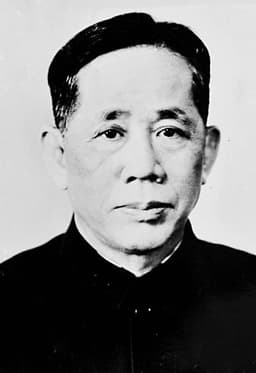
Le Duan
Politician · Modern
54.8Total
Nayef Hawatmeh
Politician · Modern
44.9Total
Basic Information
Born
1907
1935
Died
1986
—
Era
Modern
Modern
Nationality
Vietnam
Palestine
Occupation
Politician
Politician
Civilization
Eastern
Middle Eastern
Score Comparison
Military (10%)
25.9
50.0
Political (20%)
65.0
33.6
Influence (20%)
58.3
51.0
Legacy (20%)
52.0
40.8
Leadership (15%)
72.0
51.9
Strategy (15%)
41.0
41.4
TOTAL
54.8
44.9
Le Duan — Complete Timeline
1960 AD
Elected to PolitburoPolitical Action◆ Major
Le Duan was elected to the Politburo of the Communist Party of Vietnam, becoming a top leader. He was a key figure in directing the Vietnam War against the United States and South Vietnam.
PolitburoCommunist PartyVietnam War
Impact: national
General Secretary of the Communist PartyPolitical Action◆ Major
Le Duan became General Secretary of the Communist Party of Vietnam, succeeding Ho Chi Minh as the top leader. He oversaw the unification of Vietnam after the war and implemented socialist policies.
General SecretaryLeadershipUnification
Impact: nationalconstructive
1968 AD
Tet Offensive planningWar◆ Major
Le Duan was a key architect of the Tet Offensive, a massive military campaign against South Vietnam and US forces. Although a tactical defeat, the offensive shifted US public opinion against the war.
Tet OffensiveVietnam WarMilitary strategy
Impact: global
1976 AD
Reunification of VietnamPolitical Action◆ Major
Le Duan oversaw the formal reunification of North and South Vietnam into the Socialist Republic of Vietnam. He implemented a Soviet-style command economy and collectivization in the south.
ReunificationSocialist RepublicCollectivization
Impact: nationalconstructive
1978 AD
Invasion of CambodiaWar◆ Major
Le Duan ordered the Vietnamese invasion of Cambodia, overthrowing the Khmer Rouge regime. The invasion led to a decade-long occupation and international isolation for Vietnam.
CambodiaInvasionKhmer Rouge
Impact: regionaldestructive
Nayef Hawatmeh — Complete Timeline
1969 AD
Founding of the Democratic Front for the Liberation of Palestine (DFLP)Political Action◆ Major
Hawatmeh split from the Popular Front for the Liberation of Palestine (PFLP) to establish the DFLP, a Marxist-Leninist Palestinian faction. The DFLP advocated for a secular, democratic state in Palestine and became a significant player in the Palestinian national movement.
Palestinian FactionMarxismSplit
Impact: regional
1974 AD
Advocacy for the Two-State SolutionPolitical Action◆ Major
Hawatmeh's DFLP was among the first Palestinian factions to publicly endorse a two-state solution, accepting a Palestinian state alongside Israel. This position marked a significant shift from the PLO's earlier rejection of Israel and influenced later peace negotiations.
Peace ProcessDiplomacyPalestinian State
Impact: regionalconstructive
1993 AD
Participation in the 1993 Oslo AccordsPolitical Action
Hawatmeh and the DFLP initially opposed the Oslo Accords but later engaged in dialogue. The DFLP's stance evolved, and Hawatmeh participated in discussions about Palestinian self-governance, though the faction remained critical of the final agreement.
Oslo AccordsNegotiationsPLO
Impact: regional
1999 AD
Rejection of Armed Struggle and Shift to Political WorkPolitical Action◆ Major
Hawatmeh led the DFLP to formally renounce armed struggle and focus on political and diplomatic efforts. This decision aligned the faction with the Palestinian Authority and marginalized it among more militant groups, reducing its operational capacity.
De-escalationPolitical StrategyPalestinian Authority
Impact: nationalconstructive
Expert Analysis
Origins
Le Duan (born 1907) came from a peasant family in Quang Tri province, central Vietnam. He joined the Revolutionary Youth League in 1928 and was imprisoned by the French colonial authorities in the 1930s. His early experiences in prison radicalized him, and he became a founding member of the Indochinese Communist Party. After release, he worked underground, rising through party ranks. He spent years in Hanoi and the Viet Minh resistance, gaining trust from Ho Chi Minh.
Nayef Hawatmeh (born 1938) was born in Salt, Jordan, to a Christian Palestinian family. He studied at Cairo University, where he became involved in Arab nationalist movements. In the 1960s, he joined the Arab Nationalist Movement, which later evolved into the Popular Front for the Liberation of Palestine (PFLP). Hawatmeh split from the PFLP in 1969 to form the Democratic Front for the Liberation of Palestine (DFLP), a Marxist-Leninist faction that emphasized class struggle and a democratic Palestine.
Rise to Power
Le Duan's rise was gradual but steady. He was elected to the Politburo in 1951 and became acting General Secretary in 1959, formally taking the top party post in 1960. He consolidated power after Ho Chi Minh's death in 1969, becoming the de facto leader of North Vietnam. Le Duan was a key architect of the Tet Offensive in 1968, a massive military campaign that, despite heavy losses, shifted American public opinion against the war. He directed the final offensive in 1975 that led to the fall of Saigon and reunification.
Hawatmeh's rise came through factionalism. He broke from the PFLP due to ideological differences, advocating for a more democratic and less dogmatic approach. The DFLP gained prominence in the 1970s for its armed operations, including the 1974 Ma'alot massacre, which killed 22 Israeli schoolchildren. However, Hawatmeh later shifted the DFLP toward political work. In 1974, the DFLP joined the Palestine Liberation Organization (PLO) and became its second-largest faction. Hawatmeh's influence peaked in the 1980s as a PLO executive committee member.
Leadership & Governance
Le Duan led a unified communist party with absolute control over North Vietnam and later all of Vietnam. He implemented a Soviet-style command economy, collectivizing agriculture and nationalizing industry. His leadership was authoritarian, suppressing dissent through the security apparatus. He also ordered the invasion of Cambodia in 1978 to overthrow the Khmer Rouge, leading to a decade-long occupation. Le Duan's governance score of 72.0 reflects his tight control but also the economic failures of his policies, which contributed to widespread poverty.
Hawatmeh never held state power; his leadership was within a faction of the Palestinian national movement. He advocated for a two-state solution as early as 1974, a position that was radical at the time. The DFLP under his guidance renounced armed struggle in the 1990s and focused on political activism. However, his influence waned as the PLO and later the Palestinian Authority sidelined him. His leadership score of 51.9 reflects his limited organizational control and the DFLP's decline.
Triumph & Tragedy
Le Duan's greatest triumph was overseeing the reunification of Vietnam in 1976, ending decades of war. He also successfully directed the Tet Offensive, which, despite tactical failure, strategically weakened American will. His invasion of Cambodia removed the Khmer Rouge from power, but it also bogged Vietnam in a costly occupation and international isolation. Economically, his policies led to stagnation and famine in the 1980s. His legacy score of 52.0 reflects these mixed outcomes.
Hawatmeh's triumph was his early advocacy for a two-state solution, which later became mainstream Palestinian policy. He also kept the DFLP relevant through shifting political landscapes. However, his tragedy was the DFLP's gradual irrelevance due to internal splits and the rise of Hamas. The Ma'alot massacre remains a stain on his legacy, despite his later renunciation of violence. His overall score of 44.9 indicates limited lasting impact.
Character & Destiny
Le Duan was pragmatic and ruthless, willing to sacrifice thousands for strategic goals. He was a skilled organizer but inflexible in economic ideology, resisting reforms that could have improved living standards. His character—determined and secretive—helped him survive purges and maintain power for 25 years. However, his stubbornness led to economic disaster.
Hawatmeh was an ideologue who evolved from armed struggle to diplomacy. He was principled but often isolated, unable to build broad coalitions. His intellectual bent made him a thinker rather than a mass leader. His destiny was to be a historical footnote rather than a transformative figure.
Legacy
Le Duan's legacy is the unified Vietnam that exists today, but also the economic and political systems that required major reform after his death. He is remembered as the man who completed Ho Chi Minh's work, but also as a rigid bureaucrat. His military score of 25.9 is low because he was not a field commander, but his political score of 65.0 reflects his party dominance.
Hawatmeh's legacy is tied to the two-state solution idea, which remains central to peace efforts. However, the DFLP is now a minor faction. His influence score of 51.0 reflects his role as a pioneer of the two-state concept, but his overall impact is limited.
Conclusion
Le Duan had greater impact. His total score of 54.8 vs Hawatmeh's 44.9 is a gap of 9.9 points. Le Duan directly shaped the fate of 90 million Vietnamese, while Hawatmeh's influence was confined to a faction that never achieved statehood. Le Duan's decisions led to war, reunification, and economic hardship, but his actions were consequential on a national scale. Hawatmeh's advocacy was forward-thinking but ineffectual. Le Duan's legacy is tangible: a united Vietnam. Hawatmeh's is an idea, yet unrealized.
Rankings
🥇
Le DuanLeader
Mil: 25.9Pol: 65.0Inf: 58.3
54.8
🥈
Nayef Hawatmeh
Mil: 50.0Pol: 33.6Inf: 51.0
44.9
+9.9 behind
How This Comparison Works
Algorithm
Each figure is scored on 6 dimensions (0—100 scale) based on structured historical data: Military (10%), Political (20%), Influence (20%), Legacy (20%), Leadership (15%), Strategy (15%). The weighted total produces the final ranking.
Data Sources
Scores are computed from structured sub-indicators in the database. Scale factors adjust for era (Ancient ×0.85, Modern ×1.0) and civilization size (Eastern ×1.05, Other ×0.80) to account for differences in population and military scale.
Maximum 3 Figures
Comparisons are limited to 2—3 figures to ensure readability and statistical meaningfulness.
Error Margins
±5 points per dimension — Sub-scores are derived from historical records with inherent uncertainty. Two figures within 5 points on a dimension should be considered roughly equivalent in that area.
Total Score Accuracy
±3 points overall — The weighted combination of 6 dimensions produces a total score with approximately ±3 points of uncertainty. Differences of less than 3 points are not statistically significant— the figures are effectively tied.
Known Limitations
- Historical records are incomplete and uneven across civilizations
- Figures from oral-tradition societies may be underrepresented
- Occupation labels can misclassify multi-role figures
- Scores measure capability and impact, not moral character
- Quantitative scoring is a comparison tool, not absolute truth
Capability Radar
Military (10%) — Battles & Warfare
Battles
20
24
Win Rate
20
26
Expansion
30
25
Political (20%) — Governance & Reform
Reform
70
20
Diplomacy
75
40
Economy
60
10
Influence (20%) — Cultural & Global Reach
Cultural
50
20
Global
60
25
Legacy (20%) — Historical Impact
Historical
70
25
Longevity
60
20
Leadership (15%) — Power & Stability
Tenure
85
30
Stability
65
15
Strategy (15%) — Tactics & Innovation
Strategy
30
28
Tactics
20
33
Reform
30
35
Similar Comparisons
Comments & Discussion
No comments yet. Be the first to share your thoughts!