Loading...
This comparison has not been analyzed yet.
One-time AI generation (~1 minute). Scores and timeline are already available below.
Le Duc Anh vs Petro Doroshenko
Petro Doroshenko leads by 6.7 pts · 2 figures compared
…
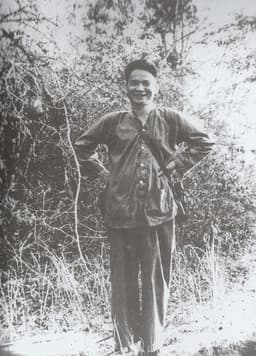
Le Duc Anh
General · Modern
49.9Total

Petro Doroshenko
General · Modern
56.6Total
Basic Information
Born
1920
1627
Died
—
1698
Era
Modern
Modern
Nationality
Vietnam
Ukraine
Occupation
General
General
Civilization
Eastern
Western
Score Comparison
Military (10%)
10.0
40.0
Political (20%)
68.0
68.0
Influence (20%)
53.3
56.4
Legacy (20%)
43.3
48.3
Leadership (15%)
68.0
68.0
Strategy (15%)
43.3
60.0
TOTAL
49.9
56.6
Le Duc Anh — Complete Timeline
1954 AD
Commanded Forces in the Battle of Dien Bien PhuWar◆ Major
Le Duc Anh served as a regimental commander during the Battle of Dien Bien Phu, the decisive engagement that ended French colonial rule in Indochina. His unit played a key role in the siege, contributing to the Viet Minh victory.
Dien Bien PhuViet MinhIndochina War
Impact: regional
1979 AD
Led Vietnamese Forces in CambodiaWar◆ Major
Le Duc Anh commanded Vietnamese forces during the invasion of Cambodia in 1979, which overthrew the Khmer Rouge regime. He oversaw military operations that installed the People's Republic of Kampuchea and remained in command of occupation forces until 1987.
CambodiaInvasionKhmer Rouge
Impact: regional
1987 AD
Appointed Minister of DefensePolitical Action◆ Major
Le Duc Anh was appointed Minister of Defense of Vietnam in 1987, overseeing the military during the latter stages of the Cambodian occupation and the normalization of relations with China. He modernized the armed forces and reduced troop levels.
Minister of DefenseMilitaryVietnam
Impact: national
1992 AD
Elected President of VietnamPolitical Action◆ Major
Le Duc Anh was elected President of Vietnam by the National Assembly in September 1992, serving as head of state until 1997. His presidency focused on consolidating party rule and maintaining stability during the post-Doi Moi period.
PresidentVietnamHead of State
Impact: national
Petro Doroshenko — Complete Timeline
1665 AD
Elected Hetman of Right-Bank UkrainePolitical Action◆ Major
Doroshenko was elected Hetman of Right-Bank Ukraine, a region under Polish-Lithuanian Commonwealth influence. He sought to unite all Ukrainian lands under a single rule and pursued an independent foreign policy.
Cossack HetmanateUkraineLeadership
Impact: regional
1669 AD
Allied with Ottoman EmpirePolitical Action◆ Major
To counter Polish and Russian influence, Doroshenko placed Right-Bank Ukraine under Ottoman suzerainty. This alliance provided him with military support but also made Ukraine a battleground in the Ottoman-Polish wars.
Ottoman AllianceCossack PoliticsControversy
Impact: regional
1672 AD
Failed to Unite Left and Right Bank UkraineWar◆ Major
Doroshenko's attempt to capture Left-Bank Ukraine from the Russian-aligned Hetman Ivan Samoilovich failed. The resulting conflict, known as the Ruin, further devastated Ukrainian lands and prevented unification.
The RuinUnification FailureWar
Impact: regionaltragic
1676 AD
Surrendered to Russian ForcesPolitical Action
After losing Ottoman support and facing a Russian-Cossack invasion, Doroshenko surrendered to Russian forces. He was taken to Moscow and later exiled, ending his rule and the last serious attempt to unite Ukraine under a single hetman.
SurrenderExileEnd of Hetmanate
Impact: regionaltragic
This comparison has not been analyzed yet.
One-time AI generation (~1 minute). Scores and timeline are already available below.
Rankings
🥇
Petro DoroshenkoLeader
Mil: 40.0Pol: 68.0Inf: 56.4
56.6
🥈
Le Duc Anh
Mil: 10.0Pol: 68.0Inf: 53.3
49.9
+6.7 behind
How This Comparison Works
Algorithm
Each figure is scored on 6 dimensions (0—100 scale) based on structured historical data: Military (10%), Political (20%), Influence (20%), Legacy (20%), Leadership (15%), Strategy (15%). The weighted total produces the final ranking.
Data Sources
Scores are computed from structured sub-indicators in the database. Scale factors adjust for era (Ancient ×0.85, Modern ×1.0) and civilization size (Eastern ×1.05, Other ×0.80) to account for differences in population and military scale.
Maximum 3 Figures
Comparisons are limited to 2—3 figures to ensure readability and statistical meaningfulness.
Error Margins
±5 points per dimension — Sub-scores are derived from historical records with inherent uncertainty. Two figures within 5 points on a dimension should be considered roughly equivalent in that area.
Total Score Accuracy
±3 points overall — The weighted combination of 6 dimensions produces a total score with approximately ±3 points of uncertainty. Differences of less than 3 points are not statistically significant— the figures are effectively tied.
Known Limitations
- Historical records are incomplete and uneven across civilizations
- Figures from oral-tradition societies may be underrepresented
- Occupation labels can misclassify multi-role figures
- Scores measure capability and impact, not moral character
- Quantitative scoring is a comparison tool, not absolute truth
Capability Radar
Military (10%) — Battles & Warfare
Battles
40
45
Win Rate
45
40
Expansion
25
40
Political (20%) — Governance & Reform
Reform
40
45
Diplomacy
50
55
Economy
45
35
Influence (20%) — Cultural & Global Reach
Cultural
30
40
Global
20
30
Legacy (20%) — Historical Impact
Historical
35
45
Longevity
25
35
Leadership (15%) — Power & Stability
Tenure
55
50
Stability
50
25
Strategy (15%) — Tactics & Innovation
Strategy
40
55
Tactics
35
50
Reform
30
30
Similar Comparisons
Comments & Discussion
No comments yet. Be the first to share your thoughts!