Loading...
Le Duc Anh vs Napoleon Bonaparte
Napoleon Bonaparte leads by 21.0 pts · 2 figures compared
…
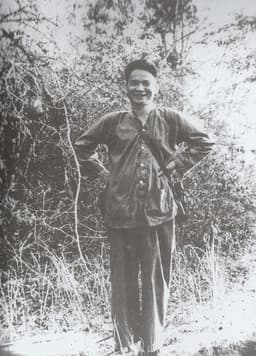
Le Duc Anh
General · Modern
49.9Total

Napoleon Bonaparte
General · Modern
70.9Total
Basic Information
Born
1920
1769
Died
—
1821
Era
Modern
Modern
Nationality
Vietnam
France
Occupation
General
General
Civilization
Eastern
Western
Score Comparison
Military (10%)
10.0
94.0
Political (20%)
68.0
72.0
Influence (20%)
53.3
40.0
Legacy (20%)
43.3
80.0
Leadership (15%)
68.0
78.0
Strategy (15%)
43.3
90.0
TOTAL
49.9
70.9
Le Duc Anh — Complete Timeline
1954 AD
Commanded Forces in the Battle of Dien Bien PhuWar◆ Major
Le Duc Anh served as a regimental commander during the Battle of Dien Bien Phu, the decisive engagement that ended French colonial rule in Indochina. His unit played a key role in the siege, contributing to the Viet Minh victory.
Dien Bien PhuViet MinhIndochina War
Impact: regional
1979 AD
Led Vietnamese Forces in CambodiaWar◆ Major
Le Duc Anh commanded Vietnamese forces during the invasion of Cambodia in 1979, which overthrew the Khmer Rouge regime. He oversaw military operations that installed the People's Republic of Kampuchea and remained in command of occupation forces until 1987.
CambodiaInvasionKhmer Rouge
Impact: regional
1987 AD
Appointed Minister of DefensePolitical Action◆ Major
Le Duc Anh was appointed Minister of Defense of Vietnam in 1987, overseeing the military during the latter stages of the Cambodian occupation and the normalization of relations with China. He modernized the armed forces and reduced troop levels.
Minister of DefenseMilitaryVietnam
Impact: national
1992 AD
Elected President of VietnamPolitical Action◆ Major
Le Duc Anh was elected President of Vietnam by the National Assembly in September 1992, serving as head of state until 1997. His presidency focused on consolidating party rule and maintaining stability during the post-Doi Moi period.
PresidentVietnamHead of State
Impact: national
Napoleon Bonaparte — Complete Timeline
1799 AD
Coup of 18 BrumaireOther◆ Major
Napoleon Bonaparte, with support from his brother Lucien and key political figures, overthrew the Directory in a bloodless coup. He established the Consulate with himself as First Consul, effectively becoming the ruler of France. This event ended the French Revolution's most unstable period.
French RevolutionCoupRise to Power
Impact: regional
1804 AD
Promulgation of the Napoleonic CodeOther◆ Major
Napoleon enacted the Civil Code of the French, known as the Napoleonic Code, a comprehensive set of laws that replaced the fragmented feudal legal systems. The code established legal equality, protected property rights, and secularized law. It became the basis for legal systems in many European and world countries.
Legal ReformNapoleonic CodeCivil Law
Impact: globalconstructive
1805 AD
Battle of AusterlitzWar◆ Major
Napoleon's Grande Arm
Napoleonic WarsBattleDecisive Victory
Impact: global
1812 AD
Invasion of RussiaWar◆ Major
Napoleon led the Grande Arm
Napoleonic WarsInvasionDisaster
Impact: globaldestructive
1815 AD
Battle of WaterlooWar◆ Major
Napoleon's French army was defeated by the combined forces of the Duke of Wellington's Anglo-Allied army and Gebhard Leberecht von Bl
Napoleonic WarsBattleFinal Defeat
Impact: globaldestructive
Expert Analysis
le-duc-anh-vs-napoleon-bonaparte
# The Corsican and the Commander: Two Paths to Power in an Age of Upheaval
On a foggy June morning in 1815, Napoleon Bonaparte stood on a muddy ridge near Waterloo, watching his Imperial Guard march into oblivion. The man who had crowned himself Emperor of Europe was about to become a prisoner of the Atlantic. A century and a half later, on a humid April day in 1975, Le Duc Anh watched from the jungles of eastern Cambodia as the Khmer Rouge seized Phnom Penh—a victory that would lead, within four years, to his own decisive intervention to overthrow them. One general conquered a continent and lost it all. Another helped liberate his country, then spent decades quietly shaping its future. What drove such different outcomes? The answer lies not merely in talent or luck, but in the profound ways that time, place, and character conspire to forge—or break—a leader.
Origins
Napoleon Bonaparte was born in 1769 on the island of Corsica, a land that had just been sold to France by Genoa. His family belonged to the minor nobility, but they were poor, proud, and resentful of French rule. Young Napoleon spoke Italian-accented French and was mocked by his classmates at military school. This outsider status forged a restless ambition: he would prove himself not just equal to the French, but their master. The Enlightenment was in full bloom, and the French Revolution had shattered the old order. For a gifted artillery officer, the chaos was an open door.
Le Duc Anh was born in 1920 in Thua Thien province, central Vietnam, then part of French Indochina. His family were farmers, not nobles. He grew up under colonial rule, watching French officials exploit his homeland. The difference in starting points is stark: Napoleon began with a sword and an education; Le Duc Anh began with a hoe and a grievance. Yet both were shaped by war. Napoleon came of age during the Revolutionary Wars, when young officers could rise overnight. Le Duc Anh came of age during the First Indochina War, when Vietnamese nationalists were fighting for survival. For both, war was not an interruption of life—it was life itself.
Rise to Power
Napoleon’s ascent was meteoric, almost operatic. In 1793, at age 24, he recaptured the port of Toulon from British forces, earning promotion to brigadier general. By 1796, he was commanding the Army of Italy, winning battle after battle against the Austrians. His Italian campaign of 1796-1797 was a masterpiece of speed, deception, and audacity—he turned a starving, unpaid army into a victorious force that extracted millions in tribute. By 1799, he had seized power in a coup. He was 30 years old. His rise was built on a single, ruthless principle: never wait for opportunity—create it.
Le Duc Anh’s rise was slower, more patient. He joined the Viet Minh in 1945, fighting the French in the jungles. His first major command came in 1954 at the Battle of Dien Bien Phu, where he served as a regimental commander under General Vo Nguyen Giap. That battle, which ended French colonial rule in Indochina, was not a lightning campaign but a grinding siege—54 days of digging trenches, hauling artillery up mountains, and starving the enemy into surrender. Le Duc Anh learned a different lesson: victory belongs to those who endure. He would not command an army for another 25 years. Where Napoleon burned bright and fast, Le Duc Anh smoldered.
Leadership & Governance
As a ruler, Napoleon was a hurricane of reform. He centralized the French state, created the Napoleonic Code, reorganized education, and established the Bank of France. His military genius lay in operational speed—he could march an army faster than any enemy, strike at the junction of opposing forces, and destroy them piecemeal. At Austerlitz in 1805, he lured the Austro-Russian army into a trap and annihilated it. His political wisdom, however, was less impressive. He appointed his brothers to thrones across Europe, believing loyalty trumped competence. He invaded Russia in 1812 with 600,000 men; fewer than 100,000 returned. His governance was brilliant in conception, flawed in execution—he built a system that depended entirely on his own presence.
Le Duc Anh governed differently. As Minister of Defense from 1987 and President from 1992 to 1997, he focused on consolidation, not conquest. His military achievement was the 1979 invasion of Cambodia, which overthrew the Khmer Rouge after they had murdered perhaps two million of their own people. It was not a glorious campaign of maneuver but a grim, necessary intervention. Politically, he was a party man, not a charismatic visionary. He helped steer Vietnam through the difficult transition from war economy to market reforms, known as Đổi Mới. His leadership was steady, bureaucratic, and effective—no Napoleonic drama, but no Napoleonic collapse either.
Triumph & Tragedy
Napoleon’s greatest moment was Austerlitz, where he defeated two emperors in a single day. His greatest tragedy was the Russian campaign, where he lost his army to winter, disease, and his own arrogance. He once said, “There is no immortality but the memory that is left in the minds of men.” He left a vast memory—but also a vast graveyard.
Le Duc Anh’s triumph was the liberation of Cambodia from the Khmer Rouge in 1979, a campaign that saved countless lives. His tragedy is less dramatic: he is largely forgotten outside Vietnam. He did not write his name across history; he simply did his duty. As a Vietnamese saying goes, “When the elephant passes, the grass is crushed.” He was the elephant, but the grass grew back.
Character & Destiny
Napoleon was driven by an insatiable hunger for glory. “I live only for posterity,” he said. His personality—brilliant, impatient, grandiose—led him to overreach. He could not stop. He invaded Russia because he could not bear the thought of not conquering it. His destiny was to rise higher than any man in Europe, then fall harder.
Le Duc Anh was driven by survival and service. He fought for independence, then for stability. He was not a visionary; he was a soldier who became a statesman because his country needed one. His personality—cautious, patient, loyal—kept him from overreaching. He retired quietly in 1997, having served his term.
Legacy
Napoleon’s legacy is written in stone and law. The Napoleonic Code influences legal systems across Europe, Latin America, and beyond. His military campaigns are studied in every war college. He reshaped Europe, then lost it all. Yet his name remains synonymous with ambition, genius, and hubris.
Le Duc Anh’s legacy is quieter. He is remembered in Vietnam as a steady hand during a difficult transition. He helped end the Khmer Rouge nightmare. But he did not change the world. He helped his country survive and move forward. That is a different kind of achievement—less glorious, perhaps, but no less real.
Conclusion
Standing at the end of their lives, Napoleon on remote Saint Helena and Le Duc Anh in a Hanoi retirement, both might have reflected on the same question: What was it all for? Napoleon built an empire that crumbled. Le Duc Anh built a country that endured. The Corsican conquered Europe and was consumed by his own ambition. The Vietnamese commander liberated his homeland and quietly went home. One changed the world and lost himself. The other changed his country and kept himself whole. In the end, perhaps the truest measure of a leader is not how high they rise, but how well they serve—and how gracefully they let go.
Rankings
🥇
Napoleon BonaparteLeader
Mil: 94.0Pol: 72.0Inf: 40.0
70.9
🥈
Le Duc Anh
Mil: 10.0Pol: 68.0Inf: 53.3
49.9
+21.0 behind
How This Comparison Works
Algorithm
Each figure is scored on 6 dimensions (0—100 scale) based on structured historical data: Military (10%), Political (20%), Influence (20%), Legacy (20%), Leadership (15%), Strategy (15%). The weighted total produces the final ranking.
Data Sources
Scores are computed from structured sub-indicators in the database. Scale factors adjust for era (Ancient ×0.85, Modern ×1.0) and civilization size (Eastern ×1.05, Other ×0.80) to account for differences in population and military scale.
Maximum 3 Figures
Comparisons are limited to 2—3 figures to ensure readability and statistical meaningfulness.
Error Margins
±5 points per dimension — Sub-scores are derived from historical records with inherent uncertainty. Two figures within 5 points on a dimension should be considered roughly equivalent in that area.
Total Score Accuracy
±3 points overall — The weighted combination of 6 dimensions produces a total score with approximately ±3 points of uncertainty. Differences of less than 3 points are not statistically significant— the figures are effectively tied.
Known Limitations
- Historical records are incomplete and uneven across civilizations
- Figures from oral-tradition societies may be underrepresented
- Occupation labels can misclassify multi-role figures
- Scores measure capability and impact, not moral character
- Quantitative scoring is a comparison tool, not absolute truth
Capability Radar
Military (10%) — Battles & Warfare
Battles
40
95
Win Rate
45
90
Expansion
25
95
Political (20%) — Governance & Reform
Reform
40
95
Diplomacy
50
80
Economy
45
85
Influence (20%) — Cultural & Global Reach
Cultural
30
85
Global
20
90
Legacy (20%) — Historical Impact
Historical
35
95
Longevity
25
90
Leadership (15%) — Power & Stability
Tenure
55
85
Stability
50
70
Strategy (15%) — Tactics & Innovation
Strategy
40
95
Tactics
35
98
Reform
30
92
Similar Comparisons
Comments & Discussion
Artillery Emperor6/17/2026
Napoleon's artillery tactics at Austerlitz were a masterclass in concentration of force, but Le Duc Anh's jungle logistics in the 1970s were quieter genius. Give me the Corsican's grand maneuvers any day—he reshaped Europe in a decade. Anh was a cog in a machine; Napoleon was the machine itself. Waterloo was a fluke of mud and timing, not a verdict on his strategic mind.
历史数据控6/17/2026
拿破仑的参谋长贝蒂埃记下每门火炮的弹药基数,勒杜安的战报却模糊得像个谜。数据上,拿破仑在1813年指挥60万大军攻德,而安在1979年越柬边境的兵力记录支离破碎。给我精确的数字,我才能信服。模糊的英雄叙事不如弹药清单来得实在。
Spartan General6/17/2026
Le Duc Anh understood something Napoleon never did: when to stop. Napoleon's invasion of Russia in 1812 was a logistical suicide—600,000 men, 200,000 horses, and he chased shadows. Anh's 1979 campaign into Cambodia was a precise surgical strike: three weeks to topple the Khmer Rouge, then back to building a state. Restraint beats ambition every time.
古典学人6/17/2026
拿破仑的法文口音被军校嘲笑,却用帝国法典统一了半个欧洲;勒杜安从法语殖民地上来,最后用越南语写了回忆录。语言塑造战略视野——拿破仑的野心是拉丁式的:征服、同化、永恒。安的局限是本土式的:保卫、撤退、沉默。前者是罗马的野心,后者是安南的谨慎。
Revisionist Edge6/17/2026
Stop romanticizing Napoleon as a tragic hero—he was a war criminal whose 1815 return from Elba caused 50,000 more deaths at Waterloo alone. Le Duc Anh's overthrow of Pol Pot saved maybe two million lives. Let's calculate: Napoleon's corpse count in millions versus Anh's rescued millions. The "great man" myth ignores the body bags. I'll take the quiet killer over the loud butcher any war.