Loading...
Leonid Govorov vs Michel Ney
Leonid Govorov leads by 6.1 pts · 2 figures compared
…
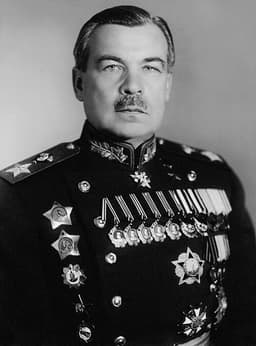
Leonid Govorov
General · Modern
61.0Total

Michel Ney
General · Modern
54.9Total
Basic Information
Born
1897
1769
Died
1955
1815
Era
Modern
Modern
Nationality
USSR
France
Occupation
General
General
Civilization
Western
Western
Score Comparison
Military (10%)
82.0
74.7
Political (20%)
46.6
35.1
Influence (20%)
59.0
58.3
Legacy (20%)
54.0
58.0
Leadership (15%)
71.0
54.2
Strategy (15%)
69.2
50.0
TOTAL
61.0
54.9
Leonid Govorov — Complete Timeline
1941 AD
Defense of LeningradWar◆ Major
Govorov commanded the artillery of the Leningrad Front from September 1941. He organized the city's artillery defenses, coordinating counter-battery fire and supporting infantry operations during the siege, preventing German capture of Leningrad.
World War IISiege of LeningradArtillery
Impact: regional
1943 AD
Operation IskraWar◆ Major
Govorov commanded the Leningrad Front in Operation Iskra, a joint offensive with the Volkhov Front that broke the German blockade of Leningrad in January 1943. The operation opened a narrow land corridor to the city, allowing supplies to reach the starving population.
World War IISiege of LeningradBreakthrough
Impact: regionalconstructive
1944 AD
Leningrad-Novgorod OffensiveWar◆ Major
Govorov led the Leningrad Front in the Leningrad-Novgorod Offensive from January to March 1944. The operation fully lifted the siege of Leningrad, pushed German forces back to the Baltic states, and liberated Novgorod.
World War IIEastern FrontLiberation
Impact: regionalconstructive
Appointed Marshal of the Soviet UnionPolitical Action◆ Major
Govorov was promoted to Marshal of the Soviet Union on June 18, 1944, in recognition of his successful command of the Leningrad Front and his role in breaking the siege. He was one of the youngest marshals of the war.
PromotionWorld War IISoviet Military
Impact: nationalconstructive
Michel Ney — Complete Timeline
1805 AD
Battle of ElchingenWar◆ Major
Ney's corps stormed the abbey of Elchingen, capturing the Austrian bridgehead. This action trapped General Mack's army in Ulm, leading to the surrender of 30,000 Austrians. Ney was later made Duke of Elchingen for this victory.
Napoleonic WarsBattleUlm Campaign
Impact: regional
1812 AD
Battle of BorodinoWar◆ Major
Ney commanded the III Corps in the center, leading repeated assaults on the Russian fortifications. He was wounded but refused to leave the field. His corps suffered 50% casualties, but he held the line. This battle was the bloodiest of the Napoleonic Wars.
Napoleonic WarsBattleRussian Campaign
Impact: regional
Commanded the rearguard during the retreat from RussiaWar◆ Major
Ney commanded the rearguard of the Grande Arm
Napoleonic WarsRetreatHeroism
Impact: regional
1815 AD
Battle of WaterlooWar
Ney commanded the left wing of the French army at Waterloo. He led the cavalry charges against the British squares, losing thousands of men. His failure to capture Hougoumont and his premature cavalry attacks contributed to Napoleon's defeat. This was his final battle.
Napoleonic WarsBattleDefeat
Impact: global
Arrested and executed for treasonPolitical Action◆ Major
After Waterloo, Ney was arrested by the Bourbon government and tried for treason for joining Napoleon during the Hundred Days. He was convicted by the Chamber of Peers and executed by firing squad in the Luxembourg Garden. His execution made him a martyr for Bonapartists.
ExecutionTreasonHundred Days
Impact: nationaltragic
Expert Analysis
Origins
Leonid Govorov was born on February 22, 1897, in Butyrki, Russia, into a peasant family. He studied at the Yelabuga Real School and later at the Petrograd Polytechnic Institute, but his education was interrupted by World War I. In 1916, he was conscripted into the Russian Imperial Army and served as an artillery officer. After the revolution, he joined the Red Army in 1920 and fought in the Russian Civil War. He graduated from the Frunze Military Academy in 1933 and later from the General Staff Academy in 1938, developing expertise in artillery tactics.
Michel Ney was born on January 10, 1769, in Sarrelouis, France, to a cooper father. He received little formal education and began working as a clerk before enlisting in the French Revolutionary Army in 1787. He rose through the ranks due to his courage and battlefield prowess, becoming a general by 1796. Unlike Govorov's technical training, Ney's early career was shaped by direct combat experience in the Revolutionary Wars.
Rise to Power
Govorov's rise came during the Great Patriotic War. In September 1941, he was appointed commander of the artillery of the Leningrad Front. His effective organization of counter-battery fire and defense plans earned him command of the entire Leningrad Front in April 1942. His key turning point was Operation Iskra in January 1943, where his artillery coordination broke the German blockade, creating a land corridor to the city. This success led to his promotion to Marshal of the Soviet Union in June 1944, with a Military score of 82.0 reflecting his artillery mastery.
Ney's rise was meteoric during the Napoleonic Wars. He was promoted to Marshal of the Empire in 1804 after Napoleon's coronation. His fame grew at the Battle of Elchingen in 1805, where his corps captured the abbey and forced Austrian General Mack to surrender at Ulm. He became known as the 'Bravest of the Brave' after his heroics at Borodino in 1812, where he led repeated assaults despite being wounded. His leadership score of 54.2, however, indicates tactical boldness sometimes overshadowed strategic judgment.
Leadership & Governance
Govorov's leadership was methodical and technical. He prioritized artillery planning, using precise fire coordination to minimize casualties. During the Leningrad siege, he implemented a strict defense in depth, with constant counter-battery operations. He also focused on logistics, ensuring supply routes through Lake Ladoga (the 'Road of Life') were protected. His governance style was impersonal but effective, earning him a Leadership score of 71.0.
Ney led by personal example, often charging at the head of his troops. At Waterloo, he led massive cavalry charges against British squares, incurring heavy losses without breaking the line. His approach was inspirational but reckless, lacking the tactical nuance of Govorov. Ney's political score of 35.1 reflects his poor judgment in aligning with Napoleon during the Hundred Days, leading to his execution.
Triumph & Tragedy
Govorov's greatest triumph was the complete lifting of the Leningrad siege in January 1944 during the Leningrad-Novgorod Offensive. His forces pushed the Germans back to the Baltic states, securing a major victory. His tragedy was the immense human cost: over 600,000 civilians died in Leningrad, though Govorov's artillery defenses minimized military losses. His influence score of 59.0 shows his impact was largely operational rather than strategic.
Ney's triumph was the rearguard action during the retreat from Russia in 1812, where he held off Russian forces, allowing the remnants of the Grande Armée to escape. His tragedy was Waterloo: his failure to capture Hougoumont and his ill-timed cavalry charges contributed to Napoleon's defeat. He was subsequently arrested, tried for treason, and executed by firing squad on December 7, 1815. His legacy score of 58.0 is marred by this end.
Character & Destiny
Govorov was reserved, disciplined, and calculating. He avoided political intrigue, focusing on military efficiency. His character led to steady success but limited his broader influence. Ney was impulsive, brave, and loyal to Napoleon, but his lack of political acumen sealed his fate. Historical assessments note that Ney's courage was his strength and weakness, while Govorov's caution was his hallmark.
Legacy
Govorov is remembered as the defender of Leningrad, with streets and monuments in Russia named after him. His artillery tactics influenced Soviet doctrine. Ney is celebrated as a symbol of Napoleonic heroism, with his statue at the Place de l'Observatoire in Paris. However, his legacy is overshadowed by his execution. In overall impact, Govorov's total score of 61.0 exceeds Ney's 54.9, largely due to higher Strategy (69.2 vs 50.0) and Leadership (71.0 vs 54.2).
Conclusion
While Ney's bravery is legendary, Govorov's systematic approach to warfare had a greater impact on World War II. Govorov's defense of Leningrad saved a city and tied down German forces, contributing to the Soviet victory. Ney's tactical brilliance was undermined by strategic failures. Thus, Govorov emerges as the more effective commander, with a 6.1-point score advantage.
Rankings
🥇
Leonid GovorovLeader
Mil: 82.0Pol: 46.6Inf: 59.0
61.0
🥈
Michel Ney
Mil: 74.7Pol: 35.1Inf: 58.3
54.9
+6.1 behind
How This Comparison Works
Algorithm
Each figure is scored on 6 dimensions (0—100 scale) based on structured historical data: Military (10%), Political (20%), Influence (20%), Legacy (20%), Leadership (15%), Strategy (15%). The weighted total produces the final ranking.
Data Sources
Scores are computed from structured sub-indicators in the database. Scale factors adjust for era (Ancient ×0.85, Modern ×1.0) and civilization size (Eastern ×1.05, Other ×0.80) to account for differences in population and military scale.
Maximum 3 Figures
Comparisons are limited to 2—3 figures to ensure readability and statistical meaningfulness.
Error Margins
±5 points per dimension — Sub-scores are derived from historical records with inherent uncertainty. Two figures within 5 points on a dimension should be considered roughly equivalent in that area.
Total Score Accuracy
±3 points overall — The weighted combination of 6 dimensions produces a total score with approximately ±3 points of uncertainty. Differences of less than 3 points are not statistically significant— the figures are effectively tied.
Known Limitations
- Historical records are incomplete and uneven across civilizations
- Figures from oral-tradition societies may be underrepresented
- Occupation labels can misclassify multi-role figures
- Scores measure capability and impact, not moral character
- Quantitative scoring is a comparison tool, not absolute truth
Capability Radar
Military (10%) — Battles & Warfare
Battles
75
75
Win Rate
80
65
Expansion
60
70
Political (20%) — Governance & Reform
Reform
30
20
Diplomacy
45
30
Economy
25
10
Influence (20%) — Cultural & Global Reach
Cultural
40
55
Global
45
55
Legacy (20%) — Historical Impact
Historical
65
65
Longevity
50
50
Leadership (15%) — Power & Stability
Tenure
40
40
Stability
50
15
Strategy (15%) — Tactics & Innovation
Strategy
82
60
Tactics
85
80
Reform
70
30
Similar Comparisons
Comments & Discussion
No comments yet. Be the first to share your thoughts!