Loading...
Li Rusong vs Muqali
Muqali leads by 9.5 pts · 2 figures compared
…

Li Rusong
General · Medieval
51.8Total
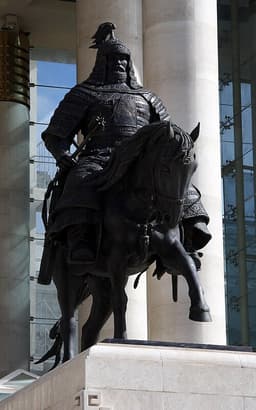
Muqali
General · Medieval
61.3Total
Basic Information
Born
1549
1170
Died
1598
1223
Era
Medieval
Medieval
Nationality
China
Mongol Empire
Occupation
General
General
Civilization
Eastern
Eastern
Score Comparison
Military (10%)
80.0
65.0
Political (20%)
32.2
68.0
Influence (20%)
55.7
58.0
Legacy (20%)
45.8
49.2
Leadership (15%)
54.2
70.4
Strategy (15%)
55.0
72.0
TOTAL
51.8
61.3
Li Rusong — Complete Timeline
1592 AD
Appointed Commander of Ming Forces in KoreaPolitical Action◆ Major
Li Rusong was appointed supreme commander of the Ming expeditionary force sent to aid Joseon Korea against the Japanese invasion led by Toyotomi Hideyoshi. He led a combined Chinese-Korean army to counter the Japanese advance.
Imjin WarMing DynastyCommand
Impact: regional
1593 AD
Recaptured PyongyangWar
Li Rusong led the Ming-Joseon forces in a decisive assault on Pyongyang, which was occupied by Japanese troops. The battle resulted in the recapture of the city and inflicted heavy casualties on the Japanese army, marking a turning point in the war.
Imjin WarBattlePyongyang
Impact: regionalconstructive
Battle of ByeokjegwanWar◆ Major
Li Rusong's forces were ambushed and defeated by a Japanese army at Byeokjegwan near Seoul. Li himself was wounded in the battle. This setback forced the Ming army to retreat and temporarily halted their advance southward.
Imjin WarBattleDefeat
Impact: regionaltragic
Negotiated Ceasefire with JapanPolitical Action◆ Major
Following the military stalemate, Li Rusong participated in negotiations with Japanese representatives for a ceasefire. The talks led to a temporary halt in hostilities and the withdrawal of Japanese forces from the Korean peninsula to the southern coast.
Imjin WarNegotiationCeasefire
Impact: regional
Recalled to ChinaPolitical Action
Li Rusong was recalled to China after the ceasefire. His recall was due to political rivalries at the Ming court and disagreements over war strategy. He was replaced by other commanders for the later phases of the Imjin War.
Ming DynastyRecallImjin War
Impact: national
Muqali — Complete Timeline
1211 AD
Campaign in Northern ChinaWar◆ Major
Muqali was a key commander in Genghis Khan's invasion of the Jin Dynasty. He led forces in the capture of numerous cities and fortresses in northern China, including the victory at the Battle of Yehuling in 1211, which broke Jin resistance.
Jin DynastyYehulingNorthern China
Impact: regional
1212 AD
Conquest of ManchuriaWar
Muqali led a campaign to subdue the Khitan and Jurchen tribes in Manchuria. He defeated the rebel Khitan leader Yel
ManchuriaKhitanJurchen
Impact: regional
1215 AD
Siege of ZhongduWar◆ Major
Muqali participated in the Mongol siege of Zhongdu (modern Beijing), the capital of the Jin Dynasty. The city fell after a prolonged siege, leading to the massacre of its inhabitants and the effective collapse of Jin authority in northern China.
ZhongduBeijingSiege
Impact: regionaldestructive
1217 AD
Appointment as Viceroy of ChinaPolitical Action◆ Major
Genghis Khan appointed Muqali as viceroy (guo-wang) of all conquered territories in China, granting him command of the Mongol forces in the region. This made Muqali the de facto ruler of Mongol-occupied northern China.
ViceroyChinaGenghis Khan
Impact: regionalconstructive
Expert Analysis
Origins
Li Rusong (1549–1598) was born into a prominent Ming military family in Liaodong. His father, Li Chengliang, was a powerful general who dominated the northeastern frontier. Li Rusong inherited his father's martial tradition, learning military tactics and command from a young age. He passed the military examination in 1570 and began his career as a frontier officer.
Muqali (1170–1223) was born into the Jalayir tribe, a vassal of the Mongol Borjigin clan. His father, Güün U'a, was a loyal follower of Genghis Khan. Muqali grew up in the steppe, mastering horse archery and nomadic warfare. He became a nökör (companion) to Genghis Khan early, fighting alongside him during the unification of the Mongol tribes.
Rise to Power
Li Rusong rose through the ranks of the Ming military, distinguishing himself in campaigns against the Mongols and Jurchens on the northern frontier. In 1592, when Toyotomi Hideyoshi invaded Korea, the Ming court appointed Li as supreme commander of the expeditionary force. This was a turning point: Li was given command of over 40,000 troops, a significant force for Ming China.
Muqali's rise was tied to Genghis Khan's ascent. He fought in the 1206 campaign that unified the Mongols, earning the title "one of the four hounds of Genghis Khan" (along with Subutai, Jebe, and Khubilai). In 1211, he led the vanguard in the invasion of the Jin Dynasty. His success in capturing cities led Genghis Khan to appoint him as viceroy (guo-wang) of China in 1217, granting him authority over all Mongol forces in the region. This gave him a strategic autonomy that Li never had.
Leadership & Governance
Li Rusong was a hands-on commander who led from the front. At the Battle of Pyongyang in 1593, he personally directed the assault, using cannons and fire arrows to break Japanese defenses. His leadership style was aggressive: he pushed his troops hard and expected quick victories. However, he was politically naive. He clashed with Ming civil officials over strategy and logistics, and his recall in 1594 was partly due to court intrigue.
Muqali was a strategic administrator as well as a general. As viceroy, he governed conquered territories, establishing garrisons and appointing Chinese officials to help administer the Jin lands. His leadership score of 70.4 reflects his ability to combine military command with governance. He used Chinese-style siege tactics, including trebuchets and sappers, to capture fortified cities. Unlike Li, Muqali maintained good relations with his subordinates and with Genghis Khan, securing resources and reinforcements.
Triumph & Tragedy
Li Rusong's greatest triumph was the recapture of Pyongyang in February 1593. He led a combined Ming-Joseon force of 43,000 men against 30,000 Japanese defenders. The battle was a crushing victory: Japanese casualties exceeded 10,000, while Ming losses were around 800. However, his tragedy came at the Battle of Byeokjegwan in March 1593, where he was ambushed and wounded. His forces suffered over 5,000 casualties, and Li himself was shot in the shoulder. This defeat stalled the Ming advance and forced him into negotiations.
Muqali's triumphs included the conquest of Manchuria and the capture of over 30 cities in northern China. His siege of Zhongdu (Beijing) in 1215, though not directly under his command, was part of his campaign. His tragedy was his death in 1223 at age 53, likely from illness, before he could complete the conquest of the Jin Dynasty. He also failed to capture the strategic city of Kaifeng, which fell only after his death.
Character & Destiny
Li Rusong was brave but impulsive. His military score of 80.0 reflects his tactical skill, but his political score of 32.2 shows his weakness in court politics. He was known for his temper and his habit of making enemies among officials. His recall to China and subsequent relegation to minor posts cut short his career. He died in 1598, possibly assassinated by political rivals.
Muqali was prudent and loyal. His political score of 68.0 and leadership of 70.4 indicate his ability to navigate Mongol politics. He never overreached and always deferred to Genghis Khan. His character of steady competence allowed him to hold power for six years as viceroy, a rare achievement in the turbulent Mongol empire. He died in office, still trusted by Genghis Khan.
Legacy
Li Rusong is remembered in Korea as a heroic ally. The Battle of Pyongyang is still celebrated as a turning point in the Imjin War. However, his legacy is overshadowed by his later failures. He scored 45.8 in legacy, reflecting his limited long-term impact. His tactics influenced later Ming generals, but his career was a cautionary tale of military success undermined by political failure.
Muqali's legacy is more substantial. He established the Mongol administrative system in northern China, which later evolved into the Yuan Dynasty's governance. His conquests paved the way for the Mongol invasion of the Jin Dynasty. His legacy score of 49.2 is slightly higher than Li's, and his influence score of 58.0 reflects his role in shaping Mongol imperial strategy.
Conclusion
Muqali had a greater overall impact. His total score of 61.3 exceeds Li's 51.8 by 9.5 points. While Li Rusong was a more brilliant tactician (military 80.0 vs 65.0), Muqali's strategic vision (72.0 vs 55.0) and leadership (70.4 vs 54.2) made him more effective over the long term. Li's failure at Byeokjegwan and his political downfall contrast with Muqali's sustained success as viceroy. Muqali's conquests directly contributed to the Mongol Empire's expansion, whereas Li's victories in Korea were temporary and ultimately reversed by Japanese resupply. Therefore, Muqali stands as the more impactful figure in world history.
Rankings
🥇
MuqaliLeader
Mil: 65.0Pol: 68.0Inf: 58.0
61.3
🥈
Li Rusong
Mil: 80.0Pol: 32.2Inf: 55.7
51.8
+9.5 behind
How This Comparison Works
Algorithm
Each figure is scored on 6 dimensions (0—100 scale) based on structured historical data: Military (10%), Political (20%), Influence (20%), Legacy (20%), Leadership (15%), Strategy (15%). The weighted total produces the final ranking.
Data Sources
Scores are computed from structured sub-indicators in the database. Scale factors adjust for era (Ancient ×0.85, Modern ×1.0) and civilization size (Eastern ×1.05, Other ×0.80) to account for differences in population and military scale.
Maximum 3 Figures
Comparisons are limited to 2—3 figures to ensure readability and statistical meaningfulness.
Error Margins
±5 points per dimension — Sub-scores are derived from historical records with inherent uncertainty. Two figures within 5 points on a dimension should be considered roughly equivalent in that area.
Total Score Accuracy
±3 points overall — The weighted combination of 6 dimensions produces a total score with approximately ±3 points of uncertainty. Differences of less than 3 points are not statistically significant— the figures are effectively tied.
Known Limitations
- Historical records are incomplete and uneven across civilizations
- Figures from oral-tradition societies may be underrepresented
- Occupation labels can misclassify multi-role figures
- Scores measure capability and impact, not moral character
- Quantitative scoring is a comparison tool, not absolute truth
Capability Radar
Military (10%) — Battles & Warfare
Battles
75
75
Win Rate
70
80
Expansion
55
85
Political (20%) — Governance & Reform
Reform
20
65
Diplomacy
50
72
Economy
25
60
Influence (20%) — Cultural & Global Reach
Cultural
45
55
Global
50
55
Legacy (20%) — Historical Impact
Historical
55
65
Longevity
40
50
Leadership (15%) — Power & Stability
Tenure
40
70
Stability
35
68
Strategy (15%) — Tactics & Innovation
Strategy
68
82
Tactics
72
78
Reform
30
60
Similar Comparisons
Comments & Discussion
No comments yet. Be the first to share your thoughts!