Loading...
Li Xiannian vs Talaat Pasha
Li Xiannian leads by 1.2 pts · 2 figures compared
…
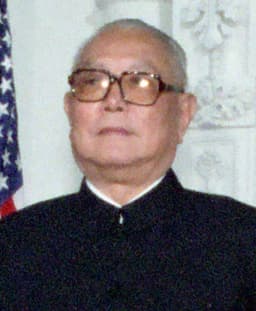
Li Xiannian
Politician · Modern
52.1Total

Talaat Pasha
Politician · Modern
50.9Total
Basic Information
Born
1909
1873
Died
1992
1921
Era
Modern
Modern
Nationality
China
Ottoman Empire
Occupation
Politician
Politician
Civilization
Eastern
Middle Eastern
Score Comparison
Military (10%)
11.5
36.5
Political (20%)
60.0
39.4
Influence (20%)
56.4
56.4
Legacy (20%)
50.0
52.0
Leadership (15%)
80.0
67.0
Strategy (15%)
33.7
42.4
TOTAL
52.1
50.9
Li Xiannian — Complete Timeline
1934 AD
Participated in the Long MarchWar◆ Major
Li Xiannian joined the Long March as a political commissar, leading troops through harsh conditions. He later became a key military commander in the Communist forces during the Chinese Civil War.
Long MarchChinese Civil WarMilitary Commander
Impact: national
1954 AD
Served as Minister of FinancePolitical Action◆ Major
Li Xiannian was appointed Minister of Finance, overseeing China's economic planning during the First Five-Year Plan. He implemented Soviet-style central planning and managed the national budget.
Economic PlanningFive-Year PlanFinance
Impact: nationalconstructive
1978 AD
Supported Deng Xiaoping's economic reformsReform◆ Major
Li Xiannian supported Deng Xiaoping's market-oriented reforms, helping to shift China from a planned economy to a more market-based system. He advocated for agricultural decollectivization and foreign investment.
Deng XiaopingEconomic ReformMarket Economy
Impact: nationalconstructive
1983 AD
Became President of the People's Republic of ChinaPolitical Action◆ Major
Li Xiannian was elected President of the PRC, serving until 1988. He was a ceremonial head of state but also a member of the Politburo Standing Committee, influencing economic policy.
PresidencyPRCEconomic Policy
Impact: nationalconstructive
1992 AD
Died in office as PresidentOther
Li Xiannian died while still serving as President of the PRC. His death marked the end of an era of revolutionary-era leaders in Chinese politics.
DeathPresidencyRevolutionary Era
Impact: national
Talaat Pasha — Complete Timeline
1915 AD
Armenian Genocide DeportationsPolitical Action
As Interior Minister, Talaat Pasha ordered the deportation of the Armenian population from eastern Anatolia to the Syrian desert beginning in April 1915. This policy resulted in the deaths of an estimated 1.5 million Armenians through massacres, starvation, and forced marches.
Armenian GenocideDeportationMass Atrocity
Impact: globaldestructive
1917 AD
Appointment as Grand VizierPolitical Action◆ Major
Talaat Pasha became Grand Vizier of the Ottoman Empire on February 4, 1917, serving as the de facto ruler during World War I. He held this position until the Ottoman defeat in October 1918, overseeing the empire's final war years.
Ottoman GovernmentGrand VizierWorld War I
Impact: national
1921 AD
Assassination by Operation NemesisOther◆ Major
Talaat Pasha was assassinated on March 15, 1921, in Berlin by Armenian student Soghomon Tehlirian as part of Operation Nemesis, the Armenian Revolutionary Federation's plot to kill perpetrators of the Armenian Genocide. Tehlirian was acquitted by a German court.
AssassinationOperation NemesisArmenian Genocide
Impact: globaltragic
Expert Analysis
Origins
Li Xiannian was born on June 23, 1909, in Huang'an, Hubei Province, China, into a poor peasant family. He received minimal formal education but joined the Chinese Communist Party (CCP) in 1927 during the tumultuous period of the Chinese Civil War. His early experiences in land reform and guerrilla warfare shaped his pragmatic approach to governance.
Talaat Pasha was born on September 1, 1874, in Kırcaali, Ottoman Empire (now Bulgaria), into a lower-middle-class family. He attended a local school and later a religious school, but he was drawn to politics early. He joined the Committee of Union and Progress (CUP) and became a key figure in the Young Turk movement, advocating for constitutional reform.
Rise to Power
Li Xiannian rose through the CCP ranks as a political commissar during the Long March (1934-1935), where he led troops through harsh conditions. He later commanded forces in the Chinese Civil War, but his military scores are low (11.5) because his primary contributions were political and economic. After the founding of the People's Republic in 1949, he was appointed Minister of Finance in 1954, overseeing the First Five-Year Plan (1953-1957), which centralized economic planning.
Talaat Pasha's rise was tied to the CUP's 1908 Young Turk Revolution, which restored the Ottoman constitution. By 1913, he became Interior Minister after a coup. He was the de facto ruler alongside Enver Pasha and Djemal Pasha. His appointment as Grand Vizier on February 4, 1917, formalized his authority during World War I. His political score is 39.4, reflecting his authoritarian grip.
Leadership & Governance
Li Xiannian's leadership style was pragmatic and technocratic. As Minister of Finance, he implemented Soviet-style central planning but later supported Deng Xiaoping's economic reforms in the late 1970s, advocating for market mechanisms. He served as President of the PRC from 1983 until his death in 1992, a largely ceremonial role, but as a member of the Politburo Standing Committee, he influenced policy. His leadership score of 80.0 reflects his steady hand during transitions.
Talaat Pasha ruled as a dictator during wartime. He centralized power, suppressed dissent, and implemented policies of Turkification. His most infamous act was ordering the Armenian Genocide in 1915-1916, resulting in the deaths of an estimated 1.5 million Armenians. His leadership score of 67.0 indicates his effectiveness in mobilizing the state for war, but his methods were brutal.
Triumph & Tragedy
Li Xiannian's greatest triumph was his role in China's economic transformation. He helped stabilize the economy after the Great Leap Forward and supported the shift to market reforms, contributing to China's growth. His greatest failure was his initial support for Maoist policies that led to economic mismanagement, though he later pivoted. He died in office, leaving a legacy of cautious reform.
Talaat Pasha's triumph was briefly leading the Ottoman Empire during World War I, but his legacy is defined by the Armenian Genocide. His failure was not only moral but strategic: the genocide alienated the West and contributed to the empire's collapse. He was assassinated in 1921 by an Armenian nationalist, scoring a legacy of 52.0 due to his infamy.
Character & Destiny
Li Xiannian was known for his pragmatism and loyalty to the CCP. He avoided ideological extremes, which allowed him to survive political purges. His character shaped his destiny as a transitional figure between Maoist and reform eras. Historical assessments note his caution and administrative competence.
Talaat Pasha was ambitious and ruthless, believing in Turkish nationalism at any cost. His character drove him to order mass deportations and killings. His destiny was a violent end, hunted by Armenian revolutionaries. Historians view him as a primary architect of genocide.
Legacy
Li Xiannian's legacy is tied to China's economic rise. He is remembered as a steady hand during the reform era, though his personal influence was limited. His scores: Influence 56.4, Legacy 50.0. He helped lay the groundwork for China's modern economy, but his role is overshadowed by Deng Xiaoping.
Talaat Pasha's legacy is overwhelmingly negative. He is a symbol of genocide and ethnic cleansing. His influence score of 56.4 reflects the enduring impact of his actions on Armenian-Turkish relations and international law. Legacy score 52.0 reflects his infamy.
Conclusion
Li Xiannian had a greater positive impact on the world. His total score of 52.1 slightly exceeds Talaat Pasha's 50.9. While Talaat Pasha's actions had profound consequences, they were destructive. Li Xiannian contributed to the development of the world's second-largest economy, lifting hundreds of millions from poverty. The comparison is not just numerical but moral: Li's legacy is constructive, while Talaat's is a cautionary tale. Therefore, Li Xiannian's impact is more significant.
Rankings
🥇
Li XiannianLeader
Mil: 11.5Pol: 60.0Inf: 56.4
52.1
🥈
Talaat Pasha
Mil: 36.5Pol: 39.4Inf: 56.4
50.9
+1.2 behind
How This Comparison Works
Algorithm
Each figure is scored on 6 dimensions (0—100 scale) based on structured historical data: Military (10%), Political (20%), Influence (20%), Legacy (20%), Leadership (15%), Strategy (15%). The weighted total produces the final ranking.
Data Sources
Scores are computed from structured sub-indicators in the database. Scale factors adjust for era (Ancient ×0.85, Modern ×1.0) and civilization size (Eastern ×1.05, Other ×0.80) to account for differences in population and military scale.
Maximum 3 Figures
Comparisons are limited to 2—3 figures to ensure readability and statistical meaningfulness.
Error Margins
±5 points per dimension — Sub-scores are derived from historical records with inherent uncertainty. Two figures within 5 points on a dimension should be considered roughly equivalent in that area.
Total Score Accuracy
±3 points overall — The weighted combination of 6 dimensions produces a total score with approximately ±3 points of uncertainty. Differences of less than 3 points are not statistically significant— the figures are effectively tied.
Known Limitations
- Historical records are incomplete and uneven across civilizations
- Figures from oral-tradition societies may be underrepresented
- Occupation labels can misclassify multi-role figures
- Scores measure capability and impact, not moral character
- Quantitative scoring is a comparison tool, not absolute truth
Capability Radar
Military (10%) — Battles & Warfare
Battles
15
23
Win Rate
16
24
Expansion
22
25
Political (20%) — Governance & Reform
Reform
60
40
Diplomacy
65
30
Economy
70
20
Influence (20%) — Cultural & Global Reach
Cultural
30
10
Global
40
60
Legacy (20%) — Historical Impact
Historical
55
70
Longevity
40
60
Leadership (15%) — Power & Stability
Tenure
75
60
Stability
60
10
Strategy (15%) — Tactics & Innovation
Strategy
23
32
Tactics
29
36
Reform
26
34
Similar Comparisons
Comments & Discussion
No comments yet. Be the first to share your thoughts!