Loading...
This comparison has not been analyzed yet.
One-time AI generation (~1 minute). Scores and timeline are already available below.
Lucius Tarquinius Superbus vs Vasudeva I
Vasudeva I leads by 3.0 pts · 2 figures compared
…
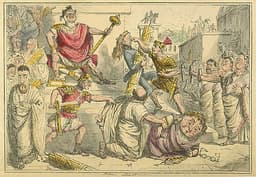
Lucius Tarquinius Superbus
Emperor · Ancient
51.5Total

Vasudeva I
Emperor · Ancient
54.5Total
Basic Information
Born
-535
190
Died
-509
230
Era
Ancient
Ancient
Nationality
Roman Kingdom
Kushan Empire
Occupation
Emperor
Emperor
Civilization
Western
Indian
Score Comparison
Military (10%)
25.0
67.5
Political (20%)
43.7
68.0
Influence (20%)
55.7
54.1
Legacy (20%)
50.0
44.2
Leadership (15%)
67.0
53.2
Strategy (15%)
60.0
50.0
TOTAL
51.5
54.5
Lucius Tarquinius Superbus — Complete Timeline
535 BC
Seizure of the ThronePolitical Action◆ Major
Lucius Tarquinius Superbus seized the throne by murdering his predecessor Servius Tullius with the help of his wife Tullia. He refused to hold elections or consult the Senate, ruling as an absolute monarch and establishing a reign of terror.
UsurpationTyrannyRoyal Murder
Impact: nationaldestructive
530 BC
Construction of the Temple of Jupiter Optimus MaximusCultural◆ Major
Tarquinius Superbus completed the construction of the Temple of Jupiter Optimus Maximus on the Capitoline Hill, a project begun by his father. This temple became the most important religious sanctuary in Rome, housing the Capitoline Triad and symbolizing Roman power.
Religious BuildingTempleCapitoline Hill
Impact: nationalconstructive
509 BC
War with the Rutuli and the Siege of ArdeaWar◆ Major
Tarquinius Superbus waged war against the Rutuli and besieged their city Ardea. The siege was prolonged and unsuccessful, and it was during this campaign that his son Sextus Tarquinius raped Lucretia, an event that sparked the rebellion leading to the monarchy's overthrow.
SiegeWarLucretia Incident
Impact: regionaldestructive
Expulsion from Rome and Establishment of the RepublicPolitical Action
Following the rape of Lucretia and a revolt led by Lucius Junius Brutus, Tarquinius Superbus was expelled from Rome along with his family. The monarchy was abolished, and the Roman Republic was established, with Brutus and Collatinus elected as the first consuls.
End of MonarchyRoman RepublicRevolution
Impact: global
508 BC
Attempted Restoration with Lars PorsenaWar◆ Major
Tarquinius Superbus sought help from Lars Porsena, king of Clusium, to regain the Roman throne. Porsena besieged Rome but eventually made peace with the Republic, abandoning Tarquinius's cause and forcing him into exile in Tusculum.
ExileSiege of RomeEtruscan Intervention
Impact: regional
Vasudeva I — Complete Timeline
195 AD
Issuance of Gold CoinageCultural
Vasudeva I issued extensive gold coinage, continuing the Kushan tradition of high-quality minting. His coins depict him in various poses, often with a trident or sacrificing at an altar, and they circulated widely across trade routes, indicating economic prosperity.
CoinageEconomyArt
Impact: regionalconstructive
200 AD
Consolidation of the Kushan EmpirePolitical Action◆ Major
Vasudeva I maintained the territorial integrity of the Kushan Empire, which stretched from Central Asia to northern India. He is considered the last great Kushan emperor, ruling from Peshawar and Mathura, and his reign marked the peak of Kushan power before decline.
Kushan EmpireTerritorial ControlStability
Impact: regionalconstructive
210 AD
Patronage of ShaivismCultural◆ Major
Vasudeva I was a Shaivite, and his coins prominently feature the god Shiva and his bull Nandi. This royal patronage helped establish Shaivism as a major sect within Hinduism, influencing religious practices in the Kushan realm.
ReligionShaivismCoinage
Impact: regionalconstructive
This comparison has not been analyzed yet.
One-time AI generation (~1 minute). Scores and timeline are already available below.
Rankings
🥇
Vasudeva ILeader
Mil: 67.5Pol: 68.0Inf: 54.1
54.5
🥈
Lucius Tarquinius Superbus
Mil: 25.0Pol: 43.7Inf: 55.7
51.5
+3.0 behind
How This Comparison Works
Algorithm
Each figure is scored on 6 dimensions (0—100 scale) based on structured historical data: Military (10%), Political (20%), Influence (20%), Legacy (20%), Leadership (15%), Strategy (15%). The weighted total produces the final ranking.
Data Sources
Scores are computed from structured sub-indicators in the database. Scale factors adjust for era (Ancient ×0.85, Modern ×1.0) and civilization size (Eastern ×1.05, Other ×0.80) to account for differences in population and military scale.
Maximum 3 Figures
Comparisons are limited to 2—3 figures to ensure readability and statistical meaningfulness.
Error Margins
±5 points per dimension — Sub-scores are derived from historical records with inherent uncertainty. Two figures within 5 points on a dimension should be considered roughly equivalent in that area.
Total Score Accuracy
±3 points overall — The weighted combination of 6 dimensions produces a total score with approximately ±3 points of uncertainty. Differences of less than 3 points are not statistically significant— the figures are effectively tied.
Known Limitations
- Historical records are incomplete and uneven across civilizations
- Figures from oral-tradition societies may be underrepresented
- Occupation labels can misclassify multi-role figures
- Scores measure capability and impact, not moral character
- Quantitative scoring is a comparison tool, not absolute truth
Capability Radar
Military (10%) — Battles & Warfare
Battles
30
60
Win Rate
35
65
Expansion
40
55
Political (20%) — Governance & Reform
Reform
30
50
Diplomacy
35
55
Economy
40
60
Influence (20%) — Cultural & Global Reach
Cultural
45
50
Global
50
35
Legacy (20%) — Historical Impact
Historical
60
45
Longevity
55
40
Leadership (15%) — Power & Stability
Tenure
50
65
Stability
20
55
Strategy (15%) — Tactics & Innovation
Strategy
45
60
Tactics
40
55
Reform
30
50
Similar Comparisons
Comments & Discussion
No comments yet. Be the first to share your thoughts!