Loading...
This comparison has not been analyzed yet.
One-time AI generation (~1 minute). Scores and timeline are already available below.
Magnus IV of Sweden vs Michael III
Michael III leads by 1.2 pts · 2 figures compared
…
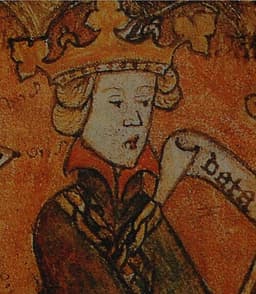
Magnus IV of Sweden
Emperor · Medieval
38.3Total

Michael III
Emperor · Medieval
39.5Total
Basic Information
Born
1316
840
Died
1374
867
Era
Medieval
Medieval
Nationality
Sweden
Byzantine Empire
Occupation
Emperor
Emperor
Civilization
Western
Western
Score Comparison
Military (10%)
21.2
50.0
Political (20%)
30.8
26.4
Influence (20%)
47.9
47.1
Legacy (20%)
37.5
38.3
Leadership (15%)
41.5
34.6
Strategy (15%)
39.6
39.6
TOTAL
38.3
39.5
Magnus IV of Sweden — Complete Timeline
1319 AD
Coronation as King of SwedenPolitical Action◆ Major
Magnus IV was crowned King of Sweden at the age of three, succeeding his grandfather Birger Magnusson. His minority led to a regency council ruling Sweden until he came of age.
CoronationMinority Rule
Impact: national
Union of Sweden and NorwayPolitical Action◆ Major
Magnus IV inherited the throne of Norway from his grandfather Haakon V, becoming king of both Sweden and Norway. This personal union united the two kingdoms under a single monarch for the first time.
UnionPersonal Union
Impact: regionalconstructive
1364 AD
Deposition by Swedish noblesPolitical Action◆ Major
Magnus IV was deposed by Swedish nobles led by Albert of Mecklenburg, who was elected king. Magnus was forced into exile in Norway, ending his rule over Sweden after 45 years.
DepositionNoble Revolt
Impact: nationaltragic
1374 AD
Death in exileOther
Magnus IV died in exile in Norway after being shipwrecked off the coast of Bergen. His death marked the end of the Swedish-Norwegian personal union, as Norway passed to his son Haakon VI.
DeathExile
Impact: nationaltragic
Michael III — Complete Timeline
842 AD
Accession as Emperor (842)Political Action◆ Major
Michael III became Byzantine emperor at age two after the death of his father Theophilos. His mother Theodora served as regent. His reign saw the final restoration of icon veneration and a cultural revival.
AccessionRegency
Impact: regional
843 AD
Restoration of Icon Veneration (843)Political Action
Under the regency of Theodora, the Council of Constantinople in 843 formally restored the veneration of icons, ending the second iconoclast period. This event is celebrated as the 'Triumph of Orthodoxy' in the Eastern Orthodox Church.
IconoclasmChurch CouncilReligious Policy
Impact: globalconstructive
863 AD
Mission to the Slavs (863)Cultural◆ Major
Michael III sponsored the mission of Saints Cyril and Methodius to the Slavs. They created the Glagolitic alphabet and translated the Bible into Old Church Slavonic, spreading Christianity and literacy among the Slavic peoples.
Missionary WorkAlphabetChristianization
Impact: globalconstructive
867 AD
Assassination by Basil I (867)Political Action◆ Major
Michael III was assassinated in his bedchamber by his co-emperor Basil I, who then became sole emperor. Michael's reign ended the Macedonian dynasty's rise. His death marked the beginning of the Macedonian Renaissance.
AssassinationCoup
Impact: regionaltragic
This comparison has not been analyzed yet.
One-time AI generation (~1 minute). Scores and timeline are already available below.
Rankings
🥇
Michael IIILeader
Mil: 50.0Pol: 26.4Inf: 47.1
39.5
🥈
Magnus IV of Sweden
Mil: 21.2Pol: 30.8Inf: 47.9
38.3
+1.2 behind
How This Comparison Works
Algorithm
Each figure is scored on 6 dimensions (0—100 scale) based on structured historical data: Military (10%), Political (20%), Influence (20%), Legacy (20%), Leadership (15%), Strategy (15%). The weighted total produces the final ranking.
Data Sources
Scores are computed from structured sub-indicators in the database. Scale factors adjust for era (Ancient ×0.85, Modern ×1.0) and civilization size (Eastern ×1.05, Other ×0.80) to account for differences in population and military scale.
Maximum 3 Figures
Comparisons are limited to 2—3 figures to ensure readability and statistical meaningfulness.
Error Margins
±5 points per dimension — Sub-scores are derived from historical records with inherent uncertainty. Two figures within 5 points on a dimension should be considered roughly equivalent in that area.
Total Score Accuracy
±3 points overall — The weighted combination of 6 dimensions produces a total score with approximately ±3 points of uncertainty. Differences of less than 3 points are not statistically significant— the figures are effectively tied.
Known Limitations
- Historical records are incomplete and uneven across civilizations
- Figures from oral-tradition societies may be underrepresented
- Occupation labels can misclassify multi-role figures
- Scores measure capability and impact, not moral character
- Quantitative scoring is a comparison tool, not absolute truth
Capability Radar
Military (10%) — Battles & Warfare
Battles
15
15
Win Rate
10
20
Expansion
5
10
Political (20%) — Governance & Reform
Reform
30
15
Diplomacy
25
20
Economy
20
15
Influence (20%) — Cultural & Global Reach
Cultural
15
10
Global
10
10
Legacy (20%) — Historical Impact
Historical
20
20
Longevity
15
10
Leadership (15%) — Power & Stability
Tenure
40
30
Stability
10
10
Strategy (15%) — Tactics & Innovation
Strategy
10
10
Tactics
10
10
Reform
5
5
Similar Comparisons
Comments & Discussion
No comments yet. Be the first to share your thoughts!