Loading...
This comparison has not been analyzed yet.
One-time AI generation (~1 minute). Scores and timeline are already available below.
Mahfud MD vs Rashid al-Ghannushi
Rashid al-Ghannushi leads by 6.5 pts · 2 figures compared
…
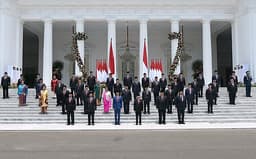
Mahfud MD
Politician · Modern
49.8Total

Rashid al-Ghannushi
Politician · Modern
56.3Total
Basic Information
Born
1957
1941
Died
—
—
Era
Modern
Modern
Nationality
Indonesia
Tunisia
Occupation
Politician
Politician
Civilization
Eastern
Middle Eastern
Score Comparison
Military (10%)
13.2
43.3
Political (20%)
60.0
68.0
Influence (20%)
55.7
62.0
Legacy (20%)
45.0
47.5
Leadership (15%)
78.0
68.0
Strategy (15%)
26.3
42.3
TOTAL
49.8
56.3
Mahfud MD — Complete Timeline
2008 AD
Appointed Chief Justice of the Constitutional CourtPolitical Action◆ Major
Mahfud MD was appointed Chief Justice of Indonesia's Constitutional Court. During his tenure, he oversaw several landmark decisions, including rulings on electoral disputes and constitutional amendments, enhancing the court's independence and credibility.
JudiciaryConstitutional CourtLegal Reform
Impact: nationalconstructive
2013 AD
Resigned as Chief Justice to Run for Vice PresidentPolitical Action
Mahfud MD resigned as Chief Justice of the Constitutional Court to pursue a vice presidential candidacy. He was ultimately not selected as a running mate, but his resignation marked a transition from judicial to political ambitions.
ResignationPolitical AmbitionTransition
Impact: national
2019 AD
Appointed Coordinating Minister for Political, Legal, and Security AffairsPolitical Action◆ Major
Mahfud MD was appointed Coordinating Minister for Political, Legal, and Security Affairs in President Joko Widodo's second cabinet. He oversaw national security policies, including counter-terrorism efforts and handling of separatist movements in Papua.
CabinetSecurityPolicy
Impact: nationalconstructive
Rashid al-Ghannushi — Complete Timeline
1981 AD
Co-founded the Ennahda MovementPolitical Action◆ Major
Al-Ghannushi co-founded the Islamic Tendency Movement (later Ennahda) in Tunisia, advocating for a democratic and Islamic political system. The movement was banned under President Habib Bourguiba, leading to al-Ghannushi's imprisonment and exile.
Political IslamTunisian PoliticsOpposition
Impact: nationalconstructive
1992 AD
Exiled to LondonPolitical Action◆ Major
After years of imprisonment and repression under President Zine El Abidine Ben Ali, al-Ghannushi was released and went into exile in London. From there, he continued to lead Ennahda and advocate for democratic reform in Tunisia.
ExileOppositionDemocracy
Impact: national
2011 AD
Returned to Tunisia after the RevolutionPolitical Action
Following the Tunisian Revolution that ousted Ben Ali, al-Ghannushi returned from exile. He led Ennahda to victory in the 2011 Constituent Assembly elections, becoming a key figure in Tunisia's democratic transition.
Arab SpringTunisian RevolutionDemocracy
Impact: nationalconstructive
2021 AD
Resigned as Ennahda LeaderPolitical Action◆ Major
Al-Ghannushi resigned as head of the Ennahda party after President Kais Saied suspended parliament and consolidated power. This marked a setback for the democratic transition and led to political crisis in Tunisia.
Political CrisisDemocracyResignation
Impact: nationaltragic
This comparison has not been analyzed yet.
One-time AI generation (~1 minute). Scores and timeline are already available below.
Rankings
🥇
Rashid al-GhannushiLeader
Mil: 43.3Pol: 68.0Inf: 62.0
56.3
🥈
Mahfud MD
Mil: 13.2Pol: 60.0Inf: 55.7
49.8
+6.5 behind
How This Comparison Works
Algorithm
Each figure is scored on 6 dimensions (0—100 scale) based on structured historical data: Military (10%), Political (20%), Influence (20%), Legacy (20%), Leadership (15%), Strategy (15%). The weighted total produces the final ranking.
Data Sources
Scores are computed from structured sub-indicators in the database. Scale factors adjust for era (Ancient ×0.85, Modern ×1.0) and civilization size (Eastern ×1.05, Other ×0.80) to account for differences in population and military scale.
Maximum 3 Figures
Comparisons are limited to 2—3 figures to ensure readability and statistical meaningfulness.
Error Margins
±5 points per dimension — Sub-scores are derived from historical records with inherent uncertainty. Two figures within 5 points on a dimension should be considered roughly equivalent in that area.
Total Score Accuracy
±3 points overall — The weighted combination of 6 dimensions produces a total score with approximately ±3 points of uncertainty. Differences of less than 3 points are not statistically significant— the figures are effectively tied.
Known Limitations
- Historical records are incomplete and uneven across civilizations
- Figures from oral-tradition societies may be underrepresented
- Occupation labels can misclassify multi-role figures
- Scores measure capability and impact, not moral character
- Quantitative scoring is a comparison tool, not absolute truth
Capability Radar
Military (10%) — Battles & Warfare
Battles
17
25
Win Rate
15
24
Expansion
20
25
Political (20%) — Governance & Reform
Reform
60
55
Diplomacy
55
65
Economy
50
40
Influence (20%) — Cultural & Global Reach
Cultural
40
50
Global
35
50
Legacy (20%) — Historical Impact
Historical
40
45
Longevity
30
40
Leadership (15%) — Power & Stability
Tenure
65
60
Stability
55
45
Strategy (15%) — Tactics & Innovation
Strategy
26
29
Tactics
28
32
Reform
27
36
Similar Comparisons
Comments & Discussion
No comments yet. Be the first to share your thoughts!