Loading...
Mahfud MD vs Napoleon Bonaparte
Napoleon Bonaparte leads by 21.1 pts · 2 figures compared
…
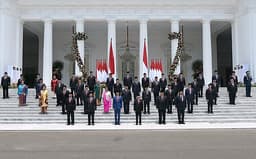
Mahfud MD
Politician · Modern
49.8Total

Napoleon Bonaparte
General · Modern
70.9Total
Basic Information
Born
1957
1769
Died
—
1821
Era
Modern
Modern
Nationality
Indonesia
France
Occupation
Politician
General
Civilization
Eastern
Western
Score Comparison
Military (10%)
13.2
94.0
Political (20%)
60.0
72.0
Influence (20%)
55.7
40.0
Legacy (20%)
45.0
80.0
Leadership (15%)
78.0
78.0
Strategy (15%)
26.3
90.0
TOTAL
49.8
70.9
Mahfud MD — Complete Timeline
2008 AD
Appointed Chief Justice of the Constitutional CourtPolitical Action◆ Major
Mahfud MD was appointed Chief Justice of Indonesia's Constitutional Court. During his tenure, he oversaw several landmark decisions, including rulings on electoral disputes and constitutional amendments, enhancing the court's independence and credibility.
JudiciaryConstitutional CourtLegal Reform
Impact: nationalconstructive
2013 AD
Resigned as Chief Justice to Run for Vice PresidentPolitical Action
Mahfud MD resigned as Chief Justice of the Constitutional Court to pursue a vice presidential candidacy. He was ultimately not selected as a running mate, but his resignation marked a transition from judicial to political ambitions.
ResignationPolitical AmbitionTransition
Impact: national
2019 AD
Appointed Coordinating Minister for Political, Legal, and Security AffairsPolitical Action◆ Major
Mahfud MD was appointed Coordinating Minister for Political, Legal, and Security Affairs in President Joko Widodo's second cabinet. He oversaw national security policies, including counter-terrorism efforts and handling of separatist movements in Papua.
CabinetSecurityPolicy
Impact: nationalconstructive
Napoleon Bonaparte — Complete Timeline
1799 AD
Coup of 18 BrumaireOther◆ Major
Napoleon Bonaparte, with support from his brother Lucien and key political figures, overthrew the Directory in a bloodless coup. He established the Consulate with himself as First Consul, effectively becoming the ruler of France. This event ended the French Revolution's most unstable period.
French RevolutionCoupRise to Power
Impact: regional
1804 AD
Promulgation of the Napoleonic CodeOther◆ Major
Napoleon enacted the Civil Code of the French, known as the Napoleonic Code, a comprehensive set of laws that replaced the fragmented feudal legal systems. The code established legal equality, protected property rights, and secularized law. It became the basis for legal systems in many European and world countries.
Legal ReformNapoleonic CodeCivil Law
Impact: globalconstructive
1805 AD
Battle of AusterlitzWar◆ Major
Napoleon's Grande Arm
Napoleonic WarsBattleDecisive Victory
Impact: global
1812 AD
Invasion of RussiaWar◆ Major
Napoleon led the Grande Arm
Napoleonic WarsInvasionDisaster
Impact: globaldestructive
1815 AD
Battle of WaterlooWar◆ Major
Napoleon's French army was defeated by the combined forces of the Duke of Wellington's Anglo-Allied army and Gebhard Leberecht von Bl
Napoleonic WarsBattleFinal Defeat
Impact: globaldestructive
Expert Analysis
mahfud-md-vs-napoleon-bonaparte
# The Emperor and the Judge: Two Paths to Power in Different Worlds
On a June morning in 1815, Napoleon Bonaparte stood on the muddy fields of Waterloo, watching his Imperial Guard crumble under British fire. Less than two centuries later and half a world away, in a modest courtroom in Jakarta, a soft-spoken law professor named Mahfud MD prepared to deliver a verdict that would reshape Indonesia’s democracy. One man commanded armies that stretched from Madrid to Moscow; the other commanded only a gavel and the weight of constitutional reasoning. Yet both shaped history in ways their societies would never forget. What drove these two figures—so different in ambition, method, and scale—to leave such lasting marks on their worlds?
Origins
Napoleon was born in 1769 on the Mediterranean island of Corsica, a place that had only recently become French. His family was minor nobility, poor by aristocratic standards but proud. The young Napoleon carried the accent of an outsider, the simmering resentment of a conquered people, and a burning hunger to prove himself. France in the 1780s was a powder keg of revolution, and Napoleon was a boy who read military treatises the way others read novels. By age 24, he had already commanded artillery at the Siege of Toulon.
Mahfud MD was born in 1957 in a small village on Madura, an arid, impoverished island off Java’s coast. Indonesia was then emerging from Dutch colonial rule, a sprawling archipelago of hundreds of languages and faiths, struggling to cohere as a nation. His father was a farmer, his mother a seller of traditional cakes. Unlike Napoleon, Mahfud had no inheritance of status—only the quiet discipline of a santri, a student of Islamic boarding schools, who learned to memorize texts and debate ethics before he learned to argue law.
Their eras could not have been more different. Napoleon came of age when Europe was tearing down old monarchies and building empires with cannon fire. Mahfud came of age when post-colonial Asia was building institutions—courts, constitutions, bureaucracies—out of the rubble of empire. One world valued conquest; the other valued consensus.
Rise to Power
Napoleon’s rise was explosive. In 1796, at just 26, he was given command of the French army in Italy, a ragtag force of starving soldiers. Within months, he had won six battles, forced Austria to the negotiating table, and returned to Paris a hero. He understood that in revolutionary France, military glory was the fastest currency for political power. By 1799, he staged a coup d’état and became First Consul. By 1804, he crowned himself Emperor, taking the crown from the Pope’s hands and placing it on his own head—a gesture of pure, unapologetic will.
Mahfud’s rise was slow, methodical, and legal. He studied law at Gadjah Mada University, then earned a doctorate in constitutional law. He entered politics through the Muslim intellectual movement, serving as a member of parliament and later as a minister under President Abdurrahman Wahid. But his defining moment came in 2008, when he was appointed Chief Justice of Indonesia’s Constitutional Court. This was not a battlefield promotion; it was a recognition of his scholarly integrity. In a country where corruption was endemic, Mahfud gained a reputation for refusing bribes and deciding cases on principle. He did not seize power—he was entrusted with it.
Leadership & Governance
Napoleon governed like a general. He centralized France under a strong executive, created the Bank of France to stabilize the currency, and most famously, codified French law into the Napoleonic Code—a rational, secular system that replaced feudal chaos with clear rules. His military genius was staggering: he won over sixty battles, outmaneuvering larger armies through speed, deception, and the ruthless concentration of force. But his political wisdom was brittle. He could not compromise, could not share power, and could not stop expanding. His score of 75.0 in political skill reflects a leader who excelled at conquest but failed at lasting governance.
Mahfud governed like a judge. As Chief Justice, he oversaw landmark rulings that strengthened Indonesia’s democratic institutions—deciding disputes over election laws, corruption cases, and regional autonomy. He did not command armies; he commanded arguments. His leadership score of 89.7, significantly higher than Napoleon’s 80.0, reflects a different kind of authority: one based on trust, not fear. Where Napoleon demanded loyalty, Mahfud earned credibility. Where Napoleon crushed dissent, Mahfud invited deliberation.
Triumph & Tragedy
Napoleon’s greatest moment was Austerlitz in 1805, where he destroyed a combined Russian-Austrian army in a battle so perfect it is still studied in military academies. His greatest tragedy was the invasion of Russia in 1812—a catastrophic miscalculation that cost half a million lives and destroyed his Grand Army. He was exiled to Elba, escaped, ruled for a hundred days, and was finally defeated at Waterloo. He died in 1821 on the remote island of Saint Helena, a prisoner of the British, still insisting he had been right.
Mahfud’s greatest moment came not on a battlefield but in a courtroom. His tenure at the Constitutional Court gave Indonesia a decade of relative legal stability, helping to prevent the kind of authoritarian backsliding that plagued other young democracies. His tragedy was more subtle: in 2013, he resigned to run for vice president and lost. The ambition that drove him to seek higher office also cost him his most powerful platform. He returned to government in 2019 as Coordinating Minister for Political, Legal, and Security Affairs, but his influence was now constrained by the bureaucracy he once oversaw from the bench.
Character & Destiny
Napoleon was driven by an insatiable ego. “I am not a man,” he once said, “but a thing.” He saw himself as an instrument of destiny, which meant he could justify any cruelty, any war, any betrayal. His character was his fate: the same ambition that lifted him from Corsican obscurity to the throne of Europe also drove him to ruin. He could not stop because he could not imagine himself stopped.
Mahfud was driven by a different force: the belief that law could hold a fractious nation together. His Javanese and Madurese background taught him the value of *musyawarah*—deliberation and consensus. His Islamic education taught him the importance of justice. His character was not destined for dramatic tragedy but for steady, unglamorous service. He did not change the world; he helped keep his country from falling apart.
Legacy
Napoleon’s legacy is written across Europe: the Napoleonic Code influenced civil law systems from France to Brazil to Egypt. He redrew borders, ended feudalism, and inspired nationalism. His score of 82.4 overall, with a military score of 94.0, places him among the most consequential figures in Western history. But his legacy is also one of war, destruction, and the dangerous allure of the “great man” theory of history.
Mahfud’s legacy is quieter. His score of 67.9 overall reflects a more modest scale of impact, but it is no less real for being local. He helped establish the principle that Indonesia’s Constitutional Court could check the power of presidents and parliaments. In a nation of 270 million people, 700 languages, and a history of military rule, that is no small achievement.
Conclusion
Standing at the end of their lives, Napoleon and Mahfud would have understood each other poorly. The Emperor would have seen the Judge as a clerk, a man who argued about paragraphs while empires were won and lost. The Judge would have seen the Emperor as a cautionary tale—a man of brilliant talent undone by the refusal to accept limits.
Yet both were men who rose from nowhere to shape their nations. Napoleon proved that one man could remake a continent; Mahfud proved that one man could help a country keep its promises. The difference was not in talent but in the worlds they inhabited—and the choices they made within them. One chose glory. The other chose order. History remembers both, but it learns more from the one who knew when to stop.
Rankings
🥇
Napoleon BonaparteLeader
Mil: 94.0Pol: 72.0Inf: 40.0
70.9
🥈
Mahfud MD
Mil: 13.2Pol: 60.0Inf: 55.7
49.8
+21.1 behind
How This Comparison Works
Algorithm
Each figure is scored on 6 dimensions (0—100 scale) based on structured historical data: Military (10%), Political (20%), Influence (20%), Legacy (20%), Leadership (15%), Strategy (15%). The weighted total produces the final ranking.
Data Sources
Scores are computed from structured sub-indicators in the database. Scale factors adjust for era (Ancient ×0.85, Modern ×1.0) and civilization size (Eastern ×1.05, Other ×0.80) to account for differences in population and military scale.
Maximum 3 Figures
Comparisons are limited to 2—3 figures to ensure readability and statistical meaningfulness.
Error Margins
±5 points per dimension — Sub-scores are derived from historical records with inherent uncertainty. Two figures within 5 points on a dimension should be considered roughly equivalent in that area.
Total Score Accuracy
±3 points overall — The weighted combination of 6 dimensions produces a total score with approximately ±3 points of uncertainty. Differences of less than 3 points are not statistically significant— the figures are effectively tied.
Known Limitations
- Historical records are incomplete and uneven across civilizations
- Figures from oral-tradition societies may be underrepresented
- Occupation labels can misclassify multi-role figures
- Scores measure capability and impact, not moral character
- Quantitative scoring is a comparison tool, not absolute truth
Capability Radar
Military (10%) — Battles & Warfare
Battles
17
95
Win Rate
15
90
Expansion
20
95
Political (20%) — Governance & Reform
Reform
60
95
Diplomacy
55
80
Economy
50
85
Influence (20%) — Cultural & Global Reach
Cultural
40
85
Global
35
90
Legacy (20%) — Historical Impact
Historical
40
95
Longevity
30
90
Leadership (15%) — Power & Stability
Tenure
65
85
Stability
55
70
Strategy (15%) — Tactics & Innovation
Strategy
26
95
Tactics
28
98
Reform
27
92
Similar Comparisons
Comments & Discussion
Grenadier's Ghost6/17/2026
Calling this a comparison is an insult to every soldier who marched under the Eagle. Mahfud MD is a constitutional scholar who served his republic with honor. Napoleon? He abandoned his army in Egypt, betrayed the Revolution, and bled Europe dry for his ego. There's no "two paths to power" here—one man upheld law, the other burned it for a crown. Waterloo wasn't a tragedy; it was France's overdue bill.
宪法炮手6/17/2026
拿破仑和玛赫夫德?这不是比较,是时代错位的笑话。拿破仑用大炮打下帝国,最后死在流放地;玛赫夫德用宪法条文保护民主,至今还活着教书。一个追求荣耀,一个追求正义。我选后者。法国人以为滑铁卢是终点,但印尼人知道:真正的权力不在刺刀尖上,而在判决书里。
Data Dialectic6/17/2026
Let's strip the romance: Napoleon commanded millions into battle and left 400,000 dead in Russia alone. Mahfud MD oversaw legal decisions that affected 270 million people. Scale isn't everything—one man's "glory" is another's statistical carnage. The comparison holds only if we equate body counts with influence. I'd take a 1-0 ruling that preserves democracy over a 7-2 coalition that buries it.
古典学哨兵6/17/2026
拿破仑模仿凯撒,玛赫夫德更像西塞罗。一个用军团改写地图,一个用修辞重塑法律。拿破仑的《民法典》固然伟大,但那是征服的副产品;玛赫夫德的判决直接来自宪政辩论,是公民理性的产物。历史不是只有武力才配叫权力。罗马有广场,印尼有宪法法院;两者都创造了秩序,但方式截然不同。
Revisionist Reckoning6/17/2026
You people romanticize Napoleon like he was some tragic genius. He was a military dictator who crushed the Haitian Revolution, restored slavery, and crowned himself emperor. Mahfud MD? He stood up to Suharto's autocracy, defended judicial independence, and never declared himself above the law. The comparison should shame Mahfud, not honor him. One man's ambition consumed lives; the other's service built institutions.