Loading...
Manuel L. Quezon vs Thomas Klestil
Manuel L. Quezon leads by 1.6 pts · 2 figures compared
…
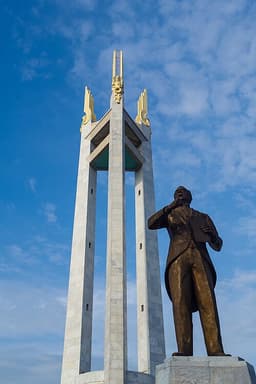
Manuel L. Quezon
Politician · Modern
53.8Total

Thomas Klestil
Politician · Modern
52.2Total
Basic Information
Born
1878
1932
Died
1944
—
Era
Modern
Modern
Nationality
Philippines
Austria
Occupation
Politician
Politician
Civilization
Eastern
Western
Score Comparison
Military (10%)
10.7
50.0
Political (20%)
72.0
68.0
Influence (20%)
62.0
51.8
Legacy (20%)
52.0
40.0
Leadership (15%)
66.0
66.0
Strategy (15%)
35.3
41.7
TOTAL
53.8
52.2
Manuel L. Quezon — Complete Timeline
1934 AD
Signed the Tydings-McDuffie ActPolitical Action◆ Major
Quezon, as president of the Philippine Senate, negotiated and secured the passage of the Tydings-McDuffie Act in the U.S. Congress. This act established the Philippine Commonwealth and set a 10-year transition period to full independence.
LegislationIndependenceU.S.-Philippines Relations
Impact: nationalconstructive
1935 AD
Became First President of the Philippine CommonwealthPolitical Action
Manuel L. Quezon was elected as the first president of the Philippine Commonwealth, a transitional government established under U.S. sovereignty leading to full independence. He was inaugurated on November 15, 1935.
PresidencyCommonwealthIndependence
Impact: nationalconstructive
1937 AD
Established the National Language (Filipino)Cultural◆ Major
Quezon proclaimed Tagalog as the basis of the national language of the Philippines, later named Filipino. This decision aimed to unify the diverse linguistic groups of the archipelago and promote national identity.
Language PolicyNational IdentityCultural Unification
Impact: nationalconstructive
1942 AD
Went into Exile During Japanese OccupationPolitical Action◆ Major
After the Japanese invasion of the Philippines, Quezon fled to the United States, establishing a government-in-exile in Washington, D.C. He continued to lead the Commonwealth government and advocate for Philippine interests during World War II.
ExileWorld War IIGovernment-in-Exile
Impact: national
1944 AD
Died in ExileOther
Quezon died of tuberculosis in Saranac Lake, New York, while still in exile. His death occurred before the liberation of the Philippines, and he was succeeded by Vice President Sergio Osme
DeathExileWorld War II
Impact: nationaltragic
Thomas Klestil — Complete Timeline
1992 AD
Elected President of AustriaPolitical Action◆ Major
Thomas Klestil was elected President of Austria on May 24, 1992, winning 56.9% of the vote against Rudolf Streicher. He took office on July 8, 1992, succeeding Kurt Waldheim.
Presidential ElectionConservative Victory
Impact: nationalconstructive
1998 AD
Re-elected President of AustriaPolitical Action◆ Major
Klestil was re-elected for a second term on April 19, 1998, winning 63.4% of the vote. His re-election was seen as a vote of confidence in his non-partisan approach to the presidency.
Re-electionPresidential Term
Impact: nationalconstructive
2004 AD
Death Two Days Before Leaving OfficeOther◆ Major
Klestil died on July 6, 2004, just two days before his second term was scheduled to end. He suffered a heart attack. His death led to a brief constitutional crisis, with the presidency temporarily assumed by the three National Council presidents.
Death in OfficeConstitutional Crisis
Impact: nationaltragic
Expert Analysis
Origins
Manuel L. Quezon was born on August 19, 1878, in Baler, Tayabas (now Quezon province), Philippines, to a Spanish mestizo family. His father, Lucio Quezon, was a primary school teacher, and his mother, Maria Dolores Molina, was a homemaker. He studied law at the University of Santo Tomas, earning his degree in 1903. Quezon's early career included serving as a provincial fiscal and later as a representative in the Philippine Assembly. In contrast, Thomas Klestil was born on November 4, 1932, in Vienna, Austria, to a working-class family; his father was a tram conductor. Klestil studied commerce at the University of World Trade in Vienna, earning a doctorate in 1957. He began his career in the Austrian civil service, joining the Federal Ministry of Finance in 1959.
Rise to Power
Quezon's rise began in 1906 when he was elected governor of Tayabas. He became a member of the Philippine Assembly in 1907 and was elected Senate President in 1916. His key turning point came in 1934 when he led the Philippine independence mission to Washington, securing the Tydings-McDuffie Act, which established the Philippine Commonwealth. He was elected its first president in 1935, winning 68% of the vote. Klestil's ascent was more gradual. He served as Austria's ambassador to the United Nations (1978-1982) and to the United States (1982-1987). In 1992, he ran for president as an independent, defeating the Social Democratic candidate Rudolf Streicher with 56.9% of the vote. His victory was notable as he broke the traditional party hold on the presidency.
Leadership & Governance
Quezon's leadership was characterized by strong centralization and nation-building. He established the National Economic Council, promoted land reform, and created the National Language Institute. His governance score of 72.0 reflects his political skill, though his military score is only 10.7, as he relied on the US for defense. Klestil, with a political score of 68.0, focused on ceremonial duties but also advocated for European integration and human rights. He faced criticism for his handling of the Waldheim affair, but his leadership style was consensus-oriented. Both scored 66.0 in leadership, indicating effective but not transformative command.
Triumph & Tragedy
Quezon's greatest triumph was securing the Tydings-McDuffie Act, which set the Philippines on a path to independence. He also unified the country linguistically by establishing Filipino as the national language. His tragedy was his exile during World War II; he fled the Japanese invasion in 1942 and died in the United States on August 1, 1944, never seeing the Philippines liberated. Klestil's triumph was his re-election in 1998 with 63.4% of the vote, a mandate for his non-partisan approach. His tragedy was his death on July 6, 2004, just two days before his term ended, creating a constitutional crisis. His legacy score of 40.0 reflects his limited long-term impact.
Character & Destiny
Quezon was known for his charisma and authoritarian tendencies. He once said, "I would rather have a government run like hell by Filipinos than a government run like heaven by Americans." His decision to go into exile was criticized, but he continued to advocate for Philippine independence from abroad. Klestil was seen as a pragmatic and dignified statesman. His character was shaped by his diplomatic background, leading to a cautious but principled presidency. His sudden death underscored the fragility of political life.
Legacy
Quezon's legacy is profound in the Philippines. He is remembered as the "Father of the National Language" and the first president of the Commonwealth. His influence score of 62.0 reflects his role in shaping Philippine democracy. The province of Quezon and many institutions bear his name. Klestil's legacy is more modest; he is remembered as a president who modernized the office and promoted Austria's role in Europe. However, his influence is limited outside Austria, with a legacy score of 40.0.
Conclusion
Manuel L. Quezon had a greater impact than Thomas Klestil, despite a narrow score gap of 1.6 points (53.8 vs 52.2). Quezon's role in establishing the Philippine Commonwealth and setting the foundation for independence is historically significant. Klestil's presidency, while competent, did not transform Austria. Quezon's political score of 72.0 and influence of 62.0 outweigh Klestil's 68.0 and 51.8. Therefore, Quezon's legacy is more enduring.
Rankings
🥇
Manuel L. QuezonLeader
Mil: 10.7Pol: 72.0Inf: 62.0
53.8
🥈
Thomas Klestil
Mil: 50.0Pol: 68.0Inf: 51.8
52.2
+1.6 behind
How This Comparison Works
Algorithm
Each figure is scored on 6 dimensions (0—100 scale) based on structured historical data: Military (10%), Political (20%), Influence (20%), Legacy (20%), Leadership (15%), Strategy (15%). The weighted total produces the final ranking.
Data Sources
Scores are computed from structured sub-indicators in the database. Scale factors adjust for era (Ancient ×0.85, Modern ×1.0) and civilization size (Eastern ×1.05, Other ×0.80) to account for differences in population and military scale.
Maximum 3 Figures
Comparisons are limited to 2—3 figures to ensure readability and statistical meaningfulness.
Error Margins
±5 points per dimension — Sub-scores are derived from historical records with inherent uncertainty. Two figures within 5 points on a dimension should be considered roughly equivalent in that area.
Total Score Accuracy
±3 points overall — The weighted combination of 6 dimensions produces a total score with approximately ±3 points of uncertainty. Differences of less than 3 points are not statistically significant— the figures are effectively tied.
Known Limitations
- Historical records are incomplete and uneven across civilizations
- Figures from oral-tradition societies may be underrepresented
- Occupation labels can misclassify multi-role figures
- Scores measure capability and impact, not moral character
- Quantitative scoring is a comparison tool, not absolute truth
Capability Radar
Military (10%) — Battles & Warfare
Battles
16
28
Win Rate
20
32
Expansion
19
35
Political (20%) — Governance & Reform
Reform
70
45
Diplomacy
60
65
Economy
55
50
Influence (20%) — Cultural & Global Reach
Cultural
55
20
Global
55
20
Legacy (20%) — Historical Impact
Historical
60
25
Longevity
50
15
Leadership (15%) — Power & Stability
Tenure
65
60
Stability
50
55
Strategy (15%) — Tactics & Innovation
Strategy
22
37
Tactics
24
42
Reform
32
41
Similar Comparisons
Comments & Discussion
No comments yet. Be the first to share your thoughts!