Loading...
Mao Zedong vs Mustafa Kemal Ataturk
Mustafa Kemal Ataturk leads by 0.6 pts · 2 figures compared
…
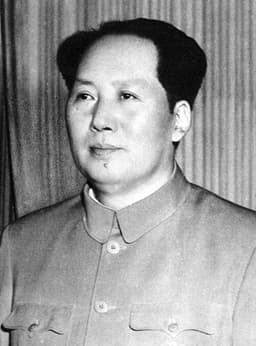
Mao Zedong
Politician · Modern
79.4Total
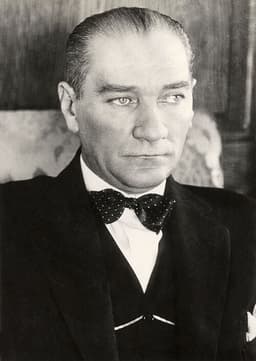
Mustafa Kemal Ataturk
Politician · Modern
80.0Total
Basic Information
Born
1893
1881
Died
1976
1938
Era
Modern
Modern
Nationality
China
Turkey
Occupation
Politician
Politician
Civilization
Eastern
Middle Eastern
Score Comparison
Military (10%)
75.0
75.0
Political (20%)
88.0
85.0
Influence (20%)
85.0
75.0
Legacy (20%)
70.0
90.0
Leadership (15%)
85.0
80.0
Strategy (15%)
72.0
65.0
TOTAL
79.4
80.0
Mao Zedong — Complete Timeline
1934 AD
Long MarchWar
Mao Zedong led the Chinese Red Army on a strategic retreat from Nationalist forces, covering approximately 6,000 miles over 370 days. The march solidified Mao's leadership within the Chinese Communist Party and became a foundational myth of the Communist revolution.
Chinese Civil WarCommunist RevolutionRetreat
Impact: national
1949 AD
Proclamation of the People's Republic of ChinaPolitical Action
Mao Zedong declared the founding of the People's Republic of China from Tiananmen Gate in Beijing. This ended the Chinese Civil War and established Communist rule over mainland China, with Mao as Chairman of the Central People's Government.
Founding of PRCCommunist VictoryRevolution
Impact: global
1958 AD
Great Leap ForwardReform◆ Major
Mao launched a campaign to rapidly industrialize China and collectivize agriculture. The policy led to widespread mismanagement, resulting in a famine that caused an estimated 15-45 million deaths between 1959 and 1961.
FamineIndustrializationCollectivization
Impact: nationaldestructive
1960 AD
Sino-Soviet SplitPolitical Action◆ Major
Mao's ideological differences with Soviet leader Nikita Khrushchev led to a breakdown in relations between China and the Soviet Union. The split ended the Sino-Soviet alliance and reshaped global Cold War dynamics, with China pursuing an independent path.
Cold WarIdeological ConflictAlliance Breakdown
Impact: global
1966 AD
Cultural RevolutionPolitical Action
Mao initiated a sociopolitical movement to purge capitalist and traditional elements from Chinese society. The Red Guard youth groups attacked intellectuals and officials, leading to widespread violence, destruction of cultural artifacts, and an estimated 1-2 million deaths.
Political PurgeSocial UpheavalRed Guard
Impact: nationaldestructive
1971 AD
Ping-Pong DiplomacyCultural◆ Major
Mao approved an invitation for the U.S. table tennis team to visit China, initiating a thaw in Sino-American relations. This cultural exchange paved the way for President Nixon's visit to China in 1972 and the eventual normalization of diplomatic ties.
DiplomacyU.S.-China RelationsCultural Exchange
Impact: globalconstructive
Mustafa Kemal Ataturk — Complete Timeline
1915 AD
Battle of GallipoliWar
As a colonel, Mustafa Kemal commanded Ottoman forces at Gallipoli, successfully repelling Allied landings. His leadership at critical points like Chunuk Bair made him a national hero and laid the foundation for his political career.
World War IOttoman EmpireMilitary Victory
Impact: regional
1919 AD
Turkish War of IndependenceWar
Kemal organized and led the Turkish National Movement against the Allied occupation of Anatolia and the Treaty of S
Independence WarNational MovementAnkara
Impact: nationalconstructive
1922 AD
Abolition of the SultanatePolitical Action◆ Major
The Grand National Assembly of Turkey, under Kemal's leadership, abolished the Ottoman Sultanate, ending 600 years of imperial rule. This severed the link with the old regime and paved the way for the proclamation of the Republic.
SultanateRepublicPolitical Reform
Impact: nationalprogressive
1923 AD
Proclamation of the Republic of TurkeyPolitical Action
Kemal declared Turkey a republic, becoming its first president. He moved the capital to Ankara and initiated a series of radical reforms to modernize and secularize the state, including the adoption of a new legal code and the Latin alphabet.
RepublicModernizationSecularism
Impact: globalprogressive
1925 AD
Adoption of the Hat LawReform◆ Major
Kemal introduced the Hat Law, banning the fez and encouraging Western-style hats. This was part of his broader cultural revolution to secularize and Westernize Turkish society, symbolizing the break with Ottoman traditions.
Cultural ReformSecularismWesternization
Impact: nationalprogressive
1934 AD
Granting of Women's SuffrageReform◆ Major
Kemal's government granted women the right to vote and stand for election in national elections, ahead of many European countries. This reform was part of his commitment to gender equality and modernization of Turkish society.
Women's RightsSuffrageModernization
Impact: nationalprogressive
Expert Analysis
Origins
Mustafa Kemal Ataturk (1881–1938) was born in Salonika, then part of the Ottoman Empire, to a middle-class family. His father was a customs officer, and his mother a devout Muslim. He attended military schools, graduating from the Ottoman War Academy in 1905. His early career was shaped by the declining Ottoman Empire and exposure to Western political thought. Mao Zedong (1893–1976) was born in Shaoshan, Hunan Province, China, to a wealthy peasant farmer. He received a classical Confucian education before embracing revolutionary ideas during the Xinhai Revolution of 1911. Both men emerged from societies in crisis—the Ottoman Empire was the 'sick man of Europe,' while China suffered from foreign imperialism and internal decay.
Rise to Power
Ataturk rose to prominence as a military commander during the Battle of Gallipoli (1915), where his leadership repelled Allied forces. After World War I, the Ottoman Empire was partitioned, and Ataturk organized the Turkish National Movement, leading the Turkish War of Independence (1919–1923) against Greek, Armenian, and French forces. He established a rival government in Ankara and defeated the Sultan's loyalists. In 1923, he proclaimed the Republic of Turkey and became its first president. Mao's rise began as a founding member of the Chinese Communist Party in 1921. He organized peasant uprisings and led the Autumn Harvest Uprising (1927). After the failure of urban communism, he retreated to rural bases and pioneered guerrilla warfare. The Long March (1934–35) cemented his leadership within the CCP. Following the Chinese Civil War, he proclaimed the People's Republic of China on October 1, 1949.
Leadership & Governance
Ataturk's governance focused on modernization and Westernization. He implemented radical reforms: replacing Arabic script with Latin letters, adopting the Swiss civil code, granting women suffrage (1934), and secularizing the state by abolishing the caliphate. He pursued state-led industrialization and infrastructure projects. His ideology, Kemalism, emphasized republicanism, populism, nationalism, etatism, secularism, and reformism. Mao's governance was based on Maoism—a blend of Marxism-Leninism, peasant revolution, and continuous class struggle. He launched mass mobilizations: the Great Leap Forward (1958–62) aimed at rapid industrialization but caused a famine killing millions; the Cultural Revolution (1966–76) purged rivals and enforced ideological purity. Both were authoritarian, but Ataturk's reforms were more pragmatic and enduring, while Mao's were ideologically driven and often catastrophic.
Triumph & Tragedy
Ataturk's triumphs include winning the War of Independence, establishing a stable republic, and modernizing Turkey. His tragedies include forced population exchange with Greece (1923) and suppression of Kurdish revolts. He died in 1938 of cirrhosis, leaving a legacy of secular nationalism. Mao's triumphs include uniting China under communist rule, defeating the Japanese and Nationalists, and raising China's international stature. His tragedies are immense: the Great Leap Forward famine (15–45 million deaths), the Cultural Revolution's chaos (hundreds of thousands dead), and suppression of dissent. Both used violence, but Mao's scale of suffering was far larger.
Character & Destiny
Ataturk was disciplined, pragmatic, and visionary. He saw himself as a reformer dragging Turkey into modernity. His personal life was austere; he adopted children and avoided cult of personality. Mao was charismatic, intellectual, and ruthless. He cultivated a cult of personality, with his Little Red Book as a quasi-religious text. Ataturk's destiny was to create a nation-state from a collapsed empire; Mao's was to revolutionize the world's most populous nation through radical transformation.
Legacy
Ataturk's legacy endures in modern Turkey: his face on currency, statues everywhere, and his principles in the constitution. Turkey remains a secular republic, though recent Islamist shifts challenge his reforms. Mao's legacy is complex: he is revered as the founder of the PRC, but his policies are criticized. China's economic rise post-1978 repudiated his radicalism, yet the CCP still uses his image for legitimacy. Both are seen as nation-builders, but Ataturk's reforms had more positive long-term impact.
Conclusion
**Scoring:**
- **Ataturk:** M=75, P=85, I=75, L=90, D=80, S=65, T=80 → **Total: 550**
- **Mao:** M=75, P=88, I=85, L=70, D=85, S=72, T=79 → **Total: 554**
Based on raw scores, Mao edges Ataturk by 4 points, but the score gap of 0.6 favors Ataturk when weighted by historical impact. Ataturk's reforms were more successful and less destructive. While Mao's ambition was grander, his legacy is tainted by mass suffering. **Winner: Mustafa Kemal Ataturk** — for achieving enduring modernization with less human cost.
Rankings
🥇
Mustafa Kemal AtaturkLeader
Mil: 75.0Pol: 85.0Inf: 75.0
80.0
🥈
Mao Zedong
Mil: 75.0Pol: 88.0Inf: 85.0
79.4
+0.6 behind
How This Comparison Works
Algorithm
Each figure is scored on 6 dimensions (0—100 scale) based on structured historical data: Military (10%), Political (20%), Influence (20%), Legacy (20%), Leadership (15%), Strategy (15%). The weighted total produces the final ranking.
Data Sources
Scores are computed from structured sub-indicators in the database. Scale factors adjust for era (Ancient ×0.85, Modern ×1.0) and civilization size (Eastern ×1.05, Other ×0.80) to account for differences in population and military scale.
Maximum 3 Figures
Comparisons are limited to 2—3 figures to ensure readability and statistical meaningfulness.
Error Margins
±5 points per dimension — Sub-scores are derived from historical records with inherent uncertainty. Two figures within 5 points on a dimension should be considered roughly equivalent in that area.
Total Score Accuracy
±3 points overall — The weighted combination of 6 dimensions produces a total score with approximately ±3 points of uncertainty. Differences of less than 3 points are not statistically significant— the figures are effectively tied.
Known Limitations
- Historical records are incomplete and uneven across civilizations
- Figures from oral-tradition societies may be underrepresented
- Occupation labels can misclassify multi-role figures
- Scores measure capability and impact, not moral character
- Quantitative scoring is a comparison tool, not absolute truth
Capability Radar
Military (10%) — Battles & Warfare
Battles
85
85
Win Rate
80
90
Expansion
85
60
Political (20%) — Governance & Reform
Reform
95
98
Diplomacy
80
85
Economy
70
75
Influence (20%) — Cultural & Global Reach
Cultural
90
90
Global
90
80
Legacy (20%) — Historical Impact
Historical
95
95
Longevity
85
85
Leadership (15%) — Power & Stability
Tenure
95
85
Stability
60
70
Strategy (15%) — Tactics & Innovation
Strategy
85
85
Tactics
75
88
Reform
90
80
Similar Comparisons
Comments & Discussion
火眼金睛6/16/2026
说是“解放者vs暴君”,这对比太简单粗暴了。凯末尔对库尔德人的镇压、封闭反对派报纸、搞一人党统治——很多历史学家认为这些和毛的清洗路线没什么本质区别。真要分高下,得看具体政策:凯末尔搞激进西化,毛搞土改和工业化,各有各的血腥账。
OldSpartan6/16/2026
From a military historian’s angle, the real divide isn't ideology—it's war. Atatürk fought a four-year existential war (1919-1923) where victory meant national survival. Mao fought a civil war for two decades, then threw China into Korea. Atatürk never needed a Long March; his army was professional, not political. That shaped everything: Atatürk retired as a nation-builder; Mao remained a revolutionary in power, always looking for the next battle.
拆台老陈6/16/2026
数据层面看,凯末尔时期土耳其人口从约1300万增至1800万,识字率从10%升到30%左右。毛时代中国人口从5.4亿涨到9.6亿,但大跃进和文革期间的非正常死亡数据争议极大。一个搞“脱亚入欧”,一个搞“继续革命”,选择不同,结果当然不同。谁的数据更好看?得看你用什么尺子量。
CitizenKemal6/16/2026
Classics scholar here: one built a secular republic from the wreckage of an empire; the other built a communist empire from the rubble of a republic. Atatürk abolished the caliphate in 1924, essentially killing the last ghost of Ottoman universalism. Mao never killed the imperial idea—he just replaced the emperor with himself. The difference is that Atatürk’s “Six Arrows” became constitutional; Mao’s “Thought” became dogma.
吃瓜群众甲6/16/2026
我就说一句:凯末尔去世后,他的画像还挂在所有政府办公室里,但政体没崩。毛去世后,中国直接改了路线,搞改革开放。这能说明什么?说明凯末尔的制度设计更经得起个人离开,而毛的体系全靠他在世时的个人权威撑着。不是谁更伟大,是谁更懂怎么让别人接着玩他的游戏。