Loading...
Mario Soares vs Yoon Suk-yeol
Mario Soares leads by 27.4 pts · 2 figures compared
…
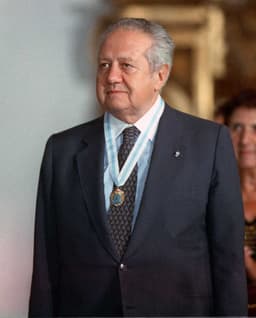
Mario Soares
Politician · Modern
63.8Total

Yoon Suk-yeol
Politician · Modern
36.4Total
Basic Information
Born
1924
1960
Died
—
—
Era
Modern
Modern
Nationality
Portugal
South Korea
Occupation
Politician
Politician
Civilization
Western
Eastern
Score Comparison
Military (10%)
14.6
13.2
Political (20%)
84.0
29.3
Influence (20%)
68.0
47.9
Legacy (20%)
68.0
37.5
Leadership (15%)
78.0
38.1
Strategy (15%)
40.8
36.4
TOTAL
63.8
36.4
Mario Soares — Complete Timeline
1973 AD
Founding of the Portuguese Socialist PartyPolitical Action◆ Major
Soares co-founded the Portuguese Socialist Party (PS) in West Germany, in exile from the Estado Novo regime. The party became a key force in the democratic transition after the Carnation Revolution.
Political PartyDemocracyExile
Impact: nationalconstructive
1974 AD
Return from Exile after Carnation RevolutionPolitical Action◆ Major
After the Carnation Revolution overthrew the Estado Novo, Soares returned from exile to Portugal. He was greeted by large crowds and immediately entered the political negotiations for the new democratic regime.
Carnation RevolutionDemocracyReturn
Impact: nationalconstructive
1976 AD
Election as Prime MinisterPolitical Action◆ Major
Soares became the first democratically elected Prime Minister of Portugal after the Carnation Revolution, leading a minority Socialist government. His election marked the consolidation of democratic institutions.
ElectionDemocracyGovernment
Impact: nationalconstructive
1985 AD
Negotiation of Portugal's Accession to the EECPolitical Action◆ Major
As Prime Minister, Soares led the negotiations for Portugal's accession to the European Economic Community (EEC). The treaty was signed in 1985, integrating Portugal into the European project and modernizing its economy.
European UnionIntegrationTreaty
Impact: regionalconstructive
1986 AD
Election as President of PortugalPolitical Action◆ Major
Soares was elected President of the Republic, becoming the first civilian president since the Carnation Revolution. He served two five-year terms, providing stability and continuity during Portugal's consolidation of democracy.
PresidencyDemocracyElection
Impact: nationalconstructive
Yoon Suk-yeol — Complete Timeline
2022 AD
Election as President of South KoreaPolitical Action◆ Major
Yoon Suk-yeol was elected as the 13th President of South Korea in March 2022, defeating Lee Jae-myung. His victory marked a return to conservative leadership after five years of liberal rule under Moon Jae-in.
ElectionConservativePolitical Shift
Impact: national
2024 AD
Declaration of Martial LawPolitical Action
Yoon Suk-yeol declared martial law in December 2024, citing threats from North Korea and internal instability. This unprecedented move led to widespread protests, international condemnation, and his subsequent impeachment by the National Assembly.
Martial LawImpeachmentPolitical Crisis
Impact: globaldestructive
Impeachment by National AssemblyPolitical Action◆ Major
Yoon Suk-yeol was impeached by the South Korean National Assembly in December 2024 for abuse of power and violation of the constitution through his martial law declaration. He was suspended from office pending a Constitutional Court ruling.
ImpeachmentConstitutional CrisisDemocracy
Impact: nationaldestructive
Expert Analysis
Origins
Mario Soares was born on December 7, 1924, in Lisbon, Portugal, into a middle-class family with strong Republican and anti-clerical traditions. His father, João Soares, was a Methodist pastor and teacher who instilled in him a commitment to social justice. Soares studied history and law at the University of Lisbon, where he became involved in opposition activities against the Estado Novo dictatorship. He was arrested multiple times for his political activism, including a 12-year prison sentence that was later commuted to exile. In 1968, he was exiled to São Tomé and then to France, where he continued his political work.
Yoon Suk-yeol was born on December 18, 1960, in Seoul, South Korea, into an academic family. His father, Yoon Ki-jung, was a professor of economics at Yonsei University. Yoon studied law at Seoul National University and passed the bar exam in 1991. He spent most of his career as a prosecutor, rising to become Prosecutor General in 2019. Unlike Soares, Yoon’s early life was not marked by political persecution; instead, he built a reputation as a corruption-fighting prosecutor, notably convicting former presidents Park Geun-hye and Lee Myung-bak.
Rise to Power
Soares’s rise to power was catalyzed by the Carnation Revolution on April 25, 1974, which overthrew the Estado Novo. He returned from exile on April 30, 1974, to a hero’s welcome at Lisbon’s airport, with crowds chanting his name. He co-founded the Portuguese Socialist Party (PS) in 1973 while in exile, and after the revolution, he quickly became a leading moderate voice. In 1975, he served as Minister of Foreign Affairs and played a key role in securing decolonization and stabilizing the fragile democracy. He became Prime Minister after the 1976 elections, the first democratically elected leader since 1926.
Yoon Suk-yeol rose to political prominence through his role as Prosecutor General under President Moon Jae-in. His investigation of corruption in the Moon administration led to a conflict with the ruling Democratic Party. In 2021, he resigned and joined the conservative People Power Party (PPP). He won the presidency in March 2022, defeating Lee Jae-myung by a narrow 0.73% margin (48.56% to 47.83%). His victory marked a return to conservative leadership after five years of liberal rule.
Leadership & Governance
Soares’s leadership style was democratic and conciliatory. As Prime Minister (1976-1978, 1983-1985) and later as President (1986-1996), he focused on consolidating democracy, integrating Portugal into Europe, and managing economic crises. He negotiated Portugal’s accession to the European Economic Community in 1985, which brought structural funds that modernized the economy. His governance was marked by coalition-building and adherence to constitutional norms. He scored 78.0 in leadership and 84.0 in political skill.
Yoon Suk-yeol’s governance was confrontational and unilateral. He pursued a conservative agenda, including deregulation, anti-feminism, and a hardline stance on North Korea. However, his approval ratings plummeted due to economic struggles and controversies. In December 2024, he declared martial law, citing threats from North Korea and internal instability, a move widely seen as authoritarian. The National Assembly impeached him on December 14, 2024, for abuse of power and constitutional violations. His leadership score of 38.1 reflects his inability to maintain democratic legitimacy.
Triumph & Tragedy
Soares’s greatest triumph was shepherding Portugal’s transition to democracy and its integration into Europe. He secured the decolonization of Angola and Mozambique peacefully, despite pressure from hardliners. His tragedy was the failure to fully modernize the economy during his tenure; Portugal remained relatively poor compared to Western Europe. Yet, his legacy as the “Father of Portuguese Democracy” endures.
Yoon’s triumph was his election as president, signaling a conservative shift. However, his tragedy was swift and catastrophic: his declaration of martial law led to impeachment and a political crisis that eroded South Korea’s democratic institutions. His total score of 36.4 is among the lowest for modern leaders.
Character & Destiny
Soares was pragmatic, resilient, and committed to democratic norms. His exile and imprisonment steeled his resolve; he believed in dialogue and compromise. His character shaped Portugal’s peaceful transition. Yoon, by contrast, was combative and rigid. His prosecutorial background made him see politics as a battlefield. His decision to declare martial law was a miscalculation that destroyed his presidency. Historians assess Soares as a visionary democrat; Yoon as a cautionary tale of authoritarian overreach.
Legacy
Soares’s legacy is profound: he is celebrated as the architect of Portuguese democracy. His PS party remains a major force, and Portugal’s EEC membership transformed the country. He scored 68.0 in legacy. Yoon’s legacy is toxic: he will be remembered for the first impeachment of a sitting president since Park Geun-hye, and his martial law declaration damaged South Korea’s democratic reputation. His legacy score of 37.5 reflects this negative impact.
Conclusion
Mario Soares had a far greater impact than Yoon Suk-yeol. Soares built a democracy from the ashes of dictatorship, integrating Portugal into Europe and ensuring lasting stability. Yoon, in contrast, undermined democracy and was impeached. Soares’s total score of 63.8 dwarfs Yoon’s 36.4. While Soares’s political skill and leadership (84.0 and 78.0) enabled constructive change, Yoon’s low scores in every category (political 29.3, leadership 38.1) reflect his failure. Soares’s legacy is one of creation; Yoon’s of destruction. Thus, Soares is the superior historical figure.
Rankings
🥇
Mario SoaresLeader
Mil: 14.6Pol: 84.0Inf: 68.0
63.8
🥈
Yoon Suk-yeol
Mil: 13.2Pol: 29.3Inf: 47.9
36.4
+27.4 behind
How This Comparison Works
Algorithm
Each figure is scored on 6 dimensions (0—100 scale) based on structured historical data: Military (10%), Political (20%), Influence (20%), Legacy (20%), Leadership (15%), Strategy (15%). The weighted total produces the final ranking.
Data Sources
Scores are computed from structured sub-indicators in the database. Scale factors adjust for era (Ancient ×0.85, Modern ×1.0) and civilization size (Eastern ×1.05, Other ×0.80) to account for differences in population and military scale.
Maximum 3 Figures
Comparisons are limited to 2—3 figures to ensure readability and statistical meaningfulness.
Error Margins
±5 points per dimension — Sub-scores are derived from historical records with inherent uncertainty. Two figures within 5 points on a dimension should be considered roughly equivalent in that area.
Total Score Accuracy
±3 points overall — The weighted combination of 6 dimensions produces a total score with approximately ±3 points of uncertainty. Differences of less than 3 points are not statistically significant— the figures are effectively tied.
Known Limitations
- Historical records are incomplete and uneven across civilizations
- Figures from oral-tradition societies may be underrepresented
- Occupation labels can misclassify multi-role figures
- Scores measure capability and impact, not moral character
- Quantitative scoring is a comparison tool, not absolute truth
Capability Radar
Military (10%) — Battles & Warfare
Battles
21
13
Win Rate
24
17
Expansion
26
22
Political (20%) — Governance & Reform
Reform
95
10
Diplomacy
90
15
Economy
70
15
Influence (20%) — Cultural & Global Reach
Cultural
70
5
Global
65
10
Legacy (20%) — Historical Impact
Historical
85
10
Longevity
75
5
Leadership (15%) — Power & Stability
Tenure
85
20
Stability
75
5
Strategy (15%) — Tactics & Innovation
Strategy
33
21
Tactics
35
25
Reform
35
31
Similar Comparisons
Comments & Discussion
No comments yet. Be the first to share your thoughts!