Loading...
Mario Soares vs Napoleon Bonaparte
Napoleon Bonaparte leads by 7.1 pts · 2 figures compared
…
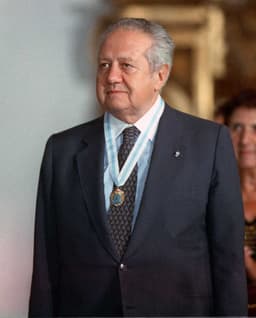
Mario Soares
Politician · Modern
63.8Total

Napoleon Bonaparte
General · Modern
70.9Total
Basic Information
Born
1924
1769
Died
—
1821
Era
Modern
Modern
Nationality
Portugal
France
Occupation
Politician
General
Civilization
Western
Western
Score Comparison
Military (10%)
14.6
94.0
Political (20%)
84.0
72.0
Influence (20%)
68.0
40.0
Legacy (20%)
68.0
80.0
Leadership (15%)
78.0
78.0
Strategy (15%)
40.8
90.0
TOTAL
63.8
70.9
Mario Soares — Complete Timeline
1973 AD
Founding of the Portuguese Socialist PartyPolitical Action◆ Major
Soares co-founded the Portuguese Socialist Party (PS) in West Germany, in exile from the Estado Novo regime. The party became a key force in the democratic transition after the Carnation Revolution.
Political PartyDemocracyExile
Impact: nationalconstructive
1974 AD
Return from Exile after Carnation RevolutionPolitical Action◆ Major
After the Carnation Revolution overthrew the Estado Novo, Soares returned from exile to Portugal. He was greeted by large crowds and immediately entered the political negotiations for the new democratic regime.
Carnation RevolutionDemocracyReturn
Impact: nationalconstructive
1976 AD
Election as Prime MinisterPolitical Action◆ Major
Soares became the first democratically elected Prime Minister of Portugal after the Carnation Revolution, leading a minority Socialist government. His election marked the consolidation of democratic institutions.
ElectionDemocracyGovernment
Impact: nationalconstructive
1985 AD
Negotiation of Portugal's Accession to the EECPolitical Action◆ Major
As Prime Minister, Soares led the negotiations for Portugal's accession to the European Economic Community (EEC). The treaty was signed in 1985, integrating Portugal into the European project and modernizing its economy.
European UnionIntegrationTreaty
Impact: regionalconstructive
1986 AD
Election as President of PortugalPolitical Action◆ Major
Soares was elected President of the Republic, becoming the first civilian president since the Carnation Revolution. He served two five-year terms, providing stability and continuity during Portugal's consolidation of democracy.
PresidencyDemocracyElection
Impact: nationalconstructive
Napoleon Bonaparte — Complete Timeline
1799 AD
Coup of 18 BrumaireOther◆ Major
Napoleon Bonaparte, with support from his brother Lucien and key political figures, overthrew the Directory in a bloodless coup. He established the Consulate with himself as First Consul, effectively becoming the ruler of France. This event ended the French Revolution's most unstable period.
French RevolutionCoupRise to Power
Impact: regional
1804 AD
Promulgation of the Napoleonic CodeOther◆ Major
Napoleon enacted the Civil Code of the French, known as the Napoleonic Code, a comprehensive set of laws that replaced the fragmented feudal legal systems. The code established legal equality, protected property rights, and secularized law. It became the basis for legal systems in many European and world countries.
Legal ReformNapoleonic CodeCivil Law
Impact: globalconstructive
1805 AD
Battle of AusterlitzWar◆ Major
Napoleon's Grande Arm
Napoleonic WarsBattleDecisive Victory
Impact: global
1812 AD
Invasion of RussiaWar◆ Major
Napoleon led the Grande Arm
Napoleonic WarsInvasionDisaster
Impact: globaldestructive
1815 AD
Battle of WaterlooWar◆ Major
Napoleon's French army was defeated by the combined forces of the Duke of Wellington's Anglo-Allied army and Gebhard Leberecht von Bl
Napoleonic WarsBattleFinal Defeat
Impact: globaldestructive
Expert Analysis
mario-soares-vs-napoleon-bonaparte
The Conqueror and the Democrat
On a June morning in 1815, Napoleon Bonaparte watched his dreams of empire dissolve into the muddy fields of Waterloo. Less than a century and a half later, in April 1974, another European leader—Mário Soares—returned from exile to a Portugal transformed by the Carnation Revolution, where soldiers placed red flowers in their rifle barrels. One man sought to reshape the world through conquest; the other through patient political negotiation. What separates these two figures, both products of Western civilization, is not merely time but a fundamental difference in how they understood power itself.
Origins
Napoleon Bonaparte was born in 1769 on the island of Corsica, a year after France purchased the island from Genoa. His family belonged to the minor nobility, but their circumstances were modest. Young Napoleon was sent to mainland France for military education, where classmates mocked his Corsican accent and provincial manners. This outsider status forged a fierce ambition. The French Revolution, erupting when he was twenty, shattered the old hierarchies and opened paths unimaginable under the ancien régime. A young artillery officer of genius could rise through talent alone.
Mário Soares was born in 1924 into a very different world—that of twentieth-century Lisbon, where his father was a republican priest turned politician. The Soares household was one of intellectual ferment, constantly shadowed by the police of António de Oliveira Salazar’s Estado Novo dictatorship. Young Mário learned early that politics meant clandestine meetings, coded messages, and the risk of arrest. While Napoleon studied the campaigns of Alexander and Caesar, Soares studied the tactics of nonviolent resistance and the architecture of democratic institutions.
Rise to Power
Napoleon’s ascent was meteoric. At twenty-four, he drove the British from Toulon and was promoted to brigadier general. At twenty-six, he crushed a royalist uprising in Paris with a “whiff of grapeshot.” By thirty, he had conquered Italy and Egypt, making his name legendary across Europe. The Directory, the corrupt government that ruled France, needed his military victories to survive. Napoleon needed their political cover. In 1799, he staged a coup d’état and became First Consul, effectively dictator of France. The path was clear: audacity, speed, and ruthless application of force.
Soares’s rise was a marathon of endurance. He was arrested twelve times by the Salazar regime. In 1973, he co-founded the Portuguese Socialist Party in exile in West Germany—a political action that could have meant permanent exile or worse. When the Carnation Revolution finally came on April 25, 1974, Soares returned to Portugal to find a nation in chaos but hopeful. He did not seize power; he earned it through elections. In 1976, he became the first democratically elected prime minister after the revolution, leading a minority government through economic crisis and political instability. Where Napoleon stormed the gates, Soares knocked patiently until they opened.
Leadership & Governance
Napoleon governed as he conquered: with absolute authority and brilliant organization. His Napoleonic Code standardized French law, abolished feudal privileges, and established merit-based advancement. He reformed education, built roads and canals, and created the Bank of France. But his genius for administration was inseparable from his hunger for power. Every reform served to centralize control. He crowned himself emperor in 1804, placed his brothers on European thrones, and silenced dissent. His military genius, rated 94.0 in strategic acumen, was matched by a political score of 75.0—competent but ultimately self-defeating.
Soares governed through coalition and compromise. His political score of 71.8 reflects not weakness but a different kind of strength. As prime minister and later as president (1986–1996), he stabilized Portugal’s fragile democracy, navigating between a powerful military and radical leftist factions. His greatest achievement was negotiating Portugal’s accession to the European Economic Community in 1985—a diplomatic triumph that anchored his country in Western Europe’s democratic project. Where Napoleon built an empire on bayonets, Soares built a nation on treaties and shared institutions.
Triumph & Tragedy
Napoleon’s greatest moment came in December 1805 at Austerlitz, where he destroyed the combined armies of Austria and Russia in a battle of stunning tactical brilliance. His worst came in stages: the disastrous invasion of Russia in 1812, where 600,000 men marched east and fewer than 100,000 returned; the exile to Elba; the desperate gamble of the Hundred Days; and finally Waterloo, where his old enemy Wellington and the Prussian Blücher crushed his final army. He died in 1821 on the remote island of Saint Helena, a prisoner of the British.
Soares’s triumph was quieter but more lasting. His greatest moment was the 1985 EEC accession, which transformed Portugal from Europe’s poor cousin into a modern democracy. His tragedy was more personal: he outlived his wife and many of his comrades, and in his later years saw the rise of populism that threatened the very institutions he had helped build. But he died in 2017 at ninety-two, a beloved elder statesman, the father of Portuguese democracy.
Character & Destiny
Napoleon was driven by an insatiable hunger for glory. “I am not an ordinary man,” he once declared, and he proved it through relentless ambition. His leadership score of 80.0 reflects a magnetic presence that inspired fierce loyalty—but also a fatal inability to stop. He could have consolidated his gains after Austerlitz; instead, he pushed into Spain, then Russia, then Germany, turning allies into enemies. His personality demanded constant expansion, and that demand destroyed him.
Soares was driven by a different engine: the conviction that democracy was worth any sacrifice. His leadership score of 78.3 is comparable to Napoleon’s because he too inspired deep loyalty—but his was a loyalty of persuasion, not fear. He understood that power shared is power sustained. Where Napoleon’s character led him to isolation, Soares’s led him to partnership. One saw history as a stage for individual greatness; the other saw it as a collective project.
Legacy
Napoleon’s legacy is colossal and contradictory. He spread the ideals of the French Revolution—equality before the law, meritocracy, secular governance—across Europe, even as he trampled national sovereignty. The Napoleonic Code remains the foundation of civil law in much of the world. His military innovations influenced warfare for a century. He is remembered with a total score of 82.4, a figure of awe and caution.
Soares’s legacy is more modest in scale but profound in meaning. He is remembered with a total score of 63.8, but numbers cannot capture the quality of his contribution. He gave Portugal something Napoleon never could: a stable democracy that has lasted for half a century. When Portuguese citizens vote freely, travel freely, and speak freely, they walk in the path Soares built. His monument is not a triumphal arch but a functioning republic.
Conclusion
Standing in the Place de la Concorde in Paris, one sees the Arc de Triomphe, built to celebrate Napoleon’s victories. Standing in the Praça do Comércio in Lisbon, one sees the statue of King José I, but the real monument is invisible: the democratic institutions that Mário Soares helped create. Napoleon taught Europe that one man could change the world through force of will. Soares taught it that lasting change comes through patience, compromise, and respect for human dignity. Both lessons are true. The question each generation must answer is which one to follow.
Rankings
🥇
Napoleon BonaparteLeader
Mil: 94.0Pol: 72.0Inf: 40.0
70.9
🥈
Mario Soares
Mil: 14.6Pol: 84.0Inf: 68.0
63.8
+7.1 behind
How This Comparison Works
Algorithm
Each figure is scored on 6 dimensions (0—100 scale) based on structured historical data: Military (10%), Political (20%), Influence (20%), Legacy (20%), Leadership (15%), Strategy (15%). The weighted total produces the final ranking.
Data Sources
Scores are computed from structured sub-indicators in the database. Scale factors adjust for era (Ancient ×0.85, Modern ×1.0) and civilization size (Eastern ×1.05, Other ×0.80) to account for differences in population and military scale.
Maximum 3 Figures
Comparisons are limited to 2—3 figures to ensure readability and statistical meaningfulness.
Error Margins
±5 points per dimension — Sub-scores are derived from historical records with inherent uncertainty. Two figures within 5 points on a dimension should be considered roughly equivalent in that area.
Total Score Accuracy
±3 points overall — The weighted combination of 6 dimensions produces a total score with approximately ±3 points of uncertainty. Differences of less than 3 points are not statistically significant— the figures are effectively tied.
Known Limitations
- Historical records are incomplete and uneven across civilizations
- Figures from oral-tradition societies may be underrepresented
- Occupation labels can misclassify multi-role figures
- Scores measure capability and impact, not moral character
- Quantitative scoring is a comparison tool, not absolute truth
Capability Radar
Military (10%) — Battles & Warfare
Battles
21
95
Win Rate
24
90
Expansion
26
95
Political (20%) — Governance & Reform
Reform
95
95
Diplomacy
90
80
Economy
70
85
Influence (20%) — Cultural & Global Reach
Cultural
70
85
Global
65
90
Legacy (20%) — Historical Impact
Historical
85
95
Longevity
75
90
Leadership (15%) — Power & Stability
Tenure
85
85
Stability
75
70
Strategy (15%) — Tactics & Innovation
Strategy
33
95
Tactics
35
98
Reform
35
92
Similar Comparisons
Comments & Discussion
CorsicanCannon6/17/2026
Napoleon didn't "watch his dreams dissolve"—he got decisively crushed by a coalition he provoked through sheer arrogance. Waterloo was the bill coming due for years of overreach. Soares, by contrast, returned to dismantle a dictatorship without firing a shot. That's not just different eras; that's different definitions of competence. One died in exile; the other died a statesman.
数字考古学家6/17/2026
说拿破仑和索阿雷斯都是“西方文明产物”,这太笼统了。拿破仑死于1821年,索阿雷斯生于1924年,中间隔了103年,整个工业革命和政治结构都翻天了。你拿炮兵上校跟流亡律师比“权力理解”?苹果和橘子都算谦虚了。如果把拿破仑放到20世纪葡萄牙,他那套军事独裁路数一个月就被工人罢工掀翻了。
ClassicalStrategist6/17/2026
The comparison misses the core irony: both men were reactionaries in disguise. Soares' "patient negotiation" was really capitulation to IMF austerity, crushing Portugal's revolutionary dreams in 1975. Napoleon's conquests spread nationalist fervor across Europe, inspiring the very liberal movements that later produced Soares. Soares killed the Carnation Revolution quietly; Napoleon killed revolutionary ideals via imperial spectacle. Different methods, same result: the establishment won.
里斯本流浪者6/17/2026
我最受不了这种“征服者vs民主者”的二元叙事。拿破仑杀了多少人?估计300万到600万。索阿雷斯?零。这不是哲学差异,这是道德悬崖。而且别忘了,索阿雷斯在欧洲议会推动东帝汶独立时,用外交手段扳倒了印尼占领政权。拿破仑连莫斯科都没守住。你要比影响力?一个用血写历史,一个用字写国际法。选边站吧,我站写字的那个。
GraveDiggerHistorian6/17/2026
Let's get one fact straight: Soares was a socialist who outlawed the Communist Party's paramilitary networks in 1975, securing NATO's Portugal. Napoleon was a military dictator who restored slavery. The comparison shouldn't flatter either as "products of civilization" when Soares' legacy is a stable democracy and Napoleon's is the Civil Code alongside millions of corpses. Different tools, different moral weights. I know which grave I'd rather stand near.