Loading...
Matsukata Masayoshi vs Nnamdi Azikiwe
Nnamdi Azikiwe leads by 7.0 pts · 2 figures compared
…
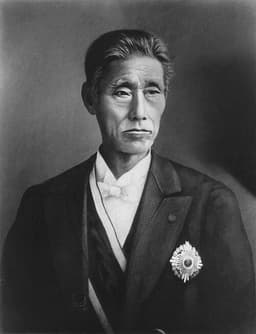
Matsukata Masayoshi
Politician · Modern
56.3Total

Nnamdi Azikiwe
Politician · Modern
63.3Total
Basic Information
Born
1835
1904
Died
1924
1996
Era
Modern
Modern
Nationality
Japan
Nigeria
Occupation
Politician
Politician
Civilization
Eastern
Other
Score Comparison
Military (10%)
10.4
25.4
Political (20%)
78.0
65.0
Influence (20%)
58.0
88.0
Legacy (20%)
54.0
55.0
Leadership (15%)
80.0
72.0
Strategy (15%)
35.5
44.8
TOTAL
56.3
63.3
Matsukata Masayoshi — Complete Timeline
1881 AD
Matsukata Fiscal PolicyReform◆ Major
As Finance Minister, Matsukata implemented the Matsukata Fiscal Policy, a series of deflationary measures to combat inflation and stabilize the currency. He established the Bank of Japan in 1882 and introduced a new tax system. These policies laid the foundation for Japan's modern economy.
FinanceReformEconomy
Impact: nationalconstructive
1891 AD
Served as Prime MinisterPolitical Action◆ Major
Matsukata Masayoshi served as the fourth Prime Minister of Japan from 1891 to 1892. His first term was marked by political instability and economic challenges. He was known for his conservative fiscal policies.
Prime MinisterGovernmentPolitics
Impact: national
1896 AD
Second Term as Prime MinisterPolitical Action◆ Major
Matsukata served a second term as Prime Minister from 1896 to 1898. His second term was also short and marked by political conflicts. He focused on foreign policy, including the Triple Intervention after the First Sino-Japanese War.
Prime MinisterGovernmentPolitics
Impact: national
1897 AD
Established the Gold StandardReform◆ Major
Matsukata, as Finance Minister, led Japan's adoption of the gold standard in 1897. This move stabilized the yen and facilitated foreign trade and investment. It was a key step in Japan's integration into the global economy.
Gold StandardFinanceEconomy
Impact: globalconstructive
Nnamdi Azikiwe — Complete Timeline
1937 AD
Publication of 'Renascent Africa'Cultural◆ Major
Azikiwe published 'Renascent Africa', a book outlining his vision for African nationalism and self-determination. The work influenced the pan-African movement and inspired anti-colonial activists across the continent.
PublicationNationalismPan-Africanism
Impact: regionalconstructive
1960 AD
Election as President of the Nigerian SenatePolitical Action◆ Major
Azikiwe was elected President of the Nigerian Senate, a position he held until 1963. This role made him a key figure in the early legislative framework of independent Nigeria.
SenateLegislatureIndependence
Impact: nationalconstructive
Governor-General of NigeriaPolitical Action
Azikiwe became the first Nigerian Governor-General, representing the British monarch. He oversaw the transition from colonial rule to independence, symbolizing Nigerian sovereignty.
Governor-GeneralIndependenceSovereignty
Impact: nationalprogressive
1963 AD
First President of NigeriaPolitical Action
When Nigeria became a republic, Azikiwe was elected as its first President. He served as a ceremonial head of state until the 1966 military coup, embodying the nation's early republican ideals.
PresidencyRepublicFounding Father
Impact: nationalprogressive
1967 AD
Role in the Nigerian Civil WarPolitical Action◆ Major
During the Nigerian Civil War, Azikiwe initially supported the Biafran secession but later switched allegiance to the federal government. He played a role in peace efforts and post-war reconciliation.
Civil WarBiafraReconciliation
Impact: national
Expert Analysis
Origins
Matsukata Masayoshi was born in 1835 in Kagoshima, Japan, into a samurai family of the Satsuma domain. His early education in Confucian classics and military training prepared him for a role in the Meiji Restoration. He studied Western finance under the guidance of Okubo Toshimichi and became a key figure in Japan's modernization. In contrast, Nnamdi Azikiwe was born in 1904 in Zungeru, Nigeria, to Igbo parents. He studied in the United States at Howard University and Lincoln University, earning degrees in political science and anthropology. His exposure to pan-Africanism and American civil rights movements shaped his nationalist ideology.
Rise to Power
Matsukata rose through the ranks of the Meiji bureaucracy, serving as Finance Minister from 1881 to 1889. His implementation of the Matsukata Fiscal Policy in 1881-1885 curbed inflation by cutting government spending and raising taxes, stabilizing the yen. He became Prime Minister in 1891, but his first term lasted only a year due to political infighting. Azikiwe's rise began as a journalist, founding newspapers like the West African Pilot to advocate for Nigerian independence. He co-founded the National Council of Nigeria and the Cameroons (NCNC) and became Premier of the Eastern Region in 1954. In 1960, he became Governor-General, and in 1963, the first President of Nigeria.
Leadership & Governance
Matsukata's leadership focused on fiscal discipline and economic stability. As Finance Minister, he reduced the money supply and established the Bank of Japan to control inflation. His adoption of the gold standard in 1897 facilitated foreign trade. However, his deflationary policies caused hardship for farmers and small businesses. Azikiwe's governance emphasized national unity and African socialism. He promoted education and industrialization in the Eastern Region, building the University of Nigeria. As a ceremonial president, his influence was limited, but he symbolized the aspirations of a new nation. His leadership style was conciliatory, but he struggled to contain ethnic tensions.
Triumph & Tragedy
Matsukata's greatest triumph was stabilizing Japan's economy and laying the foundation for its industrial growth. His fiscal policy reduced inflation from over 10% to near zero. However, his failure to secure a stable government as Prime Minister—both terms ended prematurely—limited his political legacy. Azikiwe's triumph was guiding Nigeria to independence and becoming its first president, a symbol of African self-rule. His tragedy was the Nigerian Civil War (1967-1970). Initially supporting Biafran secession, he later switched sides, damaging his reputation. His vision of a united Nigeria was shattered by the war's devastation.
Character & Destiny
Matsukata was methodical and disciplined, a technocrat who believed in sound money. His character matched the Meiji era's emphasis on modernization through efficiency. Azikiwe was charismatic and idealistic, a visionary who inspired millions. His destiny was tied to Nigeria's fragile democracy; his ceremonial role reflected the nation's struggle between ethnic identities. Historians note Matsukata's pragmatism versus Azikiwe's idealism. In leadership scores, Matsukata scored 80.0, Azikiwe 72.0, reflecting Matsukata's effective governance.
Legacy
Matsukata's legacy is Japan's stable currency and modern financial system. The Bank of Japan and gold standard endure as foundations of economic policy. He scored 54.0 in legacy. Azikiwe's legacy is Nigerian nationalism and pan-Africanism. His writings and political activism inspired generations. He scored 55.0 in legacy, slightly higher. However, Azikiwe's influence score of 88.0 dwarfs Matsukata's 58.0, reflecting his broader continental impact.
Conclusion
While Matsukata excelled in financial reform with a total score of 56.3, Azikiwe's total of 63.3 reflects greater overall impact. Azikiwe's role in decolonization and nation-building had far-reaching consequences for Africa. Matsukata's fiscal policies were crucial for Japan, but Azikiwe's influence on nationalism and independence movements gives him the edge. Nnamdi Azikiwe had a greater impact on history.
Rankings
🥇
Nnamdi AzikiweLeader
Mil: 25.4Pol: 65.0Inf: 88.0
63.3
🥈
Matsukata Masayoshi
Mil: 10.4Pol: 78.0Inf: 58.0
56.3
+7.0 behind
How This Comparison Works
Algorithm
Each figure is scored on 6 dimensions (0—100 scale) based on structured historical data: Military (10%), Political (20%), Influence (20%), Legacy (20%), Leadership (15%), Strategy (15%). The weighted total produces the final ranking.
Data Sources
Scores are computed from structured sub-indicators in the database. Scale factors adjust for era (Ancient ×0.85, Modern ×1.0) and civilization size (Eastern ×1.05, Other ×0.80) to account for differences in population and military scale.
Maximum 3 Figures
Comparisons are limited to 2—3 figures to ensure readability and statistical meaningfulness.
Error Margins
±5 points per dimension — Sub-scores are derived from historical records with inherent uncertainty. Two figures within 5 points on a dimension should be considered roughly equivalent in that area.
Total Score Accuracy
±3 points overall — The weighted combination of 6 dimensions produces a total score with approximately ±3 points of uncertainty. Differences of less than 3 points are not statistically significant— the figures are effectively tied.
Known Limitations
- Historical records are incomplete and uneven across civilizations
- Figures from oral-tradition societies may be underrepresented
- Occupation labels can misclassify multi-role figures
- Scores measure capability and impact, not moral character
- Quantitative scoring is a comparison tool, not absolute truth
Capability Radar
Military (10%) — Battles & Warfare
Battles
15
19
Win Rate
19
23
Expansion
21
29
Political (20%) — Governance & Reform
Reform
75
70
Diplomacy
70
75
Economy
85
60
Influence (20%) — Cultural & Global Reach
Cultural
40
80
Global
50
65
Legacy (20%) — Historical Impact
Historical
60
75
Longevity
55
60
Leadership (15%) — Power & Stability
Tenure
65
65
Stability
70
55
Strategy (15%) — Tactics & Innovation
Strategy
22
29
Tactics
29
35
Reform
26
35
Similar Comparisons
Comments & Discussion
No comments yet. Be the first to share your thoughts!