Loading...
Meles Zenawi vs Surendranath Banerjee
Meles Zenawi leads by 2.6 pts · 2 figures compared
…
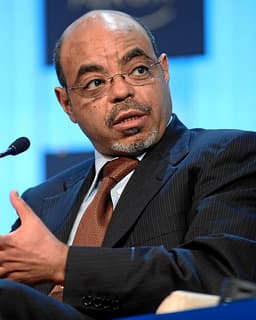
Meles Zenawi
Politician · Modern
57.6Total

Surendranath Banerjee
Politician · Modern
55.0Total
Basic Information
Born
1955
1848
Died
—
1925
Era
Modern
Modern
Nationality
Ethiopia
India
Occupation
Politician
Politician
Civilization
Other
Indian
Score Comparison
Military (10%)
36.6
48.1
Political (20%)
65.0
68.0
Influence (20%)
59.0
62.0
Legacy (20%)
48.3
50.0
Leadership (15%)
79.8
40.0
Strategy (15%)
53.5
60.0
TOTAL
57.6
55.0
Meles Zenawi — Complete Timeline
1991 AD
EPRDF capture of Addis AbabaWar◆ Major
Meles Zenawi, as leader of the Tigrayan People's Liberation Front (TPLF) and the Ethiopian People's Revolutionary Democratic Front (EPRDF) coalition, led rebel forces to overthrow the Derg regime. This ended the Ethiopian Civil War and installed Meles as president of the transitional government.
Civil WarRegime ChangeRebel Victory
Impact: national
1998 AD
Eritrean-Ethiopian WarWar◆ Major
Meles, as prime minister, led Ethiopia in a two-year border war with Eritrea. The conflict resulted in tens of thousands of deaths and ended with a stalemate, followed by the Algiers Agreement in 2000 and the establishment of the UN peacekeeping mission UNMEE.
Border WarEritreaPeacekeeping
Impact: regionaldestructive
2000 AD
Ethiopian economic reform programReform◆ Major
Meles implemented a series of economic reforms focused on agricultural development, infrastructure investment, and state-led industrialization. These policies contributed to sustained GDP growth averaging over 10% annually from 2004 to 2014, though critics noted limited political freedoms.
Economic DevelopmentAgricultureInfrastructure
Impact: nationalconstructive
2005 AD
2005 Ethiopian general electionPolitical Action◆ Major
Meles's government held multi-party elections that were initially seen as promising but ended in controversy. Opposition parties claimed fraud, leading to protests and a violent crackdown that killed at least 193 people. The event damaged Ethiopia's democratic reputation.
ElectionPolitical ViolenceDemocracy
Impact: nationaldestructive
2012 AD
Death in officeOther◆ Major
Meles Zenawi died on August 20, 2012, in a Brussels hospital from an undisclosed illness. His death ended 21 years of rule and triggered a peaceful transition of power to Deputy Prime Minister Hailemariam Desalegn, though the TPLF retained control.
DeathTransitionSuccession
Impact: national
Surendranath Banerjee — Complete Timeline
1876 AD
Founded the Indian National AssociationPolitical Action◆ Major
Banerjee founded the Indian National Association in Calcutta, one of the earliest political organizations in India. It aimed to represent Indian interests and promote political reforms, serving as a precursor to the Indian National Congress.
Political OrganizationIndian NationalismPre-Congress
Impact: nationalconstructive
1879 AD
Founded the newspaper 'The Bengalee'Cultural
Banerjee established 'The Bengalee', an English-language newspaper that became a prominent voice for Indian political opinion. Through its editorials, he criticized British policies and advocated for reforms.
JournalismPressAdvocacy
Impact: regionalconstructive
1883 AD
Imprisoned for contempt of courtPolitical Action◆ Major
Banerjee was sentenced to two months' imprisonment for publishing a contemptuous article in 'The Bengalee' criticizing a Calcutta High Court judge. His imprisonment sparked public outrage and protests, highlighting the repressive nature of British rule.
ImprisonmentPress FreedomContempt of Court
Impact: nationaltragic
1893 AD
Served as a member of the Imperial Legislative CouncilPolitical Action
Banerjee was elected to the Imperial Legislative Council, where he served as a moderate voice for Indian interests. He used his position to advocate for administrative reforms and greater Indian participation in governance.
Legislative CouncilModerate Politics
Impact: nationalconstructive
1895 AD
Presided over the Indian National Congress session in PoonaPolitical Action◆ Major
Banerjee presided over the 11th session of the Indian National Congress in Poona. His presidency marked a period of moderate constitutional agitation for greater Indian representation in the British Raj.
Congress PresidencyModerate Phase
Impact: nationalconstructive
1905 AD
Led the agitation against the partition of BengalPolitical Action◆ Major
Banerjee was a key leader in the mass movement opposing the British decision to partition Bengal along religious lines. He organized protests, boycotts, and public meetings, making the issue a national cause.
Partition of BengalSwadeshi MovementBoycott
Impact: nationalconstructive
Expert Analysis
Origins
Meles Zenawi was born on May 8, 1955, in Adwa, Tigray, Ethiopia. His father was a small landowner, and his mother was a farmer. He studied at the Wingate School in Addis Ababa and later at the University of Addis Ababa, where he joined the Tigrayan People's Liberation Front (TPLF) in 1975. His early exposure to Marxist ideology during the Ethiopian Revolution shaped his political views.
Surendranath Banerjee was born on November 10, 1848, in Calcutta, British India, into a Brahmin family. His father was a doctor. He studied at the University of Calcutta and then at the University of London, where he passed the Indian Civil Service examination in 1869. However, he was dismissed from the ICS due to a technicality, which turned him toward politics.
Rise to Power
Meles Zenawi rose through the ranks of the TPLF during the Ethiopian Civil War. By 1989, he became the leader of the Ethiopian People's Revolutionary Democratic Front (EPRDF), a coalition of ethnic-based parties. In May 1991, the EPRDF captured Addis Ababa, ending the Derg regime. Meles became president of the Transitional Government of Ethiopia and later prime minister in 1995, a position he held until his death.
Surendranath Banerjee emerged as a leader of the moderate nationalist movement in India. In 1876, he founded the Indian National Association in Calcutta, one of the first political organizations representing Indian interests. He gained prominence through his campaign against the Ilbert Bill (1883) and later presided over the 1895 Indian National Congress session in Poona. His leadership of the agitation against the partition of Bengal in 1905 solidified his status as a national figure.
Leadership & Governance
Meles Zenawi governed Ethiopia with a firm hand, implementing a system of ethnic federalism that divided the country into regions based on ethnicity. His economic policies, known as the Agricultural Development-Led Industrialization (ADLI) strategy, focused on small-scale agriculture and infrastructure. Under his rule, Ethiopia achieved high GDP growth, averaging 10.6% per year from 2004 to 2012. However, his government was criticized for human rights abuses and suppression of political dissent. In the 2005 elections, opposition parties won many seats, but the government cracked down on protesters, leading to thousands of arrests.
Surendranath Banerjee advocated for constitutional reform through petitions and public meetings. He believed in working within the British system, which earned him the label of a 'moderate'. His leadership style was inclusive, seeking to unite different communities. He founded the newspaper 'The Bengalee' to spread nationalist ideas. However, his moderate approach faced challenges from more radical elements like Bal Gangadhar Tilak. Banerjee's political score of 68.0 reflects his organizational skills but limited direct impact on policy.
Triumph & Tragedy
Meles Zenawi's greatest success was transforming Ethiopia from a famine-stricken country into one of Africa's fastest-growing economies. His government invested heavily in roads, dams, and schools. The Growth and Transformation Plan (GTP) launched in 2010 aimed at doubling GDP. However, his biggest failure was the Eritrean-Ethiopian War (1998-2000), which caused tens of thousands of deaths and led to a stalemate, costing an estimated $1 billion. Additionally, his authoritarian governance left a legacy of ethnic tensions that erupted after his death.
Surendranath Banerjee's triumph was his role in the anti-partition movement, which mobilized mass support and forced the British to reverse the partition of Bengal in 1911. He also laid the groundwork for the Indian National Congress's early organizational structure. However, his tragedy was his inability to adapt to the rising tide of extremism; he lost influence after the split in the Congress in 1907. He was imprisoned for contempt of court in 1883, which ironically boosted his popularity. His legacy score of 50.0 indicates a moderate lasting impact.
Character & Destiny
Meles Zenawi was a disciplined, strategic thinker with a strong ideological bent. He was known for his intellectual rigor and ability to articulate a vision for Ethiopia. His decision to prioritize economic growth over political freedom shaped his fate: he died in office in 2012, leaving behind a mixed legacy of rapid development and authoritarian rule. His leadership score of 79.8 reflects his effective control but also his centralized power.
Surendranath Banerjee was a principled, moderate nationalist who believed in gradual reform. His character was shaped by his experience as a civil servant dismissed for a minor infraction, which gave him a sense of injustice. He was a skilled orator and organizer, but his reluctance to embrace confrontation limited his impact. His leadership score of 40.0 indicates his inability to lead a mass movement effectively. He died in 1925, largely forgotten as more radical leaders took center stage.
Legacy
Meles Zenawi's legacy is complex. He is credited with transforming Ethiopia's economy and infrastructure, but his ethnic federalism has been blamed for fueling conflicts in Tigray, Oromia, and Amhara regions. His influence score of 59.0 reflects his impact on African development discourse, but his authoritarianism tarnishes his image. The Ethiopian economy continued to grow after his death, but political instability has challenged his legacy.
Surendranath Banerjee is remembered as a pioneer of Indian nationalism. His Indian National Association later merged into the Indian National Congress, which became the primary vehicle for independence. He is often called 'Surrender Not' Banerjee for his persistence. However, his moderate approach is often overshadowed by the more aggressive strategies of Gandhi and Nehru. His influence score of 62.0 reflects his foundational role in Indian political organization.
Conclusion
Meles Zenawi had a greater impact on his country and region than Surendranath Banerjee. Despite his authoritarian flaws, Meles's economic reforms lifted millions out of poverty and transformed Ethiopia into a regional power. His total score of 57.6 is slightly higher than Banerjee's 55.0, but the difference is significant when considering the scale of change: Meles oversaw a nation's transformation, while Banerjee contributed to a movement that would later achieve independence. Banerjee's work was crucial, but it was part of a larger effort led by others. Meles's direct control over policy and resources allowed him to enact changes that Banerjee could only advocate for. Therefore, Meles Zenawi stands as the more consequential figure.
Rankings
🥇
Meles ZenawiLeader
Mil: 36.6Pol: 65.0Inf: 59.0
57.6
🥈
Surendranath Banerjee
Mil: 48.1Pol: 68.0Inf: 62.0
55.0
+2.6 behind
How This Comparison Works
Algorithm
Each figure is scored on 6 dimensions (0—100 scale) based on structured historical data: Military (10%), Political (20%), Influence (20%), Legacy (20%), Leadership (15%), Strategy (15%). The weighted total produces the final ranking.
Data Sources
Scores are computed from structured sub-indicators in the database. Scale factors adjust for era (Ancient ×0.85, Modern ×1.0) and civilization size (Eastern ×1.05, Other ×0.80) to account for differences in population and military scale.
Maximum 3 Figures
Comparisons are limited to 2—3 figures to ensure readability and statistical meaningfulness.
Error Margins
±5 points per dimension — Sub-scores are derived from historical records with inherent uncertainty. Two figures within 5 points on a dimension should be considered roughly equivalent in that area.
Total Score Accuracy
±3 points overall — The weighted combination of 6 dimensions produces a total score with approximately ±3 points of uncertainty. Differences of less than 3 points are not statistically significant— the figures are effectively tied.
Known Limitations
- Historical records are incomplete and uneven across civilizations
- Figures from oral-tradition societies may be underrepresented
- Occupation labels can misclassify multi-role figures
- Scores measure capability and impact, not moral character
- Quantitative scoring is a comparison tool, not absolute truth
Capability Radar
Military (10%) — Battles & Warfare
Battles
5
43
Win Rate
5
45
Expansion
5
49
Political (20%) — Governance & Reform
Reform
70
60
Diplomacy
65
55
Economy
70
30
Influence (20%) — Cultural & Global Reach
Cultural
40
45
Global
45
35
Legacy (20%) — Historical Impact
Historical
50
50
Longevity
30
40
Leadership (15%) — Power & Stability
Tenure
75
55
Stability
55
40
Strategy (15%) — Tactics & Innovation
Strategy
10
55
Tactics
5
58
Reform
15
60
Similar Comparisons
Comments & Discussion
No comments yet. Be the first to share your thoughts!