Loading...
Milos Obrenovic vs Ranjit Singh of Nawanagar
Milos Obrenovic leads by 2.0 pts · 2 figures compared
…
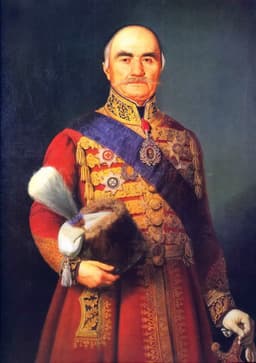
Milos Obrenovic
Emperor · Modern
52.7Total

Ranjit Singh of Nawanagar
Emperor · Modern
50.7Total
Basic Information
Born
1780
1872
Died
1860
1933
Era
Modern
Modern
Nationality
Serbia
India
Occupation
Emperor
Emperor
Civilization
Western
Indian
Score Comparison
Military (10%)
55.0
44.0
Political (20%)
68.0
46.6
Influence (20%)
53.3
55.0
Legacy (20%)
47.5
52.0
Leadership (15%)
53.2
53.2
Strategy (15%)
38.6
45.8
TOTAL
52.7
50.7
Milos Obrenovic — Complete Timeline
1815 AD
Led the Second Serbian UprisingWar
Miloš Obrenović led the Second Serbian Uprising against the Ottoman Empire. The uprising was more successful than the first, leading to negotiations with the Ottomans and the establishment of an autonomous Serbian principality under Ottoman suzerainty.
UprisingOttoman EmpireSerbian Autonomy
Impact: regionalconstructive
1817 AD
Recognized as Prince of SerbiaPolitical Action◆ Major
Miloš Obrenović was recognized as the hereditary Prince of Serbia by the Ottoman Empire, following the Second Serbian Uprising. This recognition established the Obrenović dynasty and granted Serbia a degree of autonomy.
RecognitionAutonomyDynasty Foundation
Impact: nationalconstructive
1839 AD
Abdicated the ThronePolitical Action◆ Major
Under pressure from opposition and the Ottoman Porte, Milo
AbdicationExileDynasty
Impact: national
1858 AD
Returned to Power as PrincePolitical Action◆ Major
Miloš Obrenović returned from exile and was reinstated as Prince of Serbia after the abdication of Alexander Karađorđević. He ruled until his death in 1860, consolidating the Obrenović dynasty's power.
Return to PowerDynasty RestorationSerbia
Impact: national
Ranjit Singh of Nawanagar — Complete Timeline
1895 AD
Invented the Leg GlanceInvention◆ Major
Ranjitsinhji developed and popularized the leg glance, a batting shot that deflected the ball to the leg side. This innovative stroke revolutionized batting technique and became a hallmark of his style.
CricketBatting TechniqueInnovation
Impact: globalconstructive
1896 AD
Test Cricket Debut for EnglandCultural◆ Major
Ranjitsinhji made his Test debut for England against Australia at Old Trafford. He scored 62 and 154 not out, becoming the first Indian-born cricketer to play Test cricket and scoring a century on debut.
CricketTest DebutEngland
Impact: globalconstructive
1899 AD
Scored Over 3,000 Runs in a SeasonCultural◆ Major
Ranjitsinhji scored 3,159 runs in the 1899 English cricket season, a record at the time. This feat established him as one of the greatest batsmen of the era and showcased his extraordinary skill.
CricketRecordEngland
Impact: globalconstructive
1907 AD
Appointed Maharaja of NawanagarPolitical Action◆ Major
Ranjitsinhji was formally installed as the Maharaja of Nawanagar after a long succession dispute. He ruled the princely state until his death, implementing administrative and infrastructure reforms.
SuccessionPrincely StateNawanagar
Impact: regionalconstructive
1920 AD
Represented India at the League of NationsPolitical Action
Ranjitsinhji served as India's representative at the League of Nations in Geneva. He advocated for Indian interests on the international stage, highlighting his role beyond cricket as a statesman.
DiplomacyLeague of NationsIndia
Impact: globalconstructive
Expert Analysis
Origins
Miloš Obrenović was born in 1780 in Srednja Dobrinja, Serbia, into a peasant family. His early life was marked by Ottoman rule and the First Serbian Uprising (1804-1813), in which he served as a vojvoda (military commander). After the uprising's failure, he went into exile. Ranjitsinhji Vibhaji Jadeja, known as Ranji, was born in 1872 in Sarodar, Gujarat, into a princely family of Nawanagar. He was adopted by his uncle, the Jam Saheb, and educated at Rajkumar College and later Cambridge University. His early life combined traditional Indian nobility with British education.
Rise to Power
Miloš rose to prominence by leading the Second Serbian Uprising (1815) against the Ottoman Empire. Unlike the first uprising, he pursued a pragmatic strategy of negotiation and bribery, securing partial autonomy for Serbia. In 1817, he was recognized as Prince of Serbia, establishing the Obrenović dynasty. His political acumen scored 68.0, enabling him to navigate Ottoman and Austrian pressures. Ranjit Singh's rise was different: he gained fame as a cricketer. His Test debut for England in 1896, scoring 62 and 154 not out, made him a national hero. After a succession dispute, he became Maharaja of Nawanagar in 1907. His influence score of 55.0 reflects his dual role as sportsman and ruler.
Leadership & Governance
Miloš ruled Serbia autocratically, centralizing power and modernizing the state. He abolished the feudal system, promoted education, and established a standing army. However, his authoritarian style led to opposition, and he abdicated in 1839 under pressure. He returned to power in 1858 but died in 1860. His political score of 68.0 shows effective governance, but his leadership score of 53.2 indicates mixed results. Ranjit Singh, as Maharaja, implemented reforms in education, irrigation, and public health. He built schools and hospitals, and represented India at the League of Nations. However, his rule was limited by British suzerainty. His leadership score of 53.2 matches Miloš, but his governance was less transformative due to colonial constraints.
Triumph & Tragedy
Miloš's greatest triumph was securing Serbian autonomy through the Second Serbian Uprising, establishing a hereditary dynasty. His tragedy was his autocratic rule, which caused internal strife and his abdication. He died in exile in 1860. Ranjit Singh's triumph was revolutionizing cricket with the leg glance and scoring 3,159 runs in a season (1899). His tragedy was his failure to secure a lasting political legacy; his reforms in Nawanagar were overshadowed by his cricket fame. His legacy score of 52.0 is higher than Miloš's 47.5, reflecting his global recognition.
Character & Destiny
Miloš was pragmatic, ruthless, and ambitious. His decision to negotiate with the Ottomans rather than fight outright secured autonomy but also made him enemies. His character led to a volatile reign. Ranjit Singh was charismatic, innovative, and diplomatic. His cricket prowess opened doors, but his rule was constrained by British power. His destiny was to be remembered more as a sportsman than a ruler. The total scores: Miloš 52.7, Ranjit 50.7, a narrow gap of 2.0 points.
Legacy
Miloš's legacy is foundational for modern Serbia: he established the Obrenović dynasty, which ruled until 1903, and secured autonomy that led to full independence. His political structures influenced later Serbian statehood. Ranjit Singh's legacy is dual: he popularized cricket in India and inspired generations of cricketers, and he modernized Nawanagar. However, his political impact was limited to one small princely state. Miloš's influence score of 53.3 vs Ranjit's 55.0 reflects Ranjit's global cultural reach, but Miloš's political impact was more enduring.
Conclusion
Miloš Obrenović had greater historical impact. While Ranjit Singh's cricket achievements are globally recognized, Miloš's actions shaped a nation's destiny. Miloš scored 68.0 in political acumen versus Ranjit's 46.6, and his military score of 55.0 against 44.0 reflects his role in Serbia's liberation. The 2.0-point total score difference understates Miloš's advantage in state-building. Ranjit's legacy is cultural, but Miloš's is foundational for Serbian independence.
Rankings
🥇
Milos ObrenovicLeader
Mil: 55.0Pol: 68.0Inf: 53.3
52.7
🥈
Ranjit Singh of Nawanagar
Mil: 44.0Pol: 46.6Inf: 55.0
50.7
+2.0 behind
How This Comparison Works
Algorithm
Each figure is scored on 6 dimensions (0—100 scale) based on structured historical data: Military (10%), Political (20%), Influence (20%), Legacy (20%), Leadership (15%), Strategy (15%). The weighted total produces the final ranking.
Data Sources
Scores are computed from structured sub-indicators in the database. Scale factors adjust for era (Ancient ×0.85, Modern ×1.0) and civilization size (Eastern ×1.05, Other ×0.80) to account for differences in population and military scale.
Maximum 3 Figures
Comparisons are limited to 2—3 figures to ensure readability and statistical meaningfulness.
Error Margins
±5 points per dimension — Sub-scores are derived from historical records with inherent uncertainty. Two figures within 5 points on a dimension should be considered roughly equivalent in that area.
Total Score Accuracy
±3 points overall — The weighted combination of 6 dimensions produces a total score with approximately ±3 points of uncertainty. Differences of less than 3 points are not statistically significant— the figures are effectively tied.
Known Limitations
- Historical records are incomplete and uneven across civilizations
- Figures from oral-tradition societies may be underrepresented
- Occupation labels can misclassify multi-role figures
- Scores measure capability and impact, not moral character
- Quantitative scoring is a comparison tool, not absolute truth
Capability Radar
Military (10%) — Battles & Warfare
Battles
25
31
Win Rate
30
31
Expansion
35
34
Political (20%) — Governance & Reform
Reform
55
30
Diplomacy
50
40
Economy
45
30
Influence (20%) — Cultural & Global Reach
Cultural
30
60
Global
20
60
Legacy (20%) — Historical Impact
Historical
45
60
Longevity
40
50
Leadership (15%) — Power & Stability
Tenure
60
60
Stability
40
40
Strategy (15%) — Tactics & Innovation
Strategy
25
38
Tactics
20
40
Reform
30
45
Similar Comparisons
Comments & Discussion
No comments yet. Be the first to share your thoughts!