Loading...
Milos Obrenovic vs Yusuf Ali Kenadid
Milos Obrenovic leads by 6.1 pts · 2 figures compared
…
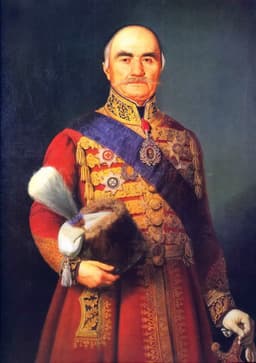
Milos Obrenovic
Emperor · Modern
52.7Total

Yusuf Ali Kenadid
Emperor · Modern
46.6Total
Basic Information
Born
1780
1837
Died
1860
1911
Era
Modern
Modern
Nationality
Serbia
Somalia
Occupation
Emperor
Emperor
Civilization
Western
Other
Score Comparison
Military (10%)
55.0
46.7
Political (20%)
68.0
39.4
Influence (20%)
53.3
48.6
Legacy (20%)
47.5
40.8
Leadership (15%)
53.2
65.7
Strategy (15%)
38.6
38.6
TOTAL
52.7
46.6
Milos Obrenovic — Complete Timeline
1815 AD
Led the Second Serbian UprisingWar
Miloš Obrenović led the Second Serbian Uprising against the Ottoman Empire. The uprising was more successful than the first, leading to negotiations with the Ottomans and the establishment of an autonomous Serbian principality under Ottoman suzerainty.
UprisingOttoman EmpireSerbian Autonomy
Impact: regionalconstructive
1817 AD
Recognized as Prince of SerbiaPolitical Action◆ Major
Miloš Obrenović was recognized as the hereditary Prince of Serbia by the Ottoman Empire, following the Second Serbian Uprising. This recognition established the Obrenović dynasty and granted Serbia a degree of autonomy.
RecognitionAutonomyDynasty Foundation
Impact: nationalconstructive
1839 AD
Abdicated the ThronePolitical Action◆ Major
Under pressure from opposition and the Ottoman Porte, Milo
AbdicationExileDynasty
Impact: national
1858 AD
Returned to Power as PrincePolitical Action◆ Major
Miloš Obrenović returned from exile and was reinstated as Prince of Serbia after the abdication of Alexander Karađorđević. He ruled until his death in 1860, consolidating the Obrenović dynasty's power.
Return to PowerDynasty RestorationSerbia
Impact: national
Yusuf Ali Kenadid — Complete Timeline
1878 AD
Foundation of the Sultanate of HobyoPolitical Action◆ Major
Yusuf Ali Kenadid established the Sultanate of Hobyo after breaking away from the Majeerteen Sultanate. He consolidated control over the central Somali coast, creating an independent state that lasted until Italian colonization.
FoundingSultanateHobyo
Impact: regionalconstructive
1879 AD
Military Campaigns Against MajeerteenWar
Yusuf Ali Kenadid led military campaigns against the Majeerteen Sultanate to secure his breakaway state's borders and expand territory. These conflicts weakened both sultanates and facilitated Italian colonial ambitions.
Civil WarExpansionHobyo
Impact: regionaldestructive
1888 AD
Signing of the Italian Protectorate TreatyPolitical Action◆ Major
Yusuf Ali Kenadid signed a protectorate treaty with Italy, placing the Sultanate of Hobyo under Italian colonial rule. This agreement granted Italy control over foreign affairs while preserving internal autonomy temporarily.
ColonialismTreatyItalian Somaliland
Impact: regional
Expert Analysis
Origins
Miloš Obrenović was born in 1780 in Srednja Dobrinja, Serbia, then part of the Ottoman Empire. He came from a peasant family and had little formal education. His half-brother Milan Obrenović was a leader in the First Serbian Uprising. Miloš initially worked as a livestock trader and later served as a knez (local chief) under Karađorđe. After the failure of the First Uprising, he fled to the Austrian Empire but returned in 1815.
Yusuf Ali Kenadid was born around 1840 in the Majeerteen Sultanate (present-day Somalia). He was a member of the Majeerteen clan, specifically the Osman Mahamud subclan. His father was a local elder. Yusuf received traditional Islamic education. He initially served as a governor under the Majeerteen Sultan, but later rebelled.
Rise to Power
Miloš Obrenović rose to prominence by leading the Second Serbian Uprising in 1815 against the Ottomans. His military strategy scored 55.0, but his political acumen (68.0) proved decisive. He negotiated a partial autonomy for Serbia in 1817, making him the de facto ruler. By 1830, the Ottoman Empire recognized him as hereditary Prince, establishing the Obrenović dynasty. He faced opposition from the rival Karađorđević family and internal rivals.
Yusuf Ali Kenadid rose by breaking away from the Majeerteen Sultanate in 1878. He founded the Sultanate of Hobyo in central Somalia. His leadership score of 65.7 helped him consolidate power. In 1888, he signed a protectorate treaty with Italy, gaining recognition and support against the Majeerteen. This treaty, however, ceded control over foreign affairs to Italy.
Leadership & Governance
Miloš Obrenović ruled Serbia as an autocrat. He centralized power, suppressed opposition, and modernized the state. He introduced a legal code, improved infrastructure, and promoted education. However, his authoritarian style led to conflicts with the nobility and the Ottoman Porte. He was forced to abdicate in 1839 under pressure from the Ottoman Porte and domestic opposition, but returned to power in 1858 after the exile of Alexander Karađorđević.
Yusuf Ali Kenadid ruled the Sultanate of Hobyo with a traditional Somali governance structure. He maintained clan alliances and collected tribute. His leadership score of 65.7 indicates effective control. However, his political score of 39.4 reflects the limitations of his power due to Italian colonial influence. He ceded significant authority to Italy, which exploited the sultanate for economic gain.
Triumph & Tragedy
Miloš Obrenović's greatest success was securing Serbian autonomy without full-scale war. He achieved recognition as hereditary Prince, laying the foundation for a modern Serbian state. His greatest failure was his autocratic rule, which led to exile and instability. His abdication in 1839 weakened the dynasty, though he later returned.
Yusuf Ali Kenadid's triumph was founding the Sultanate of Hobyo and maintaining its independence for over two decades. His tragedy was the protectorate treaty with Italy, which ultimately led to colonial subjugation. The sultanate was incorporated into Italian Somaliland after his death in 1911.
Character & Destiny
Miloš Obrenović was pragmatic and cunning, prioritizing political survival over military glory (military score 55.0). His character shaped Serbia's path toward autonomy but also created internal divisions. Historians note his ability to navigate Ottoman politics, but his authoritarianism sowed seeds of future conflict.
Yusuf Ali Kenadid was a determined leader who used diplomacy and clan politics. His leadership score (65.7) suggests strong personal authority, but his decision to ally with Italy was a strategic miscalculation. His destiny was tied to the colonial scramble for Africa, which limited his long-term impact.
Legacy
Miloš Obrenović's legacy is the establishment of the Obrenović dynasty, which ruled Serbia until 1903. His political score of 68.0 reflects his role in building state institutions. Serbia's autonomy under him paved the way for full independence in 1878. However, his legacy is mixed due to his authoritarian rule and the dynasty's eventual fall.
Yusuf Ali Kenadid's legacy is the Sultanate of Hobyo, which existed until 1926. His legacy score of 40.8 indicates limited long-term impact. The sultanate is remembered as a short-lived state in Somali history, overshadowed by colonial rule. His alliance with Italy is criticized for facilitating colonization.
Conclusion
Miloš Obrenović had a greater impact due to his role in establishing Serbian autonomy and a dynasty that influenced the Balkans for decades. His total score of 52.7 exceeds Yusuf Ali Kenadid's 46.6. While Kenadid founded a sultanate, his political decisions ceded sovereignty to Italy, limiting his influence. Obrenović's political acumen and legacy of state-building outweigh Kenadid's leadership in a colonial context.
Rankings
🥇
Milos ObrenovicLeader
Mil: 55.0Pol: 68.0Inf: 53.3
52.7
🥈
Yusuf Ali Kenadid
Mil: 46.7Pol: 39.4Inf: 48.6
46.6
+6.1 behind
How This Comparison Works
Algorithm
Each figure is scored on 6 dimensions (0—100 scale) based on structured historical data: Military (10%), Political (20%), Influence (20%), Legacy (20%), Leadership (15%), Strategy (15%). The weighted total produces the final ranking.
Data Sources
Scores are computed from structured sub-indicators in the database. Scale factors adjust for era (Ancient ×0.85, Modern ×1.0) and civilization size (Eastern ×1.05, Other ×0.80) to account for differences in population and military scale.
Maximum 3 Figures
Comparisons are limited to 2—3 figures to ensure readability and statistical meaningfulness.
Error Margins
±5 points per dimension — Sub-scores are derived from historical records with inherent uncertainty. Two figures within 5 points on a dimension should be considered roughly equivalent in that area.
Total Score Accuracy
±3 points overall — The weighted combination of 6 dimensions produces a total score with approximately ±3 points of uncertainty. Differences of less than 3 points are not statistically significant— the figures are effectively tied.
Known Limitations
- Historical records are incomplete and uneven across civilizations
- Figures from oral-tradition societies may be underrepresented
- Occupation labels can misclassify multi-role figures
- Scores measure capability and impact, not moral character
- Quantitative scoring is a comparison tool, not absolute truth
Capability Radar
Military (10%) — Battles & Warfare
Battles
25
30
Win Rate
30
35
Expansion
35
40
Political (20%) — Governance & Reform
Reform
55
30
Diplomacy
50
35
Economy
45
25
Influence (20%) — Cultural & Global Reach
Cultural
30
20
Global
20
10
Legacy (20%) — Historical Impact
Historical
45
25
Longevity
40
20
Leadership (15%) — Power & Stability
Tenure
60
40
Stability
40
25
Strategy (15%) — Tactics & Innovation
Strategy
25
30
Tactics
20
25
Reform
30
20
Similar Comparisons
Comments & Discussion
No comments yet. Be the first to share your thoughts!