Loading...
This comparison has not been analyzed yet.
One-time AI generation (~1 minute). Scores and timeline are already available below.
Mswati I vs Ntare I of Burundi
Ntare I of Burundi leads by 5.9 pts · 2 figures compared
…
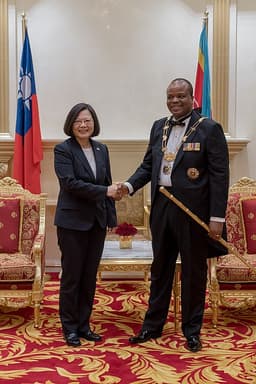
Mswati I
Emperor · Modern
43.9Total

Ntare I of Burundi
Emperor · Modern
49.8Total
Basic Information
Born
1800
1650
Died
1840
1705
Era
Modern
Modern
Nationality
Eswatini
Burundi
Occupation
Emperor
Emperor
Civilization
Other
Other
Score Comparison
Military (10%)
50.0
50.0
Political (20%)
32.2
39.4
Influence (20%)
48.6
53.3
Legacy (20%)
37.5
47.5
Leadership (15%)
58.8
67.0
Strategy (15%)
36.8
36.8
TOTAL
43.9
49.8
Mswati I — Complete Timeline
1836 AD
First Contact with European TradersPolitical Action◆ Major
Mswati I established initial diplomatic and trade relations with European hunters and traders entering Swazi territory. This opened the kingdom to external commerce and introduced firearms, altering the regional balance of power.
European ContactTradeDiplomacy
Impact: regional
1838 AD
Expansion of Swazi TerritoryWar◆ Major
Mswati I led military campaigns that expanded Swazi control northward into present-day Mpumalanga and southward toward the Pongola River. These conquests secured valuable grazing lands and trade routes.
Territorial ExpansionMilitary CampaignConquest
Impact: regional
1840 AD
Conflict with the Zulu KingdomWar
Mswati I engaged in a series of skirmishes with the Zulu kingdom under Dingane and later Mpande. The conflict ended with a negotiated boundary agreement that stabilized the southern frontier.
Zulu ConflictBorder DisputeWar
Impact: regional
Ntare I of Burundi — Complete Timeline
1680 AD
Founded the Kingdom of BurundiPolitical Action◆ Major
According to oral tradition, Ntare I established the Kingdom of Burundi, unifying various Hutu and Tutsi clans under a single monarchy. He is considered the first mwami (king) of the Ganwa dynasty, laying the foundation for Burundi's political structure that lasted until the 20th century.
FoundingMonarchyOral Tradition
Impact: regionalconstructive
1690 AD
Expanded territory through conquest and alliancesWar◆ Major
Ntare I led military campaigns to expand the nascent kingdom's territory, incorporating neighboring regions through conquest and strategic marriages. These expansions established the core of the Burundian state, including the central highlands and parts of the Ruzizi plain.
ExpansionConquestState Formation
Impact: regional
1700 AD
Established the Ganwa dynasty's royal lineagePolitical Action◆ Major
Ntare I formalized the succession system for the Burundian monarchy, establishing the Ganwa dynasty as the ruling lineage. This system defined the political hierarchy, with the mwami at the apex, and influenced Burundian governance for over two centuries.
DynastySuccessionGovernance
Impact: regionalconstructive
This comparison has not been analyzed yet.
One-time AI generation (~1 minute). Scores and timeline are already available below.
Rankings
🥇
Ntare I of BurundiLeader
Mil: 50.0Pol: 39.4Inf: 53.3
49.8
🥈
Mswati I
Mil: 50.0Pol: 32.2Inf: 48.6
43.9
+5.9 behind
How This Comparison Works
Algorithm
Each figure is scored on 6 dimensions (0—100 scale) based on structured historical data: Military (10%), Political (20%), Influence (20%), Legacy (20%), Leadership (15%), Strategy (15%). The weighted total produces the final ranking.
Data Sources
Scores are computed from structured sub-indicators in the database. Scale factors adjust for era (Ancient ×0.85, Modern ×1.0) and civilization size (Eastern ×1.05, Other ×0.80) to account for differences in population and military scale.
Maximum 3 Figures
Comparisons are limited to 2—3 figures to ensure readability and statistical meaningfulness.
Error Margins
±5 points per dimension — Sub-scores are derived from historical records with inherent uncertainty. Two figures within 5 points on a dimension should be considered roughly equivalent in that area.
Total Score Accuracy
±3 points overall — The weighted combination of 6 dimensions produces a total score with approximately ±3 points of uncertainty. Differences of less than 3 points are not statistically significant— the figures are effectively tied.
Known Limitations
- Historical records are incomplete and uneven across civilizations
- Figures from oral-tradition societies may be underrepresented
- Occupation labels can misclassify multi-role figures
- Scores measure capability and impact, not moral character
- Quantitative scoring is a comparison tool, not absolute truth
Capability Radar
Military (10%) — Battles & Warfare
Battles
15
20
Win Rate
20
25
Expansion
25
30
Political (20%) — Governance & Reform
Reform
20
35
Diplomacy
25
30
Economy
20
25
Influence (20%) — Cultural & Global Reach
Cultural
20
35
Global
10
15
Legacy (20%) — Historical Impact
Historical
20
40
Longevity
15
45
Leadership (15%) — Power & Stability
Tenure
30
40
Stability
25
30
Strategy (15%) — Tactics & Innovation
Strategy
20
20
Tactics
15
15
Reform
10
10
Similar Comparisons
Comments & Discussion
No comments yet. Be the first to share your thoughts!