Loading...
This comparison has not been analyzed yet.
One-time AI generation (~1 minute). Scores and timeline are already available below.
Mundzuk vs Natakamani
Mundzuk leads by 2.7 pts · 2 figures compared
…
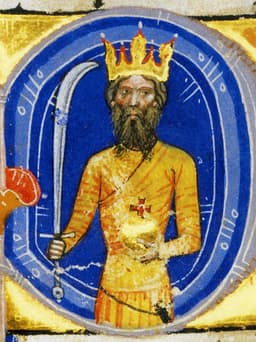
Mundzuk
Emperor · Ancient
55.2Total

Natakamani
Emperor · Ancient
52.5Total
Basic Information
Born
380
1
Died
420
20
Era
Ancient
Ancient
Nationality
Hunnic Empire
Kush
Occupation
Emperor
Emperor
Civilization
Western
Other
Score Comparison
Military (10%)
20.5
35.0
Political (20%)
68.0
68.0
Influence (20%)
56.2
54.1
Legacy (20%)
52.1
45.0
Leadership (15%)
77.6
68.0
Strategy (15%)
42.3
38.3
TOTAL
55.2
52.5
Mundzuk — Complete Timeline
400 AD
Father of Attila and BledaOther◆ Major
Mundzuk fathered Attila and Bleda, who would later become the most famous rulers of the Hunnic Empire. His paternity established the lineage that would lead to the Huns' greatest period of power and their campaigns against the Roman Empire.
HunsLineageAttilaBleda
Impact: regional
Hun noble statusOther
Mundzuk was a prominent Hun noble, likely a chieftain or king of a Hun tribe. His status allowed his sons to claim leadership of the Huns after his death, though he did not rule the entire Hun confederation himself.
HunsNobilityChieftain
420 AD
DeathOther
Mundzuk died around 420 AD, leaving his sons Attila and Bleda under the guardianship of his brother Rugila. His death set the stage for Rugila's unification of the Huns and the eventual rise of Attila and Bleda as co-rulers.
HunsDeathSuccession
Natakamani — Complete Timeline
1 AD
Co-Rulership with AmanitorePolitical Action◆ Major
Natakamani ruled jointly with Queen Amanitore, a unique co-regency that lasted for most of his reign. Their images appear together on monuments, indicating shared authority and a period of stability and prosperity for Kush.
Co-RulershipGovernmentStability
Impact: nationalconstructive
5 AD
Construction of Amun Temple at NaqaCultural◆ Major
Natakamani oversaw the construction of the Temple of Amun at Naqa, one of the largest and best-preserved Meroitic temples. The temple complex featured elaborate reliefs and a kiosk, showcasing the architectural achievements of his reign.
ArchitectureReligionBuilding Program
Impact: regionalconstructive
10 AD
Building of the Royal Enclosure at MeroeCultural◆ Major
Natakamani expanded and renovated the Royal Enclosure at Meroe, including the construction of palaces, temples, and administrative buildings. This complex became the political and ceremonial heart of the Kushite kingdom.
ArchitectureCapitalBuilding Program
Impact: nationalconstructive
This comparison has not been analyzed yet.
One-time AI generation (~1 minute). Scores and timeline are already available below.
Rankings
🥇
MundzukLeader
Mil: 20.5Pol: 68.0Inf: 56.2
55.2
🥈
Natakamani
Mil: 35.0Pol: 68.0Inf: 54.1
52.5
+2.7 behind
How This Comparison Works
Algorithm
Each figure is scored on 6 dimensions (0—100 scale) based on structured historical data: Military (10%), Political (20%), Influence (20%), Legacy (20%), Leadership (15%), Strategy (15%). The weighted total produces the final ranking.
Data Sources
Scores are computed from structured sub-indicators in the database. Scale factors adjust for era (Ancient ×0.85, Modern ×1.0) and civilization size (Eastern ×1.05, Other ×0.80) to account for differences in population and military scale.
Maximum 3 Figures
Comparisons are limited to 2—3 figures to ensure readability and statistical meaningfulness.
Error Margins
±5 points per dimension — Sub-scores are derived from historical records with inherent uncertainty. Two figures within 5 points on a dimension should be considered roughly equivalent in that area.
Total Score Accuracy
±3 points overall — The weighted combination of 6 dimensions produces a total score with approximately ±3 points of uncertainty. Differences of less than 3 points are not statistically significant— the figures are effectively tied.
Known Limitations
- Historical records are incomplete and uneven across civilizations
- Figures from oral-tradition societies may be underrepresented
- Occupation labels can misclassify multi-role figures
- Scores measure capability and impact, not moral character
- Quantitative scoring is a comparison tool, not absolute truth
Capability Radar
Military (10%) — Battles & Warfare
Battles
3
20
Win Rate
5
20
Expansion
12
30
Political (20%) — Governance & Reform
Reform
49
55
Diplomacy
52
50
Economy
52
60
Influence (20%) — Cultural & Global Reach
Cultural
67
55
Global
79
30
Legacy (20%) — Historical Impact
Historical
69
50
Longevity
71
40
Leadership (15%) — Power & Stability
Tenure
49
60
Stability
58
65
Strategy (15%) — Tactics & Innovation
Strategy
15
25
Tactics
14
25
Reform
22
15
Similar Comparisons
Comments & Discussion
No comments yet. Be the first to share your thoughts!