Loading...
This comparison has not been analyzed yet.
One-time AI generation (~1 minute). Scores and timeline are already available below.
Mundzuk vs Yashodharman
Mundzuk leads by 5.8 pts · 2 figures compared
…
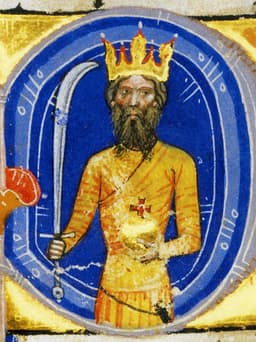
Mundzuk
Emperor · Ancient
55.2Total

Yashodharman
Emperor · Ancient
49.4Total
Basic Information
Born
380
-515
Died
420
—
Era
Ancient
Ancient
Nationality
Hunnic Empire
India
Occupation
Emperor
Emperor
Civilization
Western
Indian
Score Comparison
Military (10%)
20.5
70.0
Political (20%)
68.0
36.5
Influence (20%)
56.2
48.6
Legacy (20%)
52.1
40.0
Leadership (15%)
77.6
58.8
Strategy (15%)
42.3
60.0
TOTAL
55.2
49.4
Mundzuk — Complete Timeline
400 AD
Father of Attila and BledaOther◆ Major
Mundzuk fathered Attila and Bleda, who would later become the most famous rulers of the Hunnic Empire. His paternity established the lineage that would lead to the Huns' greatest period of power and their campaigns against the Roman Empire.
HunsLineageAttilaBleda
Impact: regional
Hun noble statusOther
Mundzuk was a prominent Hun noble, likely a chieftain or king of a Hun tribe. His status allowed his sons to claim leadership of the Huns after his death, though he did not rule the entire Hun confederation himself.
HunsNobilityChieftain
420 AD
DeathOther
Mundzuk died around 420 AD, leaving his sons Attila and Bleda under the guardianship of his brother Rugila. His death set the stage for Rugila's unification of the Huns and the eventual rise of Attila and Bleda as co-rulers.
HunsDeathSuccession
Yashodharman — Complete Timeline
525 AD
Expanded the Aulikara KingdomWar◆ Major
Yashodharman conquered territories in central and western India, including parts of Malwa, Gujarat, and Rajasthan. His campaigns expanded the Aulikara kingdom into a major regional power, though it collapsed after his death.
ConquestTerritorial Expansion
Impact: regional
528 AD
Defeated the Huna King MihirakulaWar
Yashodharman led a coalition of Indian kings to defeat the Huna ruler Mihirakula, who had terrorized northern India. The victory ended Huna dominance in the region and is recorded in the Mandasor pillar inscription, which celebrates Yashodharman as a liberator.
BattleHuna Defeat
Impact: regional
Issued the Mandasor Pillar InscriptionCultural
Yashodharman erected a victory pillar at Mandasor (modern Madhya Pradesh) with an inscription boasting of his conquests. The inscription claims he ruled from the Brahmaputra to the Arabian Sea and the Himalayas to the Vindhyas, though this may be exaggerated.
InscriptionPropaganda
Impact: regional
This comparison has not been analyzed yet.
One-time AI generation (~1 minute). Scores and timeline are already available below.
Rankings
🥇
MundzukLeader
Mil: 20.5Pol: 68.0Inf: 56.2
55.2
🥈
Yashodharman
Mil: 70.0Pol: 36.5Inf: 48.6
49.4
+5.8 behind
How This Comparison Works
Algorithm
Each figure is scored on 6 dimensions (0—100 scale) based on structured historical data: Military (10%), Political (20%), Influence (20%), Legacy (20%), Leadership (15%), Strategy (15%). The weighted total produces the final ranking.
Data Sources
Scores are computed from structured sub-indicators in the database. Scale factors adjust for era (Ancient ×0.85, Modern ×1.0) and civilization size (Eastern ×1.05, Other ×0.80) to account for differences in population and military scale.
Maximum 3 Figures
Comparisons are limited to 2—3 figures to ensure readability and statistical meaningfulness.
Error Margins
±5 points per dimension — Sub-scores are derived from historical records with inherent uncertainty. Two figures within 5 points on a dimension should be considered roughly equivalent in that area.
Total Score Accuracy
±3 points overall — The weighted combination of 6 dimensions produces a total score with approximately ±3 points of uncertainty. Differences of less than 3 points are not statistically significant— the figures are effectively tied.
Known Limitations
- Historical records are incomplete and uneven across civilizations
- Figures from oral-tradition societies may be underrepresented
- Occupation labels can misclassify multi-role figures
- Scores measure capability and impact, not moral character
- Quantitative scoring is a comparison tool, not absolute truth
Capability Radar
Military (10%) — Battles & Warfare
Battles
3
60
Win Rate
5
70
Expansion
12
45
Political (20%) — Governance & Reform
Reform
49
30
Diplomacy
52
35
Economy
52
30
Influence (20%) — Cultural & Global Reach
Cultural
67
30
Global
79
20
Legacy (20%) — Historical Impact
Historical
69
40
Longevity
71
20
Leadership (15%) — Power & Stability
Tenure
49
40
Stability
58
35
Strategy (15%) — Tactics & Innovation
Strategy
15
50
Tactics
14
55
Reform
22
30
Similar Comparisons
Comments & Discussion
No comments yet. Be the first to share your thoughts!