Loading...
Ammi-Saduqa vs Yashodharman
Yashodharman leads by 9.7 pts · 2 figures compared
…
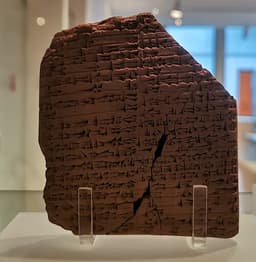
Ammi-Saduqa
Emperor · Ancient
39.7Total

Yashodharman
Emperor · Ancient
49.4Total
Basic Information
Born
-1646
-515
Died
-1626
—
Era
Ancient
Ancient
Nationality
Babylon
India
Occupation
Emperor
Emperor
Civilization
Middle Eastern
Indian
Score Comparison
Military (10%)
34.4
70.0
Political (20%)
32.1
36.5
Influence (20%)
44.0
48.6
Legacy (20%)
41.7
40.0
Leadership (15%)
31.2
58.8
Strategy (15%)
53.3
60.0
TOTAL
39.7
49.4
Ammi-Saduqa — Complete Timeline
1646 BC
Recording of Venus Tablet ObservationsCultural
During Ammi-Saduqa's reign, Babylonian astronomers recorded detailed observations of the planet Venus over a 21-year period. These records, preserved on cuneiform tablets, are now crucial for establishing the absolute chronology of the ancient Near East by correlating them with astronomical calculations.
AstronomyChronologyVenus
Impact: globalconstructive
Yashodharman — Complete Timeline
525 AD
Expanded the Aulikara KingdomWar◆ Major
Yashodharman conquered territories in central and western India, including parts of Malwa, Gujarat, and Rajasthan. His campaigns expanded the Aulikara kingdom into a major regional power, though it collapsed after his death.
ConquestTerritorial Expansion
Impact: regional
528 AD
Defeated the Huna King MihirakulaWar
Yashodharman led a coalition of Indian kings to defeat the Huna ruler Mihirakula, who had terrorized northern India. The victory ended Huna dominance in the region and is recorded in the Mandasor pillar inscription, which celebrates Yashodharman as a liberator.
BattleHuna Defeat
Impact: regional
Issued the Mandasor Pillar InscriptionCultural
Yashodharman erected a victory pillar at Mandasor (modern Madhya Pradesh) with an inscription boasting of his conquests. The inscription claims he ruled from the Brahmaputra to the Arabian Sea and the Himalayas to the Vindhyas, though this may be exaggerated.
InscriptionPropaganda
Impact: regional
Expert Analysis
Origins
Ammi-Saduqa was the 10th king of the First Dynasty of Babylon, reigning from approximately 1646 to 1626 BCE. He was the son of Abi-Eshuh and grandson of Hammurabi, inheriting a stable but declining empire. His early life was steeped in the administrative and religious traditions of Babylon, but little is known of his personal experiences. The Venus tablets, which record the planet's appearances over 21 years, were likely compiled by court astronomers and bear his name, making him a linchpin in ancient chronology.
Yashodharman, in contrast, emerged from the Aulikara dynasty in central India around the 6th century CE. He was likely born into a warrior clan in Malwa (modern Madhya Pradesh). His early life is obscure, but he must have been trained in martial arts and statecraft. The Aulikaras had been vassals of the Gupta Empire, but with Gupta decline, Yashodharman seized the opportunity to assert independence.
Rise to Power
Ammi-Saduqa ascended to the throne peacefully, inheriting a kingdom that had already peaked under Hammurabi. His reign focused on maintaining stability and religious observance. The Venus tablets were a scientific endeavor, but they also served to legitimize his rule by connecting celestial events with royal authority. No major military campaigns are recorded, and his political power was limited to the traditional Babylonian heartland.
Yashodharman rose through military prowess. Around 528 CE, the Huna king Mihirakula, a brutal ruler, had devastated northern India. Yashodharman organized a coalition of regional kings and defeated Mihirakula in a decisive battle. This victory, recorded in the Mandasor Pillar Inscription, ended Huna dominance and allowed Yashodharman to expand his territory across Malwa, Gujarat, and Rajasthan.
Leadership & Governance
Ammi-Saduqa's leadership was passive and ceremonial. He maintained the existing Babylonian bureaucracy, supported temples, and commissioned astronomical records. His governance score of 31.2 reflects his lack of initiative in reform or expansion. The Venus tablets, while scientifically valuable, were not a product of his direct leadership but of court scholars.
Yashodharman was a proactive military leader, scoring 70.0 in military strategy. He personally led campaigns and forged alliances. His political score of 36.5 indicates limited administrative innovation; he ruled as a conqueror, relying on tribute and loyalty from defeated kings. The Mandasor inscription boasts of his conquests from the Himalayas to the western ocean, but his governance likely lacked the institutional depth of the Guptas.
Triumph & Tragedy
Ammi-Saduqa's greatest triumph is the Venus tablets, which have been used by modern historians to anchor Mesopotamian chronology. By correlating the recorded Venus cycles with astronomical models, scholars have dated his reign with precision. This is a legacy of immense scholarly value. His greatest failure was his inability to prevent the gradual decline of Babylon; after his death, the First Dynasty fell to the Hittites in 1595 BCE.
Yashodharman's triumph was his defeat of Mihirakula, a tyrant who had destroyed monasteries and cities. This victory saved Indian culture from further Huna depredations. His tragedy is that his empire did not outlast him. Within a generation, the Aulikara kingdom dissolved, and Yashodharman himself vanished from history after his victory pillar was erected. His political score of 36.5 reflects this short-lived empire.
Character & Destiny
Ammi-Saduqa appears as a traditionalist, content to uphold his ancestors' legacy. His decision to record Venus observations suggests an interest in omens and astrology, common for Babylonian kings. His character was cautious, not ambitious, which suited a period of consolidation but not expansion. Destiny gave him a role as a chronological marker rather than a great conqueror.
Yashodharman was a warrior-king of fierce ambition. The Mandasor inscription describes him as "the king of kings" and claims he ruled the entire earth, typical hyperbolic boast. His character was decisive and ruthless, as needed to defeat the Hunas. Yet his destiny was to be a brief flame—his empire crumbled due to lack of administrative foundation. He scored 58.8 in leadership, indicating strong personal command but poor institutional legacy.
Legacy
Ammi-Saduqa's legacy is indirect but profound. His Venus tablets are among the most important astronomical records from antiquity, used to date the entire ancient Near East. The conventional chronology of Babylon, Assyria, and Egypt relies on these observations. His legacy score of 41.7 reflects this enduring academic impact, even if his name is obscure.
Yashodharman's legacy is more immediate but narrower. He is remembered as the liberator of India from Huna tyranny, celebrated in regional history and inscriptions. However, his empire left no lasting institutions, and his name is not widely known outside specialist circles. His legacy score of 40.0 is slightly lower than Ammi-Saduqa's, as the Venus tablets have global chronological significance.
Conclusion
Yashodharman has a higher total score (49.4 vs 39.7) and clearly superior military and leadership metrics. He defeated a major enemy and expanded his territory, while Ammi-Saduqa presided over a declining kingdom. However, in terms of lasting impact, Ammi-Saduqa's Venus tablets are more significant for world history. They provide a fixed point for ancient chronology, affecting the study of Egypt, Mesopotamia, and the Levant. Yashodharman's victory was important regionally but did not change the course of world history. Therefore, while Yashodharman was the more capable ruler in his lifetime, Ammi-Saduqa's legacy has a greater long-term influence on historical scholarship.
Rankings
🥇
YashodharmanLeader
Mil: 70.0Pol: 36.5Inf: 48.6
49.4
🥈
Ammi-Saduqa
Mil: 34.4Pol: 32.1Inf: 44.0
39.7
+9.7 behind
How This Comparison Works
Algorithm
Each figure is scored on 6 dimensions (0—100 scale) based on structured historical data: Military (10%), Political (20%), Influence (20%), Legacy (20%), Leadership (15%), Strategy (15%). The weighted total produces the final ranking.
Data Sources
Scores are computed from structured sub-indicators in the database. Scale factors adjust for era (Ancient ×0.85, Modern ×1.0) and civilization size (Eastern ×1.05, Other ×0.80) to account for differences in population and military scale.
Maximum 3 Figures
Comparisons are limited to 2—3 figures to ensure readability and statistical meaningfulness.
Error Margins
±5 points per dimension — Sub-scores are derived from historical records with inherent uncertainty. Two figures within 5 points on a dimension should be considered roughly equivalent in that area.
Total Score Accuracy
±3 points overall — The weighted combination of 6 dimensions produces a total score with approximately ±3 points of uncertainty. Differences of less than 3 points are not statistically significant— the figures are effectively tied.
Known Limitations
- Historical records are incomplete and uneven across civilizations
- Figures from oral-tradition societies may be underrepresented
- Occupation labels can misclassify multi-role figures
- Scores measure capability and impact, not moral character
- Quantitative scoring is a comparison tool, not absolute truth
Capability Radar
Military (10%) — Battles & Warfare
Battles
37
60
Win Rate
39
70
Expansion
47
45
Political (20%) — Governance & Reform
Reform
10
30
Diplomacy
10
35
Economy
10
30
Influence (20%) — Cultural & Global Reach
Cultural
10
30
Global
10
20
Legacy (20%) — Historical Impact
Historical
40
40
Longevity
30
20
Leadership (15%) — Power & Stability
Tenure
20
40
Stability
15
35
Strategy (15%) — Tactics & Innovation
Strategy
47
50
Tactics
52
55
Reform
54
30
Similar Comparisons
Comments & Discussion
No comments yet. Be the first to share your thoughts!