Loading...
Muqali vs Yue Fei
Muqali leads by 9.9 pts · 2 figures compared
…
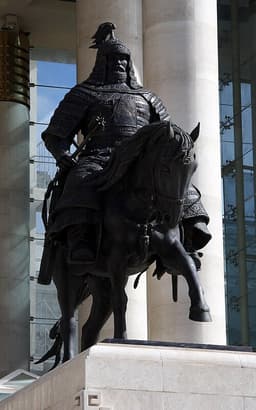
Muqali
General · Medieval
61.3Total

Yue Fei
General · Medieval
51.4Total
Basic Information
Born
1170
1103
Died
1223
1142
Era
Medieval
Medieval
Nationality
Mongol Empire
China
Occupation
General
General
Civilization
Eastern
Eastern
Score Comparison
Military (10%)
65.0
72.0
Political (20%)
68.0
27.9
Influence (20%)
58.0
56.7
Legacy (20%)
49.2
55.0
Leadership (15%)
70.4
30.0
Strategy (15%)
72.0
76.0
TOTAL
61.3
51.4
Muqali — Complete Timeline
1211 AD
Campaign in Northern ChinaWar◆ Major
Muqali was a key commander in Genghis Khan's invasion of the Jin Dynasty. He led forces in the capture of numerous cities and fortresses in northern China, including the victory at the Battle of Yehuling in 1211, which broke Jin resistance.
Jin DynastyYehulingNorthern China
Impact: regional
1212 AD
Conquest of ManchuriaWar
Muqali led a campaign to subdue the Khitan and Jurchen tribes in Manchuria. He defeated the rebel Khitan leader Yel
ManchuriaKhitanJurchen
Impact: regional
1215 AD
Siege of ZhongduWar◆ Major
Muqali participated in the Mongol siege of Zhongdu (modern Beijing), the capital of the Jin Dynasty. The city fell after a prolonged siege, leading to the massacre of its inhabitants and the effective collapse of Jin authority in northern China.
ZhongduBeijingSiege
Impact: regionaldestructive
1217 AD
Appointment as Viceroy of ChinaPolitical Action◆ Major
Genghis Khan appointed Muqali as viceroy (guo-wang) of all conquered territories in China, granting him command of the Mongol forces in the region. This made Muqali the de facto ruler of Mongol-occupied northern China.
ViceroyChinaGenghis Khan
Impact: regionalconstructive
Yue Fei — Complete Timeline
1134 AD
Recapture of XiangyangWar◆ Major
Yue Fei recaptured the strategic city of Xiangyang from the Jin dynasty. This victory secured the Song's northern frontier and provided a base for further offensives. The campaign demonstrated his military skill and boosted Song morale.
Jin-Song WarSiegeTerritorial Recovery
Impact: regional
1140 AD
Battle of YanchengWar◆ Major
Yue Fei led the Song army to a major victory against the Jin forces at Yancheng. His troops, using innovative tactics, defeated a larger Jin cavalry force. This battle was part of his campaign to recover lost territories north of the Huai River.
Jin-Song WarMilitary VictoryNorthern Campaign
Impact: regional
1141 AD
Recall and Arrest by Emperor GaozongPolitical Action◆ Major
Emperor Gaozong, fearing Yue Fei's growing power and seeking peace with the Jin, ordered him to return to the capital. Yue Fei was arrested on false charges of treason. This decision ended the Song's northern offensive and led to a peace treaty.
Political ArrestPeace PolicyImperial Decision
Impact: nationaltragic
1142 AD
Execution of Yue FeiPolitical Action◆ Major
Yue Fei was executed in prison on orders of Emperor Gaozong, likely under pressure from the Jin dynasty. His death was a miscarriage of justice that shocked the nation. He was later posthumously exonerated and became a symbol of loyalty.
ExecutionInjusticeMartyrdom
Impact: nationaltragic
Expert Analysis
Origins
Muqali was born around 1170 into the Jalayir clan, a Mongol tribe that submitted to Genghis Khan early. His father served as a commander, and Muqali grew up in the steppe, learning horsemanship and archery. He became a trusted nökör (companion) to Genghis Khan, participating in the unification of Mongol tribes. Yue Fei was born in 1103 in Tangyin, Henan, during the Northern Song dynasty. His family was poor, but his father taught him Confucian classics and martial arts. He joined the Song army in 1122 to resist the Jin invasion after the fall of Kaifeng.
Rise to Power
Muqali rose through military merit. In 1206, after Genghis Khan proclaimed the Mongol Empire, Muqali was appointed as one of the four 'hounds of war' along with Subutai, Jebe, and Khubilai. His key turning point came in 1211 during the invasion of the Jin dynasty, where he led the vanguard at the Battle of Yehuling, a decisive Mongol victory. In 1217, Genghis Khan appointed Muqali as viceroy (guo-wang) of all conquered Chinese territories, granting him command of 23,000 troops to continue the conquest. Yue Fei rose by distinguishing himself in battle against the Jin. In 1134, he recaptured Xiangyang, a strategic city, and was promoted to commander. His victories at Yancheng (1140) where his cavalry defeated Jin forces using innovative tactics made him a national hero. However, his political naivety led to his downfall: Emperor Gaozong, fearing his power and seeking peace, recalled and arrested him in 1141.
Leadership & Governance
Muqali ruled as a military governor, focusing on consolidating Mongol control. He employed Chinese administrators and adopted siege warfare techniques, capturing cities like Zhongdu (Beijing) in 1215. His leadership style was pragmatic: he rewarded loyalty and integrated local elites. Yue Fei was a strict disciplinarian, known for his 'Yue Family Army' which followed a code of conduct: 'Do not harm the people, do not steal.' He emphasized infantry training and combined arms tactics. While Muqali scored 70.4 in leadership, Yue Fei scored only 30.0, reflecting his inability to navigate court politics.
Triumph & Tragedy
Muqali's greatest success was conquering most of Jin China by 1223, including Manchuria and parts of northern China. His failure was his death in 1223 before completing the conquest, leaving the task to others. Yue Fei's triumph was his undefeated record in battle, including the recapture of Xiangyang and the victory at Yancheng. His tragedy was his execution in 1142 on false charges, orchestrated by Chancellor Qin Hui and Emperor Gaozong. This betrayal made him a martyr, but his death halted Song counteroffensives.
Character & Destiny
Muqali was loyal and trusted by Genghis Khan, never questioning orders. His strategic mind (score 72.0) allowed him to adapt Mongol tactics to Chinese siege warfare. He died of illness, still in command. Yue Fei was idealistic and patriotic, but politically inflexible. His strategy score of 76.0 is higher than Muqali's, but his political score of 27.9 reflects his fatal inability to secure imperial support. His destiny was sealed by his own naivety and the emperor's fear.
Legacy
Muqali's legacy is as the architect of Mongol rule in China, paving the way for the Yuan dynasty. He is remembered in the Secret History of the Mongols. Yue Fei became a symbol of loyalty and patriotism in Chinese culture, with temples dedicated to him. His story is taught in Chinese schools, and his poem 'Man Jiang Hong' is famous. While Muqali's influence (58.0) is more immediate, Yue Fei's legacy (55.0) is enduring in Chinese national identity.
Conclusion
Muqali had greater immediate impact, conquering vast territories with a total score of 61.3 compared to Yue Fei's 51.4. However, Yue Fei's symbolic legacy as a patriot has shaped Chinese nationalism for centuries. In terms of military strategy, Yue Fei scored higher (76.0 vs 72.0), but Muqali's political acumen (68.0 vs 27.9) made him more effective in his time. Ultimately, Muqali's concrete achievements in expanding the Mongol Empire outweigh Yue Fei's tragic martyrdom. Muqali is the greater historical figure in terms of tangible impact.
Rankings
🥇
MuqaliLeader
Mil: 65.0Pol: 68.0Inf: 58.0
61.3
🥈
Yue Fei
Mil: 72.0Pol: 27.9Inf: 56.7
51.4
+9.9 behind
How This Comparison Works
Algorithm
Each figure is scored on 6 dimensions (0—100 scale) based on structured historical data: Military (10%), Political (20%), Influence (20%), Legacy (20%), Leadership (15%), Strategy (15%). The weighted total produces the final ranking.
Data Sources
Scores are computed from structured sub-indicators in the database. Scale factors adjust for era (Ancient ×0.85, Modern ×1.0) and civilization size (Eastern ×1.05, Other ×0.80) to account for differences in population and military scale.
Maximum 3 Figures
Comparisons are limited to 2—3 figures to ensure readability and statistical meaningfulness.
Error Margins
±5 points per dimension — Sub-scores are derived from historical records with inherent uncertainty. Two figures within 5 points on a dimension should be considered roughly equivalent in that area.
Total Score Accuracy
±3 points overall — The weighted combination of 6 dimensions produces a total score with approximately ±3 points of uncertainty. Differences of less than 3 points are not statistically significant— the figures are effectively tied.
Known Limitations
- Historical records are incomplete and uneven across civilizations
- Figures from oral-tradition societies may be underrepresented
- Occupation labels can misclassify multi-role figures
- Scores measure capability and impact, not moral character
- Quantitative scoring is a comparison tool, not absolute truth
Capability Radar
Military (10%) — Battles & Warfare
Battles
75
75
Win Rate
80
80
Expansion
85
65
Political (20%) — Governance & Reform
Reform
65
20
Diplomacy
72
25
Economy
60
15
Influence (20%) — Cultural & Global Reach
Cultural
55
85
Global
55
70
Legacy (20%) — Historical Impact
Historical
65
90
Longevity
50
85
Leadership (15%) — Power & Stability
Tenure
70
30
Stability
68
10
Strategy (15%) — Tactics & Innovation
Strategy
82
80
Tactics
78
85
Reform
60
70
Similar Comparisons
Comments & Discussion
No comments yet. Be the first to share your thoughts!