Loading...
This comparison has not been analyzed yet.
One-time AI generation (~1 minute). Scores and timeline are already available below.
Naomi Mataafa vs Yashwantrao Chavan
Yashwantrao Chavan leads by 3.6 pts · 2 figures compared
…
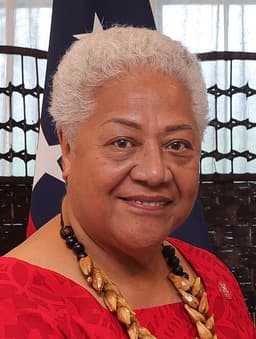
Naomi Mataafa
Politician · Modern
54.8Total

Yashwantrao Chavan
Politician · Modern
58.4Total
Basic Information
Born
1957
1913
Died
—
1984
Era
Modern
Modern
Nationality
Samoa
India
Occupation
Politician
Politician
Civilization
Other
Indian
Score Comparison
Military (10%)
50.0
37.9
Political (20%)
68.0
72.0
Influence (20%)
55.7
58.0
Legacy (20%)
45.8
50.0
Leadership (15%)
65.0
72.0
Strategy (15%)
44.9
60.0
TOTAL
54.8
58.4
Naomi Mataafa — Complete Timeline
2021 AD
Became first female Prime Minister of SamoaPolitical Action◆ Major
Mataafa led the FAST party to victory in the general election, becoming Samoa's first female prime minister. Her election ended the 22-year rule of Tuilaepa Malielegaoi and marked a historic shift in Samoan politics.
Prime MinisterGender EqualityHistoric First
Impact: nationalprogressive
Navigated constitutional crisis after electionPolitical Action◆ Major
Following her election victory, Malielegaoi refused to step down, leading to a standoff. Mataafa was sworn in by the Head of State, and the crisis was resolved when the Court of Appeal ruled in her favor, affirming her legitimacy.
Constitutional CrisisPolitical TransitionCourt Ruling
Impact: national
2022 AD
Repealed the Land Titles Registration ActReform◆ Major
Mataafa's government repealed the controversial Land Titles Registration Act, restoring customary land tenure systems. The repeal was seen as a victory for traditional leaders and communities who opposed the previous law.
Land ReformCustomary LandLegislation Repeal
Impact: nationalconstructive
Strengthened ties with China and Pacific neighborsPolitical Action
Mataafa pursued a balanced foreign policy, strengthening diplomatic and economic ties with China while maintaining relations with traditional partners like Australia and New Zealand. She also engaged with Pacific Island Forum initiatives.
Foreign PolicyChina RelationsPacific Diplomacy
Impact: regionalconstructive
Yashwantrao Chavan — Complete Timeline
1960 AD
Became First Chief Minister of MaharashtraPolitical Action◆ Major
Yashwantrao Chavan became the first Chief Minister of the newly formed state of Maharashtra after the bifurcation of Bombay State. He led the state through its formative years, focusing on industrial development and cooperative movements.
Chief MinisterMaharashtraState Formation
Impact: regionalconstructive
1971 AD
Served as Defence Minister during the 1971 Indo-Pakistan WarWar◆ Major
As Defence Minister, Chavan oversaw India's military operations during the war that led to the creation of Bangladesh. The war resulted in a decisive Indian victory and the largest military surrender since World War II.
Indo-Pakistan WarDefence MinisterBangladesh Liberation
Impact: regionalconstructive
1973 AD
Served as Finance Minister and Presented the 'Black Budget'Political Action
As Finance Minister, Chavan presented the 1973-74 Union Budget, which became known as the 'Black Budget' due to its large fiscal deficit. The budget included measures to nationalize coal mines and impose a ceiling on urban land holdings.
Finance MinisterBudgetEconomic Policy
Impact: national
1979 AD
Served as Deputy Prime Minister of IndiaPolitical Action◆ Major
Chavan served as Deputy Prime Minister under Prime Minister Morarji Desai in the Janata Party government. He also held the Home Ministry portfolio, dealing with internal security and political stability during a turbulent period.
Deputy Prime MinisterHome MinisterJanata Party
Impact: nationalconstructive
This comparison has not been analyzed yet.
One-time AI generation (~1 minute). Scores and timeline are already available below.
Rankings
🥇
Yashwantrao ChavanLeader
Mil: 37.9Pol: 72.0Inf: 58.0
58.4
🥈
Naomi Mataafa
Mil: 50.0Pol: 68.0Inf: 55.7
54.8
+3.6 behind
How This Comparison Works
Algorithm
Each figure is scored on 6 dimensions (0—100 scale) based on structured historical data: Military (10%), Political (20%), Influence (20%), Legacy (20%), Leadership (15%), Strategy (15%). The weighted total produces the final ranking.
Data Sources
Scores are computed from structured sub-indicators in the database. Scale factors adjust for era (Ancient ×0.85, Modern ×1.0) and civilization size (Eastern ×1.05, Other ×0.80) to account for differences in population and military scale.
Maximum 3 Figures
Comparisons are limited to 2—3 figures to ensure readability and statistical meaningfulness.
Error Margins
±5 points per dimension — Sub-scores are derived from historical records with inherent uncertainty. Two figures within 5 points on a dimension should be considered roughly equivalent in that area.
Total Score Accuracy
±3 points overall — The weighted combination of 6 dimensions produces a total score with approximately ±3 points of uncertainty. Differences of less than 3 points are not statistically significant— the figures are effectively tied.
Known Limitations
- Historical records are incomplete and uneven across civilizations
- Figures from oral-tradition societies may be underrepresented
- Occupation labels can misclassify multi-role figures
- Scores measure capability and impact, not moral character
- Quantitative scoring is a comparison tool, not absolute truth
Capability Radar
Military (10%) — Battles & Warfare
Battles
24
41
Win Rate
23
49
Expansion
29
51
Political (20%) — Governance & Reform
Reform
45
60
Diplomacy
55
70
Economy
40
55
Influence (20%) — Cultural & Global Reach
Cultural
45
50
Global
30
40
Legacy (20%) — Historical Impact
Historical
40
55
Longevity
35
45
Leadership (15%) — Power & Stability
Tenure
30
65
Stability
50
60
Strategy (15%) — Tactics & Innovation
Strategy
31
51
Tactics
33
58
Reform
35
60
Similar Comparisons
Comments & Discussion
No comments yet. Be the first to share your thoughts!