Loading...
This comparison has not been analyzed yet.
One-time AI generation (~1 minute). Scores and timeline are already available below.
Natsagiin Bagabandi vs Nicolae Ceausescu
Natsagiin Bagabandi leads by 2.0 pts · 2 figures compared
…

Natsagiin Bagabandi
Politician · Modern
48.4Total
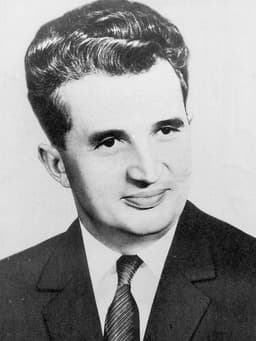
Nicolae Ceausescu
Politician · Modern
46.4Total
Basic Information
Born
1950
1918
Died
—
1989
Era
Modern
Modern
Nationality
Mongolia
Romania
Occupation
Politician
Politician
Civilization
Eastern
Western
Score Comparison
Military (10%)
13.0
36.6
Political (20%)
68.0
26.4
Influence (20%)
49.4
49.4
Legacy (20%)
40.8
40.0
Leadership (15%)
72.0
74.0
Strategy (15%)
35.6
53.0
TOTAL
48.4
46.4
Natsagiin Bagabandi — Complete Timeline
1997 AD
Election as President of MongoliaPolitical Action◆ Major
Natsagiin Bagabandi was elected president of Mongolia as the candidate of the Mongolian People's Revolutionary Party (MPRP). His victory marked the return of the former communist party to power through democratic elections.
Presidential ElectionMPRPMongolia
Impact: national
2000 AD
Economic Growth and Mining DevelopmentReform◆ Major
During Bagabandi's presidency, Mongolia experienced economic growth driven by mining sector development. His government pursued policies to attract foreign investment, though concerns about corruption and inequality emerged.
Economic GrowthMiningForeign Investment
Impact: nationalconstructive
2001 AD
Re-election as PresidentPolitical Action
Bagabandi was re-elected for a second term, continuing his presidency. His re-election reflected the MPRP's continued popularity and stability in Mongolian politics.
Re-electionMPRPPolitical Stability
Impact: national
Nicolae Ceausescu — Complete Timeline
1965 AD
Elected General Secretary of Romanian Communist PartyPolitical Action◆ Major
Ceausescu became General Secretary of the Romanian Communist Party after the death of Gheorghe Gheorghiu-Dej. He consolidated power by purging rivals and promoting family members to key positions, establishing a personal dictatorship.
CommunismDictatorshipCold War
Impact: nationaldestructive
1968 AD
Ceausescu's independent foreign policyPolitical Action◆ Major
Ceausescu publicly condemned the Warsaw Pact invasion of Czechoslovakia in 1968, refusing to send Romanian troops. This stance won him Western praise and loans, but also allowed him to pursue an independent nationalist line within the Eastern Bloc.
Foreign PolicyCold WarNationalism
Impact: regional
1974 AD
Systematization programReform◆ Major
Ceausescu launched a massive urban and rural systematization program aimed at demolishing traditional villages and replacing them with standardized agro-industrial centers. The plan destroyed thousands of historic buildings and displaced hundreds of thousands of people.
Urban PlanningHuman RightsDestruction
Impact: nationaldestructive
1989 AD
Romanian Revolution and executionPolitical Action
After a week of mass protests in Timisoara and Bucharest, Ceausescu and his wife Elena fled the capital. They were captured, tried by a military tribunal, and executed by firing squad on December 25, 1989, ending his 24-year rule.
RevolutionExecutionCold War
Impact: globaltragic
This comparison has not been analyzed yet.
One-time AI generation (~1 minute). Scores and timeline are already available below.
Rankings
🥇
Natsagiin BagabandiLeader
Mil: 13.0Pol: 68.0Inf: 49.4
48.4
🥈
Nicolae Ceausescu
Mil: 36.6Pol: 26.4Inf: 49.4
46.4
+2.0 behind
How This Comparison Works
Algorithm
Each figure is scored on 6 dimensions (0—100 scale) based on structured historical data: Military (10%), Political (20%), Influence (20%), Legacy (20%), Leadership (15%), Strategy (15%). The weighted total produces the final ranking.
Data Sources
Scores are computed from structured sub-indicators in the database. Scale factors adjust for era (Ancient ×0.85, Modern ×1.0) and civilization size (Eastern ×1.05, Other ×0.80) to account for differences in population and military scale.
Maximum 3 Figures
Comparisons are limited to 2—3 figures to ensure readability and statistical meaningfulness.
Error Margins
±5 points per dimension — Sub-scores are derived from historical records with inherent uncertainty. Two figures within 5 points on a dimension should be considered roughly equivalent in that area.
Total Score Accuracy
±3 points overall — The weighted combination of 6 dimensions produces a total score with approximately ±3 points of uncertainty. Differences of less than 3 points are not statistically significant— the figures are effectively tied.
Known Limitations
- Historical records are incomplete and uneven across civilizations
- Figures from oral-tradition societies may be underrepresented
- Occupation labels can misclassify multi-role figures
- Scores measure capability and impact, not moral character
- Quantitative scoring is a comparison tool, not absolute truth
Capability Radar
Military (10%) — Battles & Warfare
Battles
16
5
Win Rate
16
5
Expansion
19
5
Political (20%) — Governance & Reform
Reform
45
15
Diplomacy
55
20
Economy
40
10
Influence (20%) — Cultural & Global Reach
Cultural
20
15
Global
15
20
Legacy (20%) — Historical Impact
Historical
25
30
Longevity
20
10
Leadership (15%) — Power & Stability
Tenure
65
75
Stability
60
10
Strategy (15%) — Tactics & Innovation
Strategy
23
5
Tactics
27
5
Reform
27
10
Similar Comparisons
Comments & Discussion
No comments yet. Be the first to share your thoughts!