Loading...
Nguyen Cao Ky vs Ramon Castilla
Ramon Castilla leads by 10.7 pts · 2 figures compared
…
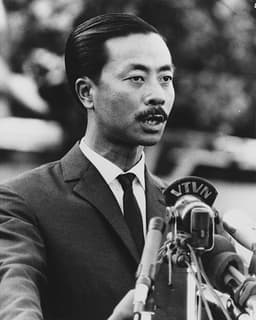
Nguyen Cao Ky
General · Modern
49.0Total
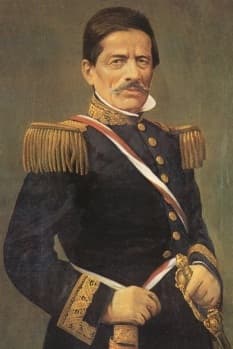
Ramon Castilla
General · Modern
59.7Total
Basic Information
Born
1930
1797
Died
—
1867
Era
Modern
Modern
Nationality
Vietnam
Peru
Occupation
General
General
Civilization
Eastern
Western
Score Comparison
Military (10%)
45.0
40.0
Political (20%)
39.4
72.0
Influence (20%)
50.2
56.7
Legacy (20%)
40.0
52.0
Leadership (15%)
67.0
78.0
Strategy (15%)
60.0
60.0
TOTAL
49.0
59.7
Nguyen Cao Ky — Complete Timeline
1963 AD
Commander of South Vietnamese Air ForcePolitical Action◆ Major
Nguyen Cao Ky was appointed commander of the Republic of Vietnam Air Force. He led the air force during the Buddhist crisis and participated in the coup that overthrew President Ngo Dinh Diem.
Air ForceCoupDiem
Impact: national
1965 AD
Appointed Prime MinisterPolitical Action◆ Major
Nguyen Cao Ky became Prime Minister of South Vietnam, leading a military junta. His government intensified the war against the Viet Cong and North Vietnam, with strong US support.
Prime MinisterMilitary juntaVietnam War
Impact: national
1967 AD
Conflict with President ThieuPolitical Action
Nguyen Cao Ky ran for president but lost to Nguyen Van Thieu, becoming vice president. The two leaders had a tense relationship, with Ky later accusing Thieu of corruption and mismanagement of the war.
ElectionThieuRivalry
Impact: nationaldestructive
1975 AD
Exile after fall of SaigonPolitical Action◆ Major
Nguyen Cao Ky fled South Vietnam as Saigon fell to North Vietnamese forces. He settled in the United States, where he became a critic of the communist government and later returned to Vietnam for visits.
ExileFall of SaigonVietnam War
Impact: nationaltragic
Ramon Castilla — Complete Timeline
1824 AD
Battle of AyacuchoWar
Castilla fought as a junior officer in the decisive Battle of Ayacucho, which ended Spanish rule in Peru. This victory secured Peruvian independence and marked the end of the Spanish Empire in South America, shaping Castilla's nationalist views.
Peruvian War of IndependenceBattleLiberation
Impact: regional
1845 AD
First Presidency of PeruPolitical Action◆ Major
Castilla was elected President of Peru in 1845, serving until 1851. His first term focused on economic development, including the guano boom, and infrastructure projects such as railroads and ports, modernizing the Peruvian state.
PresidencyEconomic DevelopmentGuano
Impact: nationalconstructive
1854 AD
Abolition of Slavery in PeruReform◆ Major
During his second presidency, Castilla issued a decree abolishing slavery in Peru on December 3, 1854. This reform freed approximately 25,000 slaves and was part of a broader liberal agenda, though it faced opposition from slave-owning elites.
AbolitionSlaveryHuman Rights
Impact: nationalprogressive
Abolition of Indigenous TributeReform◆ Major
Castilla also abolished the indigenous tribute tax in 1854, which had been a burden on native communities since colonial times. This measure aimed to integrate indigenous peoples into the Peruvian state as equal citizens, though its implementation was uneven.
Indigenous RightsTax ReformCitizenship
Impact: nationalprogressive
1855 AD
Second Presidency and Guano BoomPolitical Action◆ Major
Castilla served a second term from 1855 to 1862, during the peak of the guano export boom. He used guano revenues to fund public works, pay off foreign debt, and modernize the military, but also faced criticism for corruption and over-reliance on a single resource.
PresidencyGuanoModernization
Impact: nationalconstructive
1860 AD
Constitutional Reform of 1860Reform◆ Major
Castilla oversaw the adoption of a new constitution in 1860, which established a centralized republic with a strong executive. The constitution remained in effect until 1920 and shaped Peru's political structure, though it limited regional autonomy.
ConstitutionPolitical ReformCentralization
Impact: nationalconstructive
Expert Analysis
Ramon Castilla vs Nguyen Cao Ky
### The General and the Reformer: Two Paths from War to Power
On a dusty plain in the Peruvian highlands, a young officer named Ramon Castilla watched the Spanish flag fall for the last time at the Battle of Ayacucho in 1824. A century and a half later, on the other side of the Pacific, a Vietnamese air force commander named Nguyen Cao Ky piloted his fighter jet over Buddhist pagodas, bombing his own countrymen to preserve a government he would soon lead. Both men were generals. Both came to power through the chaos of war. But their stories diverged as sharply as the continents they called home—one building a nation, the other losing one.
### Origins
Ramon Castilla was born in 1797 in Tarapacá, then a remote province of the Spanish Viceroyalty of Peru. His father was a Spanish colonial administrator, his mother a descendant of indigenous nobility. This mixed heritage placed him on the fault line of empire. He joined the royalist army as a young man, but in 1821, he switched sides to join the independence forces led by Simón Bolívar. He was not a man of grand ideology but of practical ambition, shaped by the Enlightenment currents that swept Latin America after Napoleon’s invasion of Spain.
Nguyen Cao Ky was born in 1930 in Hanoi, French Indochina, into a middle-class family. His father was a schoolteacher, his mother a homemaker. He grew up under French colonial rule, then the Japanese occupation, then the First Indochina War. Where Castilla’s world was one of creole elites and indigenous masses, Ky’s was a crucible of communism, nationalism, and Cold War rivalry. He joined the Vietnamese National Army, trained by the French, and quickly rose through the ranks of the air force. He was a product of war, not of state-building.
### Rise to Power
Castilla’s rise was slow and steady. After Ayacucho, he served in various administrative posts, learning the art of governance. He became a diplomat, a minister of war, and finally, in 1845, was elected president. His path was one of institutional accumulation—he did not seize power; he earned it through competence and connections.
Ky’s ascent was violent and sudden. In 1963, he was appointed commander of the South Vietnamese Air Force just as the Buddhist crisis toppled President Ngo Dinh Diem. Ky led air strikes against Buddhist protests, demonstrating a ruthlessness that made him indispensable to the military junta that followed. In 1965, at age 35, he became prime minister of South Vietnam, the youngest leader in the nation’s history. He came to power not through elections but through a coup—a pattern that would define his career.
### Leadership & Governance
Castilla governed during the guano boom, when Peru’s coastal islands became a global source of fertilizer. He used this windfall to modernize the country: building railroads, expanding public education, and professionalizing the army. His political wisdom lay in balancing interests. In 1854, during his second presidency, he abolished slavery and the indigenous tribute tax—two reforms that undercut the old colonial elite while winning support from freed blacks and native communities. His 1860 constitution established a centralized republic that lasted for decades.
Ky governed in a state of permanent crisis. His military strategy was aggressive: he escalated the war against the Viet Cong and North Vietnam, relying on American air power and ground troops. Politically, he was a strongman who suppressed dissent, but he also attempted land reforms and anti-corruption campaigns. Yet his rule was unstable. In 1967, he lost the presidency to Nguyen Van Thieu, a rival general, and became a powerless vice president. His leadership was defined not by construction but by survival.
### Triumph & Tragedy
Castilla’s greatest triumph was the abolition of slavery in 1854. He issued the decree in the midst of a civil war, using it to rally support and undermine his enemies. It was both a moral act and a political masterstroke. His tragedy was that the guano boom, which funded his reforms, also created a dependency on a single resource that would later cripple Peru’s economy.
Ky’s triumph was his charisma and courage as a pilot. He flew dangerous missions and inspired loyalty among his men. His tragedy was the fall of Saigon in 1975. As North Vietnamese tanks rolled into the city, Ky fled to the United States, where he spent the rest of his life as an exile, running a liquor store in California. He had fought for a country that no longer existed.
### Character & Destiny
Castilla was pragmatic, patient, and institution-minded. He believed in progress, but he also understood power. He died in 1867, still respected, still relevant. Ky was impulsive, vain, and romantic. He wore a purple scarf and a pearl-handled revolver, projecting an image of a dashing warrior. But that image could not hold together a fractured nation. His personality—brave but brittle—mirrored South Vietnam itself: flashy, doomed, and ultimately abandoned.
### Legacy
Castilla is remembered as Peru’s great reformer. His abolition of slavery and indigenous tribute are celebrated as foundational acts of modern Peru. His legacy score of 75.0 reflects a man who built, not merely ruled.
Ky’s legacy is more ambiguous. In Vietnam, he is a footnote—a leader of a failed state. Among overseas Vietnamese, he is a symbol of anti-communist resistance, but also of corruption and defeat. His legacy score of 56.0 is a measure of a life that ended in loss.
### Conclusion
Ramon Castilla and Nguyen Cao Ky were both generals who rose through war, but they governed in fundamentally different worlds. Castilla had time, resources, and a coherent national project. Ky had none of these. One built a nation from the wreckage of empire; the other tried to hold one together as it collapsed. Their stories remind us that leadership is not just about character—it is about context. And that the difference between a reformer and a failure can be as simple as the age in which they lived.
Rankings
🥇
Ramon CastillaLeader
Mil: 40.0Pol: 72.0Inf: 56.7
59.7
🥈
Nguyen Cao Ky
Mil: 45.0Pol: 39.4Inf: 50.2
49.0
+10.7 behind
How This Comparison Works
Algorithm
Each figure is scored on 6 dimensions (0—100 scale) based on structured historical data: Military (10%), Political (20%), Influence (20%), Legacy (20%), Leadership (15%), Strategy (15%). The weighted total produces the final ranking.
Data Sources
Scores are computed from structured sub-indicators in the database. Scale factors adjust for era (Ancient ×0.85, Modern ×1.0) and civilization size (Eastern ×1.05, Other ×0.80) to account for differences in population and military scale.
Maximum 3 Figures
Comparisons are limited to 2—3 figures to ensure readability and statistical meaningfulness.
Error Margins
±5 points per dimension — Sub-scores are derived from historical records with inherent uncertainty. Two figures within 5 points on a dimension should be considered roughly equivalent in that area.
Total Score Accuracy
±3 points overall — The weighted combination of 6 dimensions produces a total score with approximately ±3 points of uncertainty. Differences of less than 3 points are not statistically significant— the figures are effectively tied.
Known Limitations
- Historical records are incomplete and uneven across civilizations
- Figures from oral-tradition societies may be underrepresented
- Occupation labels can misclassify multi-role figures
- Scores measure capability and impact, not moral character
- Quantitative scoring is a comparison tool, not absolute truth
Capability Radar
Military (10%) — Battles & Warfare
Battles
30
45
Win Rate
35
50
Expansion
10
30
Political (20%) — Governance & Reform
Reform
20
85
Diplomacy
25
70
Economy
15
75
Influence (20%) — Cultural & Global Reach
Cultural
15
55
Global
15
50
Legacy (20%) — Historical Impact
Historical
20
65
Longevity
10
60
Leadership (15%) — Power & Stability
Tenure
40
65
Stability
10
60
Strategy (15%) — Tactics & Innovation
Strategy
30
45
Tactics
40
40
Reform
25
55
Similar Comparisons
Comments & Discussion
TRAJAN'S EQUIVOCATOR6/16/2026
"Castilla won his wars honorably and then built railroads, schools, and abolished slavery. Ky lost his country, bombed Buddhist civilians, and ended up running a liquor store in California. This isn’t a comparison—it’s a cautionary tale dressed in epaulets. One reformed a nation; the other reformed his resume."
反讽史官6/16/2026
“Castilla是拉美改革之父,Ky就是美式噩梦里的配角。一个靠法令废除奴隶制,一个靠空袭压制僧侣。别拿烈士和赌徒比,两个人都拿过枪,但一个用枪开了路,一个用枪摔了跤。”
SYLLOGISM SURGEON6/16/2026
"Castilla’s independence credentials? Pragmatic: he switched sides just before Ayacucho and later used state capacity to emancipate slaves. Ky’s credentials? Airborne and authoritarian: he bombed his own capital, fled when Saigon fell, and left no institutional legacy. One knew wars end—the other only knew wars."
历史坐标员6/16/2026
“同一个年代?Ky和Castilla差了快一百五十年。Castilla在十九世纪末的南美搞税改和基建,Ky在冷战泥潭里打代理人战争。时代不同,但结果分明:一个留下了国家,一个留下了逃亡录像。”