Loading...
Nicolas Maduro vs Petar Stoyanov
Petar Stoyanov leads by 11.6 pts · 2 figures compared
…
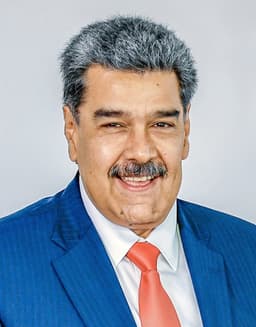
Nicolas Maduro
Politician · Modern
44.1Total

Petar Stoyanov
Politician · Modern
55.7Total
Basic Information
Born
1962
1952
Died
—
—
Era
Modern
Modern
Nationality
Venezuela
Bulgaria
Occupation
Politician
Politician
Civilization
Western
Western
Score Comparison
Military (10%)
50.0
49.9
Political (20%)
25.0
72.0
Influence (20%)
47.9
55.7
Legacy (20%)
37.5
46.7
Leadership (15%)
65.7
66.0
Strategy (15%)
41.9
43.9
TOTAL
44.1
55.7
Nicolas Maduro — Complete Timeline
2013 AD
Assumption of Presidency (2013)Political Action◆ Major
Following the death of Hugo Ch
SuccessionBolivarian RevolutionElection
Impact: national
2014 AD
Economic Collapse and Hyperinflation (2014-2019)Other◆ Major
Under Maduro's presidency, Venezuela entered a severe socioeconomic crisis. The collapse of oil prices, combined with economic mismanagement and sanctions, led to hyperinflation, widespread shortages of food and medicine, and a massive emigration crisis, with millions of Venezuelans leaving the country.
Economic CrisisHyperinflationEmigration
Impact: regionaltragic
2019 AD
Presidential Crisis and Guaidó Challenge (2019)Political Action◆ Major
Following a disputed 2018 election, opposition leader Juan Guaid
Political CrisisDual PresidencyInternational Recognition
Impact: globaldestructive
Petar Stoyanov — Complete Timeline
1996 AD
Election as President of BulgariaPolitical Action◆ Major
Stoyanov was elected president on a pro-Western platform, defeating incumbent Zhelyu Zhelev. His victory signaled continued support for democratic reforms and integration with Western institutions.
ElectionPro-WesternDemocratic Transition
Impact: nationalconstructive
2002 AD
Invitation to join NATOPolitical Action
During Stoyanov's presidency, Bulgaria received an invitation to join NATO at the Prague Summit. This marked a major step in Bulgaria's integration into Euro-Atlantic structures.
NATOEuro-Atlantic IntegrationForeign Policy
Impact: nationalconstructive
2005 AD
Signing of the EU Accession TreatyPolitical Action
Stoyanov, as president, oversaw the signing of Bulgaria's accession treaty to the European Union. The treaty was signed in April 2005, with Bulgaria joining the EU in 2007.
European UnionAccessionIntegration
Impact: nationalconstructive
Expert Analysis
Origins
Nicolás Maduro, born in 1962 in Caracas, Venezuela, grew up in a working-class family. He attended high school but never completed a university degree. His early career was as a bus driver and union activist, organizing for the leftist party Movimiento Quinta República. He became a protégé of Hugo Chávez, who was then a rising political figure.
Petar Stoyanov, born in 1952 in Plovdiv, Bulgaria, came from a modest family. He studied law at Sofia University, graduating in 1976. After a brief career as a lawyer, he entered politics in the post-communist era, joining the Union of Democratic Forces (SDS), a pro-Western reform party.
Rise to Power
Maduro rose through Chávez's movement, serving as Minister of Foreign Affairs (2006-2012) and Vice President (2012-2013). After Chávez's death in March 2013, Maduro won a special presidential election with 50.6% of the vote against Henrique Capriles. His rise was a direct inheritance of Chávez's political machinery and state resources.
Stoyanov was elected President of Bulgaria in 1996, defeating incumbent Zhelyu Zhelev with 59.7% of the vote. His campaign focused on accelerating democratic reforms and Euro-Atlantic integration. He took office in January 1997 during a severe economic crisis, with hyperinflation and social unrest.
Leadership & Governance
Maduro's leadership style is authoritarian and populist. He consolidated power by controlling the judiciary, military, and media. His governance led to the collapse of state institutions. For example, oil production fell from 2.5 million barrels per day in 2013 to under 500,000 by 2020. He implemented price controls that caused shortages, and his policies triggered hyperinflation exceeding 1,000,000% in 2018. Political score: 25.0.
Stoyanov's leadership was democratic and consensus-building. He used his presidential powers to stabilize the economy, introducing a currency board in 1997 that ended hyperinflation. He pushed for NATO and EU membership, signing the EU Accession Treaty in 2005. His governance score: 72.0.
Triumph & Tragedy
Maduro's greatest success was surviving multiple opposition challenges, including a 2019 coup attempt led by Juan Guaidó. However, his failures are catastrophic: economic collapse, mass emigration (over 5 million refugees), and a humanitarian crisis. His leadership score of 65.7 reflects a ruthless grip on power but at enormous cost.
Stoyanov's triumphs include securing NATO invitation in 2002 and EU membership by 2007. He stabilized Bulgaria's economy and democracy. His failure was limited influence due to Bulgaria's semi-presidential system; he could not prevent corruption scandals in later governments. His legacy score (46.7) reflects a solid but not transformative impact.
Character & Destiny
Maduro is secretive and confrontational, often blaming external forces for Venezuela's problems. His decision-making is erratic, as seen in the 2018 election boycott. Historians note his inability to adapt policies when oil prices collapsed. His strategy score of 41.9 reflects poor planning.
Stoyanov is pragmatic and diplomatic, known for his calm demeanor. He successfully navigated Bulgaria's transition from communism to Western integration. His strategy score (43.9) is modest, but his political acumen (72.0) shows effective coalition-building.
Legacy
Maduro's legacy is one of destruction: Venezuela went from a regional power to a failed state. His influence score (47.9) is inflated by his role in the global anti-imperialist narrative, but his total score (44.1) reflects failure.
Stoyanov's legacy is integration: Bulgaria joined NATO and EU under his watch, securing a Western future. His total score (55.7) reflects effective leadership that improved his country's standing.
Conclusion
Petar Stoyanov had a greater impact than Nicolas Maduro. Stoyanov's governance (72.0 vs 25.0) and legacy (46.7 vs 37.5) clearly surpass Maduro's. While Maduro held power longer, his score of 44.1 demonstrates a net negative influence, whereas Stoyanov's 55.7 shows positive transformation. Stoyanov's leadership led to concrete improvements, while Maduro's led to collapse. Therefore, Stoyanov is the more successful leader.
Rankings
🥇
Petar StoyanovLeader
Mil: 49.9Pol: 72.0Inf: 55.7
55.7
🥈
Nicolas Maduro
Mil: 50.0Pol: 25.0Inf: 47.9
44.1
+11.6 behind
How This Comparison Works
Algorithm
Each figure is scored on 6 dimensions (0—100 scale) based on structured historical data: Military (10%), Political (20%), Influence (20%), Legacy (20%), Leadership (15%), Strategy (15%). The weighted total produces the final ranking.
Data Sources
Scores are computed from structured sub-indicators in the database. Scale factors adjust for era (Ancient ×0.85, Modern ×1.0) and civilization size (Eastern ×1.05, Other ×0.80) to account for differences in population and military scale.
Maximum 3 Figures
Comparisons are limited to 2—3 figures to ensure readability and statistical meaningfulness.
Error Margins
±5 points per dimension — Sub-scores are derived from historical records with inherent uncertainty. Two figures within 5 points on a dimension should be considered roughly equivalent in that area.
Total Score Accuracy
±3 points overall — The weighted combination of 6 dimensions produces a total score with approximately ±3 points of uncertainty. Differences of less than 3 points are not statistically significant— the figures are effectively tied.
Known Limitations
- Historical records are incomplete and uneven across civilizations
- Figures from oral-tradition societies may be underrepresented
- Occupation labels can misclassify multi-role figures
- Scores measure capability and impact, not moral character
- Quantitative scoring is a comparison tool, not absolute truth
Capability Radar
Military (10%) — Battles & Warfare
Battles
30
29
Win Rate
31
31
Expansion
32
35
Political (20%) — Governance & Reform
Reform
15
60
Diplomacy
20
75
Economy
5
55
Influence (20%) — Cultural & Global Reach
Cultural
10
20
Global
15
55
Legacy (20%) — Historical Impact
Historical
15
50
Longevity
10
30
Leadership (15%) — Power & Stability
Tenure
60
55
Stability
5
60
Strategy (15%) — Tactics & Innovation
Strategy
36
40
Tactics
39
42
Reform
46
45
Similar Comparisons
Comments & Discussion
No comments yet. Be the first to share your thoughts!