Loading...
This comparison has not been analyzed yet.
One-time AI generation (~1 minute). Scores and timeline are already available below.
Norman Manley vs Pervez Khattak
Norman Manley leads by 17.8 pts · 2 figures compared
…
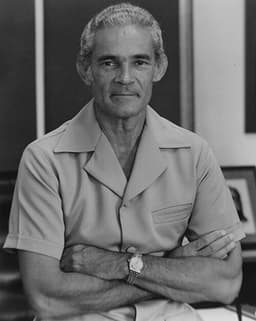
Norman Manley
Politician · Modern
57.1Total

Pervez Khattak
Politician · Modern
39.3Total
Basic Information
Born
1893
1950
Died
1969
—
Era
Modern
Modern
Nationality
Jamaica
Pakistan
Occupation
Politician
Politician
Civilization
Other
Indian
Score Comparison
Military (10%)
41.3
13.1
Political (20%)
72.0
35.1
Influence (20%)
57.2
46.3
Legacy (20%)
50.0
35.8
Leadership (15%)
74.0
55.3
Strategy (15%)
42.8
39.4
TOTAL
57.1
39.3
Norman Manley — Complete Timeline
1938 AD
Founded the People's National PartyPolitical Action◆ Major
Norman Manley founded the People's National Party (PNP) in Jamaica, advocating for self-government and social reform. The PNP became a major political force and a key player in Jamaica's independence movement.
Political PartyPNPNationalism
Impact: nationalconstructive
1944 AD
Won universal adult suffragePolitical Action
Manley's advocacy contributed to the introduction of universal adult suffrage in Jamaica in 1944, allowing all adults to vote for the first time. This was a major step toward democratic self-governance.
SuffrageDemocracyReform
Impact: nationalprogressive
1955 AD
Became Chief Minister of JamaicaPolitical Action◆ Major
Manley became Chief Minister of Jamaica after leading the PNP to victory in the 1955 general election. He focused on social welfare, education, and economic development.
Chief MinisterPNPGovernment
Impact: nationalconstructive
1961 AD
Negotiated Jamaican independence termsPolitical Action◆ Major
Manley led negotiations with the British government for Jamaican independence. He also advocated for Jamaica's membership in the West Indies Federation, but a 1961 referendum voted to withdraw from the federation.
IndependenceWest Indies FederationNegotiation
Impact: national
1962 AD
Lost 1962 general electionPolitical Action◆ Major
Manley's PNP lost the 1962 general election to Alexander Bustamante's JLP. This defeat came just before Jamaican independence, and Manley became Leader of the Opposition.
ElectionDefeatOpposition
Impact: nationaltragic
1969 AD
Retired as PNP leaderPolitical Action◆ Major
Manley retired as leader of the PNP after 31 years at the helm. He was succeeded by his son, Michael Manley. Norman Manley was later named a National Hero of Jamaica.
RetirementNational HeroLegacy
Impact: national
Pervez Khattak — Complete Timeline
2013 AD
Elected Chief Minister of Khyber PakhtunkhwaPolitical Action◆ Major
Pervez Khattak became the Chief Minister of Khyber Pakhtunkhwa after the PTI won the provincial elections. His tenure focused on reforms in education, health, and police, as well as implementing the PTI's agenda.
Chief MinisterKhyber PakhtunkhwaPTI
Impact: regionalconstructive
2014 AD
Launched Police Reforms in KPKReform◆ Major
Khattak initiated major police reforms in Khyber Pakhtunkhwa, including depoliticization and improved training. The reforms aimed to enhance law and order, but faced implementation challenges and criticism from some quarters.
Police ReformLaw and OrderKPK
Impact: regionalconstructive
2023 AD
Defected from PTIPolitical Action◆ Major
Khattak left the PTI and joined the Pakistan Muslim League (Nawaz) after political differences with PTI leadership. His defection was seen as a major blow to PTI's strength in Khyber Pakhtunkhwa and highlighted internal party rifts.
DefectionPTIPML-N
Impact: nationaldestructive
2024 AD
Appointed Federal Minister for DefencePolitical Action
After joining the PML-N, Khattak was appointed as the Federal Minister for Defence in the coalition government. This marked his return to national politics after serving as a provincial chief minister.
Federal MinisterDefenceCoalition Government
Impact: national
This comparison has not been analyzed yet.
One-time AI generation (~1 minute). Scores and timeline are already available below.
Rankings
🥇
Norman ManleyLeader
Mil: 41.3Pol: 72.0Inf: 57.2
57.1
🥈
Pervez Khattak
Mil: 13.1Pol: 35.1Inf: 46.3
39.3
+17.8 behind
How This Comparison Works
Algorithm
Each figure is scored on 6 dimensions (0—100 scale) based on structured historical data: Military (10%), Political (20%), Influence (20%), Legacy (20%), Leadership (15%), Strategy (15%). The weighted total produces the final ranking.
Data Sources
Scores are computed from structured sub-indicators in the database. Scale factors adjust for era (Ancient ×0.85, Modern ×1.0) and civilization size (Eastern ×1.05, Other ×0.80) to account for differences in population and military scale.
Maximum 3 Figures
Comparisons are limited to 2—3 figures to ensure readability and statistical meaningfulness.
Error Margins
±5 points per dimension — Sub-scores are derived from historical records with inherent uncertainty. Two figures within 5 points on a dimension should be considered roughly equivalent in that area.
Total Score Accuracy
±3 points overall — The weighted combination of 6 dimensions produces a total score with approximately ±3 points of uncertainty. Differences of less than 3 points are not statistically significant— the figures are effectively tied.
Known Limitations
- Historical records are incomplete and uneven across civilizations
- Figures from oral-tradition societies may be underrepresented
- Occupation labels can misclassify multi-role figures
- Scores measure capability and impact, not moral character
- Quantitative scoring is a comparison tool, not absolute truth
Capability Radar
Military (10%) — Battles & Warfare
Battles
20
23
Win Rate
25
25
Expansion
28
29
Political (20%) — Governance & Reform
Reform
70
30
Diplomacy
60
25
Economy
55
20
Influence (20%) — Cultural & Global Reach
Cultural
45
10
Global
40
5
Legacy (20%) — Historical Impact
Historical
55
10
Longevity
50
5
Leadership (15%) — Power & Stability
Tenure
40
35
Stability
50
15
Strategy (15%) — Tactics & Innovation
Strategy
32
32
Tactics
33
33
Reform
36
39
Similar Comparisons
Comments & Discussion
No comments yet. Be the first to share your thoughts!