Loading...
Frederick Chiluba vs Norman Manley
Norman Manley leads by 3.6 pts · 2 figures compared
…

Frederick Chiluba
Politician · Modern
53.5Total
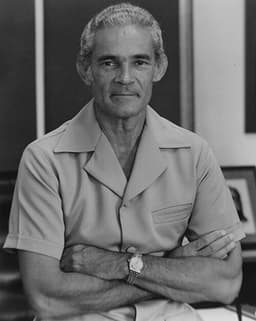
Norman Manley
Politician · Modern
57.1Total
Basic Information
Born
1943
1893
Died
—
1969
Era
Modern
Modern
Nationality
Zambia
Jamaica
Occupation
Politician
Politician
Civilization
Other
Other
Score Comparison
Military (10%)
39.9
41.3
Political (20%)
68.0
72.0
Influence (20%)
52.5
57.2
Legacy (20%)
42.5
50.0
Leadership (15%)
74.0
74.0
Strategy (15%)
44.3
42.8
TOTAL
53.5
57.1
Frederick Chiluba — Complete Timeline
1991 AD
Elected President of ZambiaPolitical Action◆ Major
Chiluba won the presidential election as the candidate of the Movement for Multiparty Democracy, defeating Kenneth Kaunda who had ruled since independence. This marked the first peaceful democratic transfer of power in Zambia.
ElectionZambiaDemocracy
Impact: nationalconstructive
1992 AD
Implemented Economic LiberalizationReform◆ Major
Chiluba's government adopted IMF and World Bank structural adjustment programs, including privatization of state enterprises, removal of subsidies, and currency devaluation. These reforms caused economic hardship but aimed to stabilize the economy.
Economic ReformIMFPrivatization
Impact: national
1996 AD
Re-elected President of ZambiaPolitical Action◆ Major
Chiluba won a second term in an election boycotted by the main opposition party and criticized by observers for irregularities. The election was marked by constitutional changes that barred Kaunda from running.
ElectionZambiaBoycott
Impact: national
2001 AD
Attempted Third Term BidPolitical Action◆ Major
Chiluba attempted to amend the constitution to allow a third term, sparking widespread protests and opposition from civil society and his own party. The bid failed, and he stepped down, but it damaged his legacy.
Third TermConstitutional CrisisZambia
Impact: nationaldestructive
2009 AD
Convicted of CorruptionPolitical Action◆ Major
Chiluba was convicted in a London court of stealing $46 million from Zambia during his presidency. The verdict was a landmark anti-corruption case, though Chiluba maintained his innocence and died before serving time.
CorruptionConvictionZambia
Impact: nationaldestructive
Norman Manley — Complete Timeline
1938 AD
Founded the People's National PartyPolitical Action◆ Major
Norman Manley founded the People's National Party (PNP) in Jamaica, advocating for self-government and social reform. The PNP became a major political force and a key player in Jamaica's independence movement.
Political PartyPNPNationalism
Impact: nationalconstructive
1944 AD
Won universal adult suffragePolitical Action
Manley's advocacy contributed to the introduction of universal adult suffrage in Jamaica in 1944, allowing all adults to vote for the first time. This was a major step toward democratic self-governance.
SuffrageDemocracyReform
Impact: nationalprogressive
1955 AD
Became Chief Minister of JamaicaPolitical Action◆ Major
Manley became Chief Minister of Jamaica after leading the PNP to victory in the 1955 general election. He focused on social welfare, education, and economic development.
Chief MinisterPNPGovernment
Impact: nationalconstructive
1961 AD
Negotiated Jamaican independence termsPolitical Action◆ Major
Manley led negotiations with the British government for Jamaican independence. He also advocated for Jamaica's membership in the West Indies Federation, but a 1961 referendum voted to withdraw from the federation.
IndependenceWest Indies FederationNegotiation
Impact: national
1962 AD
Lost 1962 general electionPolitical Action◆ Major
Manley's PNP lost the 1962 general election to Alexander Bustamante's JLP. This defeat came just before Jamaican independence, and Manley became Leader of the Opposition.
ElectionDefeatOpposition
Impact: nationaltragic
1969 AD
Retired as PNP leaderPolitical Action◆ Major
Manley retired as leader of the PNP after 31 years at the helm. He was succeeded by his son, Michael Manley. Norman Manley was later named a National Hero of Jamaica.
RetirementNational HeroLegacy
Impact: national
Expert Analysis
Origins
Frederick Chiluba was born on April 30, 1943, in Kitwe, Northern Rhodesia (now Zambia), to a Bemba family. His father was a miner, and after his father's death, Chiluba was raised by his uncle. He attended primary and secondary school but did not complete university, instead working as a clerk and later as an accountant. He became active in trade unions, rising to lead the Zambia Congress of Trade Unions.
Norman Manley was born on July 4, 1893, in Roxborough, Jamaica, to mixed-race parents. He excelled academically, winning a Rhodes Scholarship to Oxford University, where he studied law. He became a barrister and returned to Jamaica, where he established a successful legal practice and became involved in politics, advocating for social justice and self-government.
Rise to Power
Chiluba rose to prominence as a labor leader. In 1990, he co-founded the Movement for Multiparty Democracy (MMD) to oppose Kenneth Kaunda's one-party rule. In the 1991 presidential election, Chiluba won with 75% of the vote, ending Kaunda's 27-year rule. His rise was swift, fueled by economic decline and popular demand for democracy.
Manley's rise was gradual. In 1938, he helped found the People's National Party (PNP) with his cousin Alexander Bustamante, though they later split. Manley advocated for universal suffrage, which was granted in 1944. He served as Chief Minister from 1955 to 1959, then as Premier from 1959 to 1962, leading negotiations for Jamaican independence.
Leadership & Governance
Chiluba's leadership style was top-down. He implemented IMF and World Bank structural adjustment programs, privatizing state enterprises and removing subsidies. His economic policies scored 44.3 in strategy and 74.0 in leadership, but they led to job losses and increased poverty. He was re-elected in 1996 in a disputed election boycotted by the opposition. His attempt to amend the constitution for a third term in 2001 sparked protests, and he stepped down.
Manley was a consensus-builder. His government expanded social welfare, education, and infrastructure. He supported the West Indies Federation, which ultimately failed. His political score is 72.0, reflecting his role in Jamaica's transition to independence. However, his party lost the 1962 election to Bustamante's JLP, just before independence, making him Leader of the Opposition.
Triumph & Tragedy
Chiluba's triumph was leading Zambia's democratic transition in 1991, a rare peaceful transfer of power in Africa. His tragedy was his corruption conviction in 2009 for stealing $46 million, which tarnished his legacy. His influence score is 52.5, and legacy 42.5, reflecting this duality.
Manley's triumph was securing universal adult suffrage and negotiating independence terms. His tragedy was losing the 1962 election, so he did not become independent Jamaica's first prime minister. His legacy score is 50.0, as he is remembered as a founding father but overshadowed by Bustamante.
Character & Destiny
Chiluba was pragmatic but authoritarian. He used his trade union background to mobilize support but became increasingly isolated. His attempt for a third term revealed a desire to cling to power, leading to his downfall. His character led to a mixed legacy: a democrat who undermined democracy.
Manley was intellectual and principled. He believed in gradual reform and federation, but his idealism sometimes clashed with political realities. His character made him a respected statesman but not a populist winner, costing him the 1962 election.
Legacy
Chiluba's legacy is complex. He is credited with restoring multiparty democracy but condemned for corruption. His economic reforms set Zambia on a neoliberal path, but his conviction remains a stain. His total score is 53.5.
Manley's legacy is as a founding father of modern Jamaica. His advocacy for universal suffrage and self-government shaped the nation's political institutions. He is honored with a national hero designation, though his cousin Bustamante is more celebrated. His total score is 57.1.
Conclusion
Norman Manley had a greater impact. His political score of 72.0 and influence of 57.2 exceed Chiluba's 68.0 and 52.5. While Chiluba democratized Zambia, his corruption conviction and authoritarian tendencies undermine his achievements. Manley's role in securing universal suffrage and independence for Jamaica had lasting effects, despite his electoral defeat. Manley's total score of 57.1 versus Chiluba's 53.5 reflects this: Manley was more effective and principled.
Rankings
🥇
Norman ManleyLeader
Mil: 41.3Pol: 72.0Inf: 57.2
57.1
🥈
Frederick Chiluba
Mil: 39.9Pol: 68.0Inf: 52.5
53.5
+3.6 behind
How This Comparison Works
Algorithm
Each figure is scored on 6 dimensions (0—100 scale) based on structured historical data: Military (10%), Political (20%), Influence (20%), Legacy (20%), Leadership (15%), Strategy (15%). The weighted total produces the final ranking.
Data Sources
Scores are computed from structured sub-indicators in the database. Scale factors adjust for era (Ancient ×0.85, Modern ×1.0) and civilization size (Eastern ×1.05, Other ×0.80) to account for differences in population and military scale.
Maximum 3 Figures
Comparisons are limited to 2—3 figures to ensure readability and statistical meaningfulness.
Error Margins
±5 points per dimension — Sub-scores are derived from historical records with inherent uncertainty. Two figures within 5 points on a dimension should be considered roughly equivalent in that area.
Total Score Accuracy
±3 points overall — The weighted combination of 6 dimensions produces a total score with approximately ±3 points of uncertainty. Differences of less than 3 points are not statistically significant— the figures are effectively tied.
Known Limitations
- Historical records are incomplete and uneven across civilizations
- Figures from oral-tradition societies may be underrepresented
- Occupation labels can misclassify multi-role figures
- Scores measure capability and impact, not moral character
- Quantitative scoring is a comparison tool, not absolute truth
Capability Radar
Military (10%) — Battles & Warfare
Battles
21
20
Win Rate
25
25
Expansion
27
28
Political (20%) — Governance & Reform
Reform
55
70
Diplomacy
50
60
Economy
40
55
Influence (20%) — Cultural & Global Reach
Cultural
30
45
Global
25
40
Legacy (20%) — Historical Impact
Historical
35
55
Longevity
20
50
Leadership (15%) — Power & Stability
Tenure
60
40
Stability
30
50
Strategy (15%) — Tactics & Innovation
Strategy
32
32
Tactics
32
33
Reform
35
36
Similar Comparisons
Comments & Discussion
No comments yet. Be the first to share your thoughts!