Loading...
Nureddin al-Atassi vs Vaclav Klaus
Vaclav Klaus leads by 8.4 pts · 2 figures compared
…
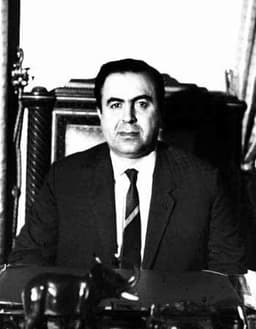
Nureddin al-Atassi
Politician · Modern
41.9Total

Vaclav Klaus
Politician · Modern
50.3Total
Basic Information
Born
1929
1941
Died
—
—
Era
Modern
Modern
Nationality
Syria
Czech Republic
Occupation
Politician
Politician
Civilization
Middle Eastern
Western
Score Comparison
Military (10%)
50.0
12.6
Political (20%)
29.3
53.8
Influence (20%)
47.1
57.2
Legacy (20%)
37.5
47.5
Leadership (15%)
48.4
72.0
Strategy (15%)
41.4
40.4
TOTAL
41.9
50.3
Nureddin al-Atassi — Complete Timeline
1970 AD
Became President of SyriaPolitical Action◆ Major
Nureddin al-Atassi became President of Syria after the 1970 coup that brought Hafez al-Assad to power. However, he was a figurehead, with real power held by Assad as Defense Minister.
PresidencyAssad Era
Impact: national
Removed from Power by AssadPolitical Action◆ Major
Nureddin al-Atassi was removed from the presidency and imprisoned by Hafez al-Assad, who consolidated power after the Corrective Movement. Atassi spent years in detention, effectively ending his political role.
CoupImprisonmentAssad
Impact: nationaldestructive
Vaclav Klaus — Complete Timeline
1989 AD
Velvet RevolutionPolitical Action
Klaus was a key figure in the Velvet Revolution, which overthrew the communist regime in Czechoslovakia. He became a leading member of the Civic Forum and later the Civic Democratic Party.
Velvet RevolutionPost-Communism
Impact: regionalconstructive
1992 AD
Prime Minister of CzechoslovakiaPolitical Action◆ Major
Klaus became Prime Minister of Czechoslovakia and pushed for rapid economic reforms, including privatization and market liberalization. His policies led to the dissolution of Czechoslovakia.
Economic ReformDissolution
Impact: nationalconstructive
2003 AD
President of the Czech RepublicPolitical Action◆ Major
Klaus was elected President of the Czech Republic, serving two terms until 2013. He was known for his eurosceptic views and opposition to further European integration.
PresidencyEuroscepticism
Impact: national
Expert Analysis
Origins
Nureddin al-Atassi was born in 1929 in Homs, Syria, into a prominent Sunni Muslim family. He studied medicine at Damascus University, graduating in 1955. His early political involvement came through the Baath Party, which he joined in the 1950s, drawn to its pan-Arab socialist ideology. Atassi's medical background gave him a professional standing, but his political rise was tied to party connections rather than military prowess.
Vaclav Klaus was born in 1941 in Prague, Czechoslovakia, into a middle-class family. He studied economics at the University of Economics, Prague, graduating in 1963. Klaus's formative years were shaped by the 1968 Prague Spring and subsequent Soviet invasion, which solidified his anti-communist views. He later earned a degree from Cornell University in the US, exposing him to free-market ideas.
Rise to Power
Atassi's ascent in Syrian politics was rapid within the Baath Party structure. He became a member of the party's Regional Command in 1963 and served as Minister of Education from 1963 to 1964. In 1965, he was appointed Prime Minister, but his tenure was short-lived due to internal party conflicts. After the 1966 coup by the neo-Baathist faction, Atassi became Secretary-General of the Baath Party and was elected President of Syria in February 1966. However, his power was always subordinate to the military wing, particularly Hafez al-Assad, who served as Defense Minister. Atassi's presidency was largely ceremonial, with real authority held by Assad.
Klaus rose to prominence during the Velvet Revolution of 1989. As an economist at the Czechoslovak Academy of Sciences, he joined the Civic Forum and became a leading voice for free-market reforms. After the revolution, he served as Minister of Finance under President Vaclav Havel from 1989 to 1992. In 1992, he became Prime Minister of Czechoslovakia, overseeing the country's transition to a market economy. His policies led to the peaceful dissolution of Czechoslovakia in 1993, after which he became Prime Minister of the newly formed Czech Republic.
Leadership & Governance
Atassi's leadership was marked by weakness and subservience. He implemented Baathist socialist policies, including nationalization of industries and land reform, but these were directed by Assad and the military. Atassi's governance score of 48.4 reflects his lack of independent authority. He failed to consolidate power or build a personal base, making him a figurehead. His decision to align with Assad's Corrective Movement in 1970 backfired, as Assad immediately sidelined and imprisoned him.
Klaus, in contrast, was a decisive leader with a clear vision. As Prime Minister, he pushed for rapid privatization, deregulation, and fiscal austerity, known as the 'Klaus reforms.' His leadership style was confrontational and eurosceptic, opposing deeper EU integration. He scored 72.0 in leadership, reflecting his ability to drive change. However, his policies also led to economic inequality and corruption scandals.
Triumph & Tragedy
Atassi's greatest success was his role in the Baath Party's consolidation of power in Syria, though his actual influence was minimal. His tragedy was his downfall: after supporting Assad's Corrective Movement in 1970, he was removed from the presidency and imprisoned for 22 years, dying in 1992 under house arrest. His political score of 29.3 indicates his inability to retain power.
Klaus's triumph was overseeing the Czech Republic's transition from communism to a market economy, with GDP growth averaging 3.5% in the 1990s. He also successfully navigated the Velvet Divorce. His tragedy includes the 'Klaus Foundation' scandal and his controversial climate change denial. His legacy score of 47.5 reflects mixed perceptions.
Character & Destiny
Atassi was a loyal party man but lacked ambition or cunning. His character—passive and trusting—led to his downfall. He scored 41.4 in strategy, showing poor political instincts. Klaus was intellectually confident and combative, often clashing with opponents. His character drove his success but also isolated him. His strategy score of 40.4 indicates that his rigid ideology sometimes backfired.
Legacy
Atassi is a footnote in Syrian history, remembered as a weak president overshadowed by Assad. His policies were reversed, and his legacy score of 37.5 reflects his negligible impact. Klaus's legacy is more significant: he is a founding father of the Czech Republic's economic system and a symbol of euroscepticism. However, his legacy is contested, with critics pointing to corruption and inequality. His total score of 50.3 vs Atassi's 41.9 indicates greater impact.
Conclusion
Vaclav Klaus had a substantially greater impact than Nureddin al-Atassi. Klaus's scores are higher across all categories except military (where Atassi's 50.0 vs Klaus's 12.6 reflects Syria's militarized politics). Klaus's leadership (72.0 vs 48.4) and political (53.8 vs 29.3) scores demonstrate his effectiveness. Atassi was a puppet whose legacy is tied to Assad's rise, while Klaus shaped a nation's trajectory. The data supports Klaus as the more influential figure.
Rankings
🥇
Vaclav KlausLeader
Mil: 12.6Pol: 53.8Inf: 57.2
50.3
🥈
Nureddin al-Atassi
Mil: 50.0Pol: 29.3Inf: 47.1
41.9
+8.4 behind
How This Comparison Works
Algorithm
Each figure is scored on 6 dimensions (0—100 scale) based on structured historical data: Military (10%), Political (20%), Influence (20%), Legacy (20%), Leadership (15%), Strategy (15%). The weighted total produces the final ranking.
Data Sources
Scores are computed from structured sub-indicators in the database. Scale factors adjust for era (Ancient ×0.85, Modern ×1.0) and civilization size (Eastern ×1.05, Other ×0.80) to account for differences in population and military scale.
Maximum 3 Figures
Comparisons are limited to 2—3 figures to ensure readability and statistical meaningfulness.
Error Margins
±5 points per dimension — Sub-scores are derived from historical records with inherent uncertainty. Two figures within 5 points on a dimension should be considered roughly equivalent in that area.
Total Score Accuracy
±3 points overall — The weighted combination of 6 dimensions produces a total score with approximately ±3 points of uncertainty. Differences of less than 3 points are not statistically significant— the figures are effectively tied.
Known Limitations
- Historical records are incomplete and uneven across civilizations
- Figures from oral-tradition societies may be underrepresented
- Occupation labels can misclassify multi-role figures
- Scores measure capability and impact, not moral character
- Quantitative scoring is a comparison tool, not absolute truth
Capability Radar
Military (10%) — Battles & Warfare
Battles
21
20
Win Rate
27
28
Expansion
30
28
Political (20%) — Governance & Reform
Reform
20
55
Diplomacy
20
60
Economy
15
60
Influence (20%) — Cultural & Global Reach
Cultural
10
40
Global
10
45
Legacy (20%) — Historical Impact
Historical
15
45
Longevity
10
40
Leadership (15%) — Power & Stability
Tenure
30
65
Stability
10
55
Strategy (15%) — Tactics & Innovation
Strategy
32
33
Tactics
34
35
Reform
38
35
Similar Comparisons
Comments & Discussion
No comments yet. Be the first to share your thoughts!