Loading...
This comparison has not been analyzed yet.
One-time AI generation (~1 minute). Scores and timeline are already available below.
Obalokun vs Prajadhipok
Prajadhipok leads by 0.2 pts · 2 figures compared
…

Obalokun
Emperor · Modern
49.8Total
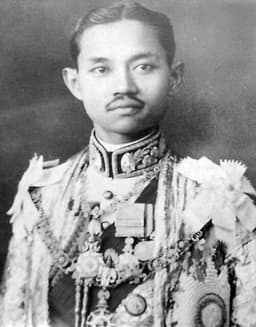
Prajadhipok
Emperor · Modern
50.0Total
Basic Information
Born
1550
1893
Died
1600
1941
Era
Modern
Modern
Nationality
Oyo Empire
Thailand
Occupation
Emperor
Emperor
Civilization
Other
Eastern
Score Comparison
Military (10%)
10.2
53.8
Political (20%)
68.0
48.0
Influence (20%)
53.3
49.4
Legacy (20%)
44.2
40.0
Leadership (15%)
65.0
62.2
Strategy (15%)
45.0
57.2
TOTAL
49.8
50.0
Obalokun — Complete Timeline
1575 AD
Opening of Oyo to European tradePolitical Action
Obalokun established diplomatic and commercial relations with Portuguese traders along the coast. He allowed European merchants to enter Oyo territory and trade for slaves, ivory, and pepper. This opened Oyo to the Atlantic slave trade, which would become a major source of wealth and power for the empire.
European ContactSlave TradeDiplomacy
Impact: regional
1580 AD
Expansion of Oyo's cavalry forcesReform◆ Major
Obalokun is credited with significantly expanding and reorganizing Oyo's cavalry, importing horses from the north. This military reform made Oyo's army one of the most powerful in the region, enabling future conquests and the empire's expansion into a major power.
Military ReformCavalryOyo Empire
Impact: nationalconstructive
Prajadhipok — Complete Timeline
1925 AD
Became the last absolute monarch of SiamPolitical Action◆ Major
Prajadhipok ascended the throne as King Rama VII, becoming the last absolute monarch of Siam. His reign began during economic difficulties and growing demands for constitutional reform.
CoronationAbsolute MonarchyEnd of Era
Impact: national
1932 AD
Granted a constitution after the 1932 revolutionPolitical Action◆ Major
Following a bloodless coup by the People's Party, Prajadhipok agreed to end absolute monarchy and granted a constitution. He became a constitutional monarch, retaining the throne but with limited powers.
Constitutional Monarchy1932 RevolutionReform
Impact: national
1935 AD
Abdicated the thronePolitical Action◆ Major
Prajadhipok abdicated the throne due to disagreements with the government over his powers and the treatment of royalists. He went into exile in England, where he died in 1941.
AbdicationExileEnd of Reign
Impact: nationaltragic
This comparison has not been analyzed yet.
One-time AI generation (~1 minute). Scores and timeline are already available below.
Rankings
🥇
PrajadhipokLeader
Mil: 53.8Pol: 48.0Inf: 49.4
50.0
🥈
Obalokun
Mil: 10.2Pol: 68.0Inf: 53.3
49.8
+0.2 behind
How This Comparison Works
Algorithm
Each figure is scored on 6 dimensions (0—100 scale) based on structured historical data: Military (10%), Political (20%), Influence (20%), Legacy (20%), Leadership (15%), Strategy (15%). The weighted total produces the final ranking.
Data Sources
Scores are computed from structured sub-indicators in the database. Scale factors adjust for era (Ancient ×0.85, Modern ×1.0) and civilization size (Eastern ×1.05, Other ×0.80) to account for differences in population and military scale.
Maximum 3 Figures
Comparisons are limited to 2—3 figures to ensure readability and statistical meaningfulness.
Error Margins
±5 points per dimension — Sub-scores are derived from historical records with inherent uncertainty. Two figures within 5 points on a dimension should be considered roughly equivalent in that area.
Total Score Accuracy
±3 points overall — The weighted combination of 6 dimensions produces a total score with approximately ±3 points of uncertainty. Differences of less than 3 points are not statistically significant— the figures are effectively tied.
Known Limitations
- Historical records are incomplete and uneven across civilizations
- Figures from oral-tradition societies may be underrepresented
- Occupation labels can misclassify multi-role figures
- Scores measure capability and impact, not moral character
- Quantitative scoring is a comparison tool, not absolute truth
Capability Radar
Military (10%) — Battles & Warfare
Battles
10
53
Win Rate
10
56
Expansion
15
59
Political (20%) — Governance & Reform
Reform
35
40
Diplomacy
60
30
Economy
55
20
Influence (20%) — Cultural & Global Reach
Cultural
30
20
Global
30
15
Legacy (20%) — Historical Impact
Historical
35
30
Longevity
30
20
Leadership (15%) — Power & Stability
Tenure
40
25
Stability
40
15
Strategy (15%) — Tactics & Innovation
Strategy
10
63
Tactics
10
65
Reform
10
69
Similar Comparisons
Comments & Discussion
No comments yet. Be the first to share your thoughts!