Loading...
Oliver Tambo vs Yukio Hatoyama
Oliver Tambo leads by 23.5 pts · 2 figures compared
…
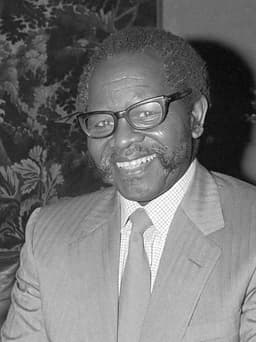
Oliver Tambo
Politician · Modern
60.9Total

Yukio Hatoyama
Politician · Modern
37.4Total
Basic Information
Born
1917
1947
Died
1993
—
Era
Modern
Modern
Nationality
South Africa
Japan
Occupation
Politician
Politician
Civilization
Other
Eastern
Score Comparison
Military (10%)
37.0
18.2
Political (20%)
70.0
39.4
Influence (20%)
82.0
48.6
Legacy (20%)
40.0
36.7
Leadership (15%)
79.8
38.1
Strategy (15%)
42.2
25.9
TOTAL
60.9
37.4
Oliver Tambo — Complete Timeline
1960 AD
Co-founded the Anti-Apartheid MovementPolitical Action◆ Major
Tambo helped establish the international Anti-Apartheid Movement, which lobbied governments and organizations to impose sanctions on South Africa. This campaign was crucial in isolating the apartheid regime.
SanctionsInternationalAnti-Apartheid
Impact: globalconstructive
1967 AD
Elected ANC President in ExilePolitical Action◆ Major
Tambo was elected President of the ANC after the death of Chief Albert Luthuli. He led the organization from exile in Zambia and London, building international support and coordinating the anti-apartheid struggle.
ANCExileLeadership
Impact: globalconstructive
1990 AD
Returned to South AfricaPolitical Action◆ Major
Tambo returned to South Africa after 30 years in exile, following the unbanning of the ANC. He was greeted as a hero and continued to lead the ANC until his health declined, handing over to Nelson Mandela.
ReturnTransitionANC
Impact: nationalconstructive
Yukio Hatoyama — Complete Timeline
2009 AD
Elected Prime Minister of JapanPolitical Action◆ Major
Hatoyama was elected as Prime Minister of Japan after leading the Democratic Party of Japan to a landslide victory in the 2009 general election. He became the first DPJ prime minister, ending LDP dominance.
JapanPrime MinisterDPJ
Impact: national
Proposed East Asian CommunityPolitical Action◆ Major
Hatoyama proposed the creation of an East Asian Community, a regional integration framework. The proposal aimed to reduce Japan's reliance on the US and strengthen ties with China and South Korea, but faced opposition from Washington.
JapanForeign PolicyEast Asia
Impact: regionalconstructive
2010 AD
Resigned over Futenma base disputePolitical Action◆ Major
Hatoyama resigned as Prime Minister after failing to relocate the US Marine Corps Air Station Futenma off Okinawa. His promise to move the base outside the prefecture was broken, leading to loss of public trust and coalition partner support.
JapanOkinawaUS Bases
Impact: nationaltragic
Expert Analysis
Origins
Oliver Tambo was born on October 27, 1917, in the village of Nkantolo in the Eastern Cape, South Africa. He was the son of a farmer and attended Anglican missionary schools. Tambo later studied at the University of Fort Hare, where he earned a Bachelor of Science degree in 1938. He then pursued a teaching diploma and became a teacher, but was dismissed for his political activities. He subsequently studied law and qualified as an attorney. In 1944, he co-founded the ANC Youth League with Nelson Mandela and Walter Sisulu.
Yukio Hatoyama was born on February 11, 1947, in Tokyo, Japan, into a prominent political family. His grandfather, Ichiro Hatoyama, served as Prime Minister of Japan. He studied at the University of Tokyo, earning a Bachelor of Engineering degree in 1969, and later a PhD in engineering from Stanford University. Before entering politics, he worked as a professor at Senshu University. He was first elected to the House of Representatives in 1986 as a member of the Liberal Democratic Party (LDP).
Rise to Power
Tambo rose to prominence through his role in the ANC Youth League and later as the ANC's Secretary-General. After the Sharpeville massacre in 1960, the ANC was banned, and Tambo was sent abroad to establish an external mission. He played a key role in organizing the ANC's diplomatic and military operations from exile. Following the death of Chief Albert Luthuli in 1967, Tambo was elected President of the ANC in 1969, leading the organization from Zambia and London. Under his leadership, the ANC gained international recognition and support.
Hatoyama's rise was marked by his departure from the LDP in 1993 to form the New Party Sakigake, and later the Democratic Party of Japan (DPJ) in 1998. He became the DPJ's president in 2009 and led the party to a landslide victory in the 2009 general election, ending over 50 years of LDP dominance. He was elected Prime Minister on September 16, 2009.
Leadership & Governance
Tambo's leadership focused on building a global anti-apartheid coalition. He traveled extensively, lobbying governments and international organizations to impose sanctions on South Africa. He fostered unity within the ANC, balancing different factions. His governance style was diplomatic and inclusive. Under his leadership, the ANC's political score was 70.0, reflecting his effectiveness in international diplomacy.
Hatoyama's governance was characterized by his push for a more independent foreign policy. He proposed the East Asian Community to reduce Japan's reliance on the United States. Domestically, he aimed to reform the bureaucracy and increase social spending. However, his tenure was marked by indecisiveness, particularly over the relocation of US Marine Corps Air Station Futenma in Okinawa. His political score of 39.4 reflects his short and troubled premiership.
Triumph & Tragedy
Tambo's greatest triumph was the international isolation of apartheid South Africa. He co-founded the Anti-Apartheid Movement, which successfully lobbied for sanctions. He also oversaw the ANC's military wing, Umkhonto we Sizwe, though his military score is 37.0. His greatest tragedy was not living to see the full transition to democracy; he suffered a stroke in 1989 and died in 1993, just months before the 1994 elections. However, he had returned to South Africa in 1990 and was greeted as a hero.
Hatoyama's triumph was leading the DPJ to a historic election victory. His proposal for an East Asian Community showed vision. However, his tragedy was his resignation after only eight months, failing to fulfill his promise to move the Futenma base. This damaged his legacy and the DPJ's credibility. His leadership score of 38.1 reflects his inability to navigate political pressures.
Character & Destiny
Tambo was known for his patience, diplomacy, and strategic thinking. He was a unifier and a skilled negotiator. His character shaped his destiny as a long-term leader in exile, maintaining the ANC's cohesion. Historical assessments emphasize his role as a steady hand during difficult times.
Hatoyama was seen as idealistic but indecisive. His character led him to make bold promises but struggle with implementation. His destiny was a brief tenure, overshadowed by the Futenma dispute. Historians note his failure to manage coalition politics and US relations.
Legacy
Tambo's legacy is immense. He is remembered as a key architect of the anti-apartheid movement. His work laid the groundwork for Nelson Mandela's presidency. The ANC's international network, which he built, remains influential. His legacy score of 40.0 is lower than his influence score of 82.0, perhaps because his role is often overshadowed by Mandela's.
Hatoyama's legacy is limited. His brief premiership is seen as a failed experiment. The DPJ later collapsed, and Japan returned to LDP rule. His East Asian Community proposal did not materialize. His legacy score of 36.7 reflects his minor impact on Japanese politics.
Conclusion
Oliver Tambo had a significantly greater impact than Yukio Hatoyama. Tambo's total score of 60.9 compared to Hatoyama's 37.4 reflects his lasting influence on global politics and the end of apartheid. While Hatoyama's historical role was brief and largely unsuccessful, Tambo's leadership changed the course of a nation. The score gap of 23.5 points is justified by Tambo's enduring legacy.
Rankings
🥇
Oliver TamboLeader
Mil: 37.0Pol: 70.0Inf: 82.0
60.9
🥈
Yukio Hatoyama
Mil: 18.2Pol: 39.4Inf: 48.6
37.4
+23.5 behind
How This Comparison Works
Algorithm
Each figure is scored on 6 dimensions (0—100 scale) based on structured historical data: Military (10%), Political (20%), Influence (20%), Legacy (20%), Leadership (15%), Strategy (15%). The weighted total produces the final ranking.
Data Sources
Scores are computed from structured sub-indicators in the database. Scale factors adjust for era (Ancient ×0.85, Modern ×1.0) and civilization size (Eastern ×1.05, Other ×0.80) to account for differences in population and military scale.
Maximum 3 Figures
Comparisons are limited to 2—3 figures to ensure readability and statistical meaningfulness.
Error Margins
±5 points per dimension — Sub-scores are derived from historical records with inherent uncertainty. Two figures within 5 points on a dimension should be considered roughly equivalent in that area.
Total Score Accuracy
±3 points overall — The weighted combination of 6 dimensions produces a total score with approximately ±3 points of uncertainty. Differences of less than 3 points are not statistically significant— the figures are effectively tied.
Known Limitations
- Historical records are incomplete and uneven across civilizations
- Figures from oral-tradition societies may be underrepresented
- Occupation labels can misclassify multi-role figures
- Scores measure capability and impact, not moral character
- Quantitative scoring is a comparison tool, not absolute truth
Capability Radar
Military (10%) — Battles & Warfare
Battles
22
12
Win Rate
23
15
Expansion
27
20
Political (20%) — Governance & Reform
Reform
85
30
Diplomacy
90
40
Economy
40
20
Influence (20%) — Cultural & Global Reach
Cultural
65
10
Global
75
10
Legacy (20%) — Historical Impact
Historical
80
15
Longevity
75
5
Leadership (15%) — Power & Stability
Tenure
60
10
Stability
70
15
Strategy (15%) — Tactics & Innovation
Strategy
30
24
Tactics
34
29
Reform
37
29
Similar Comparisons
Comments & Discussion
No comments yet. Be the first to share your thoughts!