Loading...
Camille Chamoun vs Yukio Hatoyama
Camille Chamoun leads by 14.0 pts · 2 figures compared
…
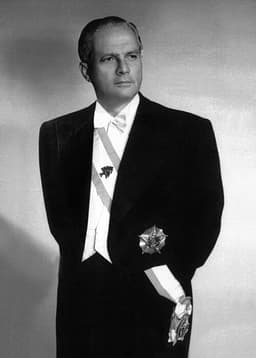
Camille Chamoun
Politician · Modern
51.4Total

Yukio Hatoyama
Politician · Modern
37.4Total
Basic Information
Born
1900
1947
Died
1987
—
Era
Modern
Modern
Nationality
Lebanon
Japan
Occupation
Politician
Politician
Civilization
Middle Eastern
Eastern
Score Comparison
Military (10%)
39.4
18.2
Political (20%)
61.3
39.4
Influence (20%)
53.3
48.6
Legacy (20%)
45.0
36.7
Leadership (15%)
65.0
38.1
Strategy (15%)
39.6
25.9
TOTAL
51.4
37.4
Camille Chamoun — Complete Timeline
1952 AD
Elected President of LebanonPolitical Action◆ Major
Camille Chamoun was elected President of Lebanon on September 23, 1952, succeeding Bechara El Khoury. His election marked a shift in Lebanese politics, and he served a six-year term until 1958.
PresidencyElectionLebanon
Impact: national
1958 AD
1958 Lebanon crisis and U.S. interventionWar◆ Major
President Chamoun faced a major political crisis when Muslim factions rebelled against his pro-Western policies and alleged attempts to amend the constitution for a second term. The U.S. intervened by landing Marines in Beirut to stabilize the government.
Civil WarU.S. InterventionPolitical Crisis
Impact: regionaldestructive
Refused to resign during the 1958 crisisPolitical Action
Chamoun refused to resign despite widespread opposition and the formation of a rebel government in Tripoli. He remained in power until the end of his term in September 1958, when he handed over to Fuad Chehab.
ResistancePolitical StalemateTransition
Impact: national
Founded the National Liberal PartyPolitical Action
After leaving the presidency, Chamoun founded the National Liberal Party (NLP) in 1958. The party became a major political force representing Maronite Christian interests and played a role in the Lebanese Civil War.
Political PartyMaronitePost-presidency
Impact: national
1975 AD
Role in the Lebanese Civil WarWar◆ Major
Chamoun's National Liberal Party and its militia, the Tigers, fought in the Lebanese Civil War as part of the Christian Lebanese Front. He opposed the Taif Agreement and remained a polarizing figure until his death in 1987.
Civil WarMilitiaChristian Faction
Impact: nationaldestructive
Yukio Hatoyama — Complete Timeline
2009 AD
Elected Prime Minister of JapanPolitical Action◆ Major
Hatoyama was elected as Prime Minister of Japan after leading the Democratic Party of Japan to a landslide victory in the 2009 general election. He became the first DPJ prime minister, ending LDP dominance.
JapanPrime MinisterDPJ
Impact: national
Proposed East Asian CommunityPolitical Action◆ Major
Hatoyama proposed the creation of an East Asian Community, a regional integration framework. The proposal aimed to reduce Japan's reliance on the US and strengthen ties with China and South Korea, but faced opposition from Washington.
JapanForeign PolicyEast Asia
Impact: regionalconstructive
2010 AD
Resigned over Futenma base disputePolitical Action◆ Major
Hatoyama resigned as Prime Minister after failing to relocate the US Marine Corps Air Station Futenma off Okinawa. His promise to move the base outside the prefecture was broken, leading to loss of public trust and coalition partner support.
JapanOkinawaUS Bases
Impact: nationaltragic
Expert Analysis
Origins
Camille Chamoun was born on April 3, 1900, in Deir el Qamar, Lebanon, into a prominent Maronite Christian family. His father was a lawyer and politician. Chamoun studied law at the Saint Joseph University in Beirut and later at the University of Paris. He entered politics early, serving as a deputy in the Lebanese parliament from 1934.
Yukio Hatoyama was born on February 11, 1947, in Tokyo, Japan, into a highly political family. His grandfather, Ichiro Hatoyama, was Prime Minister of Japan. His father was a diplomat. Hatoyama studied engineering at the University of Tokyo and later earned a PhD in operations research from Stanford University. He entered politics in 1986 as a member of the Liberal Democratic Party.
Rise to Power
Chamoun rose to prominence as a diplomat and minister. He served as Lebanon's ambassador to the United Kingdom during World War II. In 1952, he led a coalition that forced President Bechara El Khoury to resign, and Chamoun was elected President on September 23, 1952, with support from both Christians and Muslims.
Hatoyama left the LDP in 1993 to form the Japan New Party, later merging into the Democratic Party of Japan (DPJ). He became DPJ president in 1999. His breakthrough came in the 2009 general election, where the DPJ won a landslide victory, ending over 50 years of LDP dominance. He became Prime Minister on September 16, 2009.
Leadership & Governance
Chamoun's leadership was marked by a pro-Western orientation. He aligned Lebanon with the Eisenhower Doctrine, accepting U.S. aid and military assistance. Domestically, he pursued economic development but faced criticism for authoritarian tendencies. He refused to amend the constitution to allow a second term, but his efforts to centralize power alienated Muslim leaders. During the 1958 crisis, he called for U.S. military intervention, which landed Marines in Beirut.
Hatoyama's governance focused on reducing bureaucratic control and shifting foreign policy away from the U.S. He proposed an East Asian Community and attempted to renegotiate the U.S.-Japan security treaty. He also introduced child allowances and free high school education. However, his administration was plagued by indecision and infighting, particularly over the relocation of the Futenma air base.
Triumph & Tragedy
Chamoun's greatest success was maintaining Lebanon's stability during the 1958 crisis without altering the constitution. He secured U.S. intervention and left office peacefully on September 23, 1958. His tragedy was the subsequent descent into civil war in 1975, where his militia fought but failed to prevent the conflict's escalation. He scored 39.4 in military and 65.0 in leadership, reflecting his political skills but limited strategic success.
Hatoyama's triumph was the 2009 election victory, ending LDP dominance and raising hopes for reform. His proposal for an East Asian Community scored 48.6 in influence. However, his failure to relocate the Futenma base, breaking a campaign promise, led to his resignation after just eight months. His political score of 39.4 and strategy score of 25.9 highlight his inability to execute.
Character & Destiny
Chamoun was pragmatic and resilient, but also rigid in his pro-Western stance. His refusal to compromise during the 1958 crisis nearly cost him power, yet his determination preserved his presidency. Historians note his skill in navigating sectarian politics but criticize his role in deepening divisions.
Hatoyama was idealistic and intellectual, but indecisive. His vision of Asian integration was ahead of its time, but his lack of political maneuvering doomed his premiership. He resigned rather than face a no-confidence vote, reflecting a tendency to avoid confrontation.
Legacy
Chamoun's legacy is mixed. He is remembered as a strong president who upheld Christian interests, but his actions contributed to Lebanon's sectarian tensions. His National Liberal Party remained influential until the civil war. His overall score of 51.4 reflects his moderate impact.
Hatoyama's legacy is that of a reformer who failed to deliver. The DPJ collapsed after his resignation, and the LDP returned to power. His East Asian Community idea never materialized. He scored 37.4 overall, indicating limited long-term influence.
Conclusion
Camille Chamoun had greater impact than Yukio Hatoyama. Chamoun's leadership during a critical period in Lebanon's history, his ability to navigate a sectarian crisis, and his longer political career outweigh Hatoyama's brief premiership. Chamoun's score of 51.4 surpasses Hatoyama's 37.4 by 14 points. While Hatoyama's election was historic, his failure to enact lasting change places him below Chamoun in historical significance.
Rankings
🥇
Camille ChamounLeader
Mil: 39.4Pol: 61.3Inf: 53.3
51.4
🥈
Yukio Hatoyama
Mil: 18.2Pol: 39.4Inf: 48.6
37.4
+14.0 behind
How This Comparison Works
Algorithm
Each figure is scored on 6 dimensions (0—100 scale) based on structured historical data: Military (10%), Political (20%), Influence (20%), Legacy (20%), Leadership (15%), Strategy (15%). The weighted total produces the final ranking.
Data Sources
Scores are computed from structured sub-indicators in the database. Scale factors adjust for era (Ancient ×0.85, Modern ×1.0) and civilization size (Eastern ×1.05, Other ×0.80) to account for differences in population and military scale.
Maximum 3 Figures
Comparisons are limited to 2—3 figures to ensure readability and statistical meaningfulness.
Error Margins
±5 points per dimension — Sub-scores are derived from historical records with inherent uncertainty. Two figures within 5 points on a dimension should be considered roughly equivalent in that area.
Total Score Accuracy
±3 points overall — The weighted combination of 6 dimensions produces a total score with approximately ±3 points of uncertainty. Differences of less than 3 points are not statistically significant— the figures are effectively tied.
Known Limitations
- Historical records are incomplete and uneven across civilizations
- Figures from oral-tradition societies may be underrepresented
- Occupation labels can misclassify multi-role figures
- Scores measure capability and impact, not moral character
- Quantitative scoring is a comparison tool, not absolute truth
Capability Radar
Military (10%) — Battles & Warfare
Battles
23
12
Win Rate
25
15
Expansion
25
20
Political (20%) — Governance & Reform
Reform
40
30
Diplomacy
55
40
Economy
35
20
Influence (20%) — Cultural & Global Reach
Cultural
30
10
Global
30
10
Legacy (20%) — Historical Impact
Historical
40
15
Longevity
30
5
Leadership (15%) — Power & Stability
Tenure
60
10
Stability
20
15
Strategy (15%) — Tactics & Innovation
Strategy
31
24
Tactics
35
29
Reform
38
29
Similar Comparisons
Comments & Discussion
No comments yet. Be the first to share your thoughts!