Loading...
Osei Tutu vs Ruganzu II Ndoli
Osei Tutu leads by 20.7 pts · 2 figures compared
…

Osei Tutu
Emperor · Modern
68.8Total
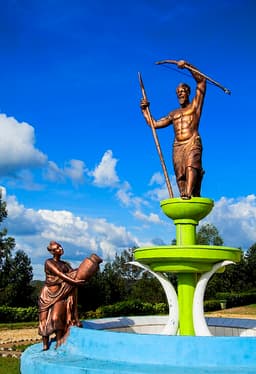
Ruganzu II Ndoli
Emperor · Modern
48.1Total
Basic Information
Born
1660
1550
Died
1717
1600
Era
Modern
Modern
Nationality
Ashanti Empire
Rwanda
Occupation
Emperor
Emperor
Civilization
Other
Other
Score Comparison
Military (10%)
78.0
50.0
Political (20%)
79.2
43.7
Influence (20%)
82.0
57.2
Legacy (20%)
40.0
47.5
Leadership (15%)
78.0
40.0
Strategy (15%)
69.1
43.3
TOTAL
68.8
48.1
Osei Tutu — Complete Timeline
1700 AD
Military ReorganizationReform◆ Major
Osei Tutu reorganized the Ashanti army into a professional force with a centralized command structure. He introduced new tactics and weaponry, including firearms obtained from European traders, enhancing military effectiveness.
Military ReformFirearmsArmy
Impact: regionalconstructive
Introduction of the Golden StoolCultural◆ Major
Osei Tutu, with the help of priest Okomfo Anokye, introduced the Golden Stool as the symbol of the Ashanti nation. According to tradition, the stool descended from the sky, representing the soul of the Ashanti people.
Golden StoolSymbolismUnity
Impact: regionalconstructive
1701 AD
Battle of FeyiaseWar◆ Major
Osei Tutu led the Ashanti forces to victory against the Denkyira kingdom at Feyiase. This battle broke Denkyira's dominance and established Ashanti as the leading power in the region, controlling gold trade routes.
BattleDenkyiraGold Trade
Impact: regional
Formation of the Ashanti UnionPolitical Action
Osei Tutu united several Akan states into the Ashanti Union under the Golden Stool, a symbol of unity and sovereignty. This confederation became the Ashanti Empire, with Kumasi as its capital.
UnificationGolden StoolAshanti Empire
Impact: regionalconstructive
Establishment of the Odwira FestivalCultural
Osei Tutu instituted the Odwira festival, an annual celebration of purification and renewal. The festival reinforced Ashanti unity and the authority of the Asantehene, becoming a central cultural institution.
FestivalOdwiraCultural Institution
Impact: regionalconstructive
Ruganzu II Ndoli — Complete Timeline
1575 AD
Expansion of Rwanda into the Eastern RegionWar◆ Major
Ruganzu II Ndoli led military campaigns that expanded the Rwandan kingdom eastward, conquering territories inhabited by the Gisaka and other groups. This expansion increased the kingdom's size and population, establishing Rwanda as a regional power.
ExpansionConquestRwanda
Impact: regional
Expert Analysis
Origins
Osei Tutu was born around 1660 in the Akan state of Akwamu (present-day Ghana). His mother was a princess of Denkyira, and his early life included exposure to the politics of the dominant Denkyira kingdom. He was educated in the military and political systems of the Akan, and after a period in exile, he returned to unite the Ashanti clans. Ruganzu II Ndoli, by contrast, is a semi-legendary mwami (king) of Rwanda, believed to have reigned in the 16th century (c. 1510–1543). He was born into the Nyiginya dynasty, which ruled a small central Rwandan kingdom. His father, Ndahiro II Cyamatare, was killed in a rebellion, forcing Ruganzu into exile in the kingdom of Karagwe. His early life was shaped by the need to reclaim his throne and expand his domain.
Rise to Power
Osei Tutu rose to prominence by forging the Ashanti Union. Around 1670, he allied with the priest Okomfo Anokye, who legitimized his rule through the myth of the Golden Stool descending from heaven. In 1701, at the Battle of Feyiase, Osei Tutu led Ashanti forces to a decisive victory over the Denkyira kingdom, breaking their dominance and establishing Ashanti as the paramount power in the region. This victory was a turning point that allowed him to consolidate control over neighboring Akan states. Ruganzu II Ndoli's rise came after his exile. He returned to Rwanda with a small army, defeated his rivals, and reclaimed the throne. He then embarked on a series of military campaigns to expand Rwanda's territory, particularly eastward into the lands of the Gisaka and other groups. His success in these campaigns solidified his rule and expanded the kingdom's influence.
Leadership & Governance
Osei Tutu's leadership was characterized by institutional innovation. He introduced the Golden Stool as a symbol of national unity, creating a centralized monarchy that balanced the power of local chiefs. He reorganized the army into a professional force with a centralized command, introducing new tactics and firearms obtained from European traders. He also established the Odwira festival to reinforce unity and loyalty. His governance created a stable, expansionist state that lasted for centuries. Ruganzu II Ndoli, in contrast, ruled through personal charisma and military prowess. His governance was less institutional; he expanded the royal domain but did not create lasting administrative structures. His campaigns increased Rwanda's size but relied on tribute and personal loyalty rather than formal bureaucracy. His leadership score of 40.0 reflects a more traditional warrior-king approach compared to Osei Tutu's 78.0.
Triumph & Tragedy
Osei Tutu's greatest triumph was founding the Ashanti Empire, which became a major West African power. His military reorganization and diplomatic strategies allowed Ashanti to dominate the gold and slave trades. His introduction of the Golden Stool created a lasting symbol of unity. However, his death around 1717 in battle against the Akyem was a tragedy that temporarily destabilized the empire. His legacy score of 40.0 is relatively low because his empire later declined under British colonialism. Ruganzu II Ndoli's triumph was expanding Rwanda eastward, laying the groundwork for the kingdom's future growth. He is remembered as a heroic figure in Rwandan oral tradition. However, his lack of institutional reforms meant that his gains were not fully consolidated. His military score of 50.0 and political score of 43.7 reflect limited strategic depth. His death is obscure, but his legacy endured through Rwanda's expansionist tradition.
Character & Destiny
Osei Tutu was a visionary strategist who combined military skill with political acumen. He understood the importance of legitimacy, using the Golden Stool to create a shared identity. His decision to ally with Okomfo Anokye showed his ability to harness religious authority. His character was pragmatic and ambitious, leading to the creation of a lasting empire. Ruganzu II Ndoli was a warrior-king driven by a desire to reclaim his throne and expand his realm. His character was more impulsive and less institutional. His reliance on personal rule meant that his achievements were fragile. Historical assessments consider him a legendary figure, but his actual impact is harder to measure due to the lack of written records. His total score of 48.1 reflects a less systematic approach to state-building.
Legacy
Osei Tutu's legacy is the Ashanti Empire, which endured until 1902. His political innovations, such as the Golden Stool and the Odwira festival, remain central to Ashanti identity. His military reforms influenced later West African states. Even today, the Asantehene (Ashanti king) is a revered figure in Ghana. Ruganzu II Ndoli's legacy is more limited. He is celebrated in Rwandan oral history as a great conqueror, but the kingdom he expanded was later reorganized by his successors, especially Kigeli IV Rwabugiri in the 19th century. His influence score of 57.2 is lower than Osei Tutu's 82.0, as his impact is largely confined to Rwanda and less documented.
Conclusion
Osei Tutu had a greater impact than Ruganzu II Ndoli. His total score of 68.8 versus 48.1 reflects his superior military, political, and leadership abilities. Osei Tutu created a centralized empire with enduring institutions, while Ruganzu II Ndoli expanded a kingdom through conquest but left no lasting administrative legacy. Osei Tutu's Ashanti Empire shaped West African history for centuries, influencing trade, politics, and culture. Ruganzu II Ndoli's Rwanda was a precursor to a larger state, but his personal achievements were overshadowed by later rulers. Therefore, Osei Tutu is the more significant historical figure.
Rankings
🥇
Osei TutuLeader
Mil: 78.0Pol: 79.2Inf: 82.0
68.8
🥈
Ruganzu II Ndoli
Mil: 50.0Pol: 43.7Inf: 57.2
48.1
+20.7 behind
How This Comparison Works
Algorithm
Each figure is scored on 6 dimensions (0—100 scale) based on structured historical data: Military (10%), Political (20%), Influence (20%), Legacy (20%), Leadership (15%), Strategy (15%). The weighted total produces the final ranking.
Data Sources
Scores are computed from structured sub-indicators in the database. Scale factors adjust for era (Ancient ×0.85, Modern ×1.0) and civilization size (Eastern ×1.05, Other ×0.80) to account for differences in population and military scale.
Maximum 3 Figures
Comparisons are limited to 2—3 figures to ensure readability and statistical meaningfulness.
Error Margins
±5 points per dimension — Sub-scores are derived from historical records with inherent uncertainty. Two figures within 5 points on a dimension should be considered roughly equivalent in that area.
Total Score Accuracy
±3 points overall — The weighted combination of 6 dimensions produces a total score with approximately ±3 points of uncertainty. Differences of less than 3 points are not statistically significant— the figures are effectively tied.
Known Limitations
- Historical records are incomplete and uneven across civilizations
- Figures from oral-tradition societies may be underrepresented
- Occupation labels can misclassify multi-role figures
- Scores measure capability and impact, not moral character
- Quantitative scoring is a comparison tool, not absolute truth
Capability Radar
Military (10%) — Battles & Warfare
Battles
75
45
Win Rate
80
50
Expansion
80
55
Political (20%) — Governance & Reform
Reform
90
40
Diplomacy
75
35
Economy
72
30
Influence (20%) — Cultural & Global Reach
Cultural
75
55
Global
65
30
Legacy (20%) — Historical Impact
Historical
80
50
Longevity
75
45
Leadership (15%) — Power & Stability
Tenure
70
50
Stability
78
45
Strategy (15%) — Tactics & Innovation
Strategy
82
45
Tactics
78
40
Reform
85
35
Similar Comparisons
Comments & Discussion
No comments yet. Be the first to share your thoughts!