Loading...
This comparison has not been analyzed yet.
One-time AI generation (~1 minute). Scores and timeline are already available below.
Pascal Lissouba vs Ramon Castillo
Pascal Lissouba leads by 5.9 pts · 2 figures compared
…
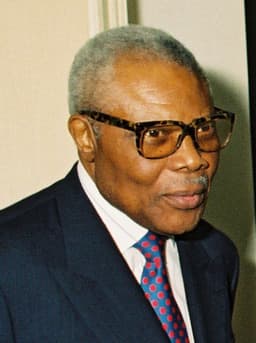
Pascal Lissouba
Politician · Modern
45.1Total

Ramon Castillo
Politician · Modern
39.2Total
Basic Information
Born
1931
1873
Died
—
1944
Era
Modern
Modern
Nationality
Congo-Brazzaville
Argentina
Occupation
Politician
Politician
Civilization
Other
Western
Score Comparison
Military (10%)
50.0
49.6
Political (20%)
39.4
26.4
Influence (20%)
47.1
45.5
Legacy (20%)
37.5
35.8
Leadership (15%)
58.8
38.1
Strategy (15%)
42.5
42.1
TOTAL
45.1
39.2
Pascal Lissouba — Complete Timeline
1992 AD
Elected President of Congo-BrazzavillePolitical Action◆ Major
Lissouba won the first multi-party presidential election in Congo-Brazzaville since independence, defeating Denis Sassou-Nguesso. His victory marked a transition from Marxist one-party rule to democratic governance.
ElectionDemocracyCongo-Brazzaville
Impact: nationalprogressive
1997 AD
Overthrown in Civil WarWar◆ Major
Lissouba was overthrown by forces loyal to Denis Sassou-Nguesso during the Republic of Congo Civil War. The conflict involved ethnic militias and foreign intervention, resulting in Sassou-Nguesso's return to power.
Civil WarCoupCongo-Brazzaville
Impact: nationaldestructive
Ramon Castillo — Complete Timeline
1938 AD
Appointment as Vice President of ArgentinaPolitical Action◆ Major
Ramon Castillo was appointed Vice President of Argentina under President Roberto M. Ortiz. This position placed him in line for the presidency and made him a key figure in the conservative Concordancia coalition government.
Vice PresidencyConcordanciaConservative Government
Impact: national
1942 AD
Assumed Presidency of ArgentinaOther◆ Major
Castillo assumed the presidency of Argentina after President Ortiz resigned due to illness. As the last conservative president of the so-called 'Infamous Decade', Castillo continued policies favoring the landed elite and maintaining neutrality in World War II.
PresidencyInfamous DecadeConservative Rule
Impact: national
1943 AD
Overthrow in the 1943 Argentine CoupPolitical Action◆ Major
Castillo was overthrown in a military coup led by the Group of United Officers (GOU), which included Juan Per
CoupOverthrowMilitary GovernmentPerón
Impact: nationaldestructive
Imposition of State of SiegePolitical Action
In response to growing political unrest and labor strikes, Castillo imposed a state of siege, suspending constitutional guarantees and cracking down on opposition. This action further alienated the working class and contributed to the instability that led to his overthrow.
State of SiegeRepressionPolitical Unrest
Impact: nationaldestructive
This comparison has not been analyzed yet.
One-time AI generation (~1 minute). Scores and timeline are already available below.
Rankings
🥇
Pascal LissoubaLeader
Mil: 50.0Pol: 39.4Inf: 47.1
45.1
🥈
Ramon Castillo
Mil: 49.6Pol: 26.4Inf: 45.5
39.2
+5.9 behind
How This Comparison Works
Algorithm
Each figure is scored on 6 dimensions (0—100 scale) based on structured historical data: Military (10%), Political (20%), Influence (20%), Legacy (20%), Leadership (15%), Strategy (15%). The weighted total produces the final ranking.
Data Sources
Scores are computed from structured sub-indicators in the database. Scale factors adjust for era (Ancient ×0.85, Modern ×1.0) and civilization size (Eastern ×1.05, Other ×0.80) to account for differences in population and military scale.
Maximum 3 Figures
Comparisons are limited to 2—3 figures to ensure readability and statistical meaningfulness.
Error Margins
±5 points per dimension — Sub-scores are derived from historical records with inherent uncertainty. Two figures within 5 points on a dimension should be considered roughly equivalent in that area.
Total Score Accuracy
±3 points overall — The weighted combination of 6 dimensions produces a total score with approximately ±3 points of uncertainty. Differences of less than 3 points are not statistically significant— the figures are effectively tied.
Known Limitations
- Historical records are incomplete and uneven across civilizations
- Figures from oral-tradition societies may be underrepresented
- Occupation labels can misclassify multi-role figures
- Scores measure capability and impact, not moral character
- Quantitative scoring is a comparison tool, not absolute truth
Capability Radar
Military (10%) — Battles & Warfare
Battles
23
27
Win Rate
25
32
Expansion
27
38
Political (20%) — Governance & Reform
Reform
35
10
Diplomacy
30
15
Economy
25
10
Influence (20%) — Cultural & Global Reach
Cultural
10
5
Global
10
5
Legacy (20%) — Historical Impact
Historical
15
10
Longevity
10
5
Leadership (15%) — Power & Stability
Tenure
40
20
Stability
15
5
Strategy (15%) — Tactics & Innovation
Strategy
30
35
Tactics
31
39
Reform
36
47
Similar Comparisons
Comments & Discussion
No comments yet. Be the first to share your thoughts!