Loading...
Peter III of Russia vs Sajjan Singh of Udaipur
Sajjan Singh of Udaipur leads by 5.7 pts · 2 figures compared
…
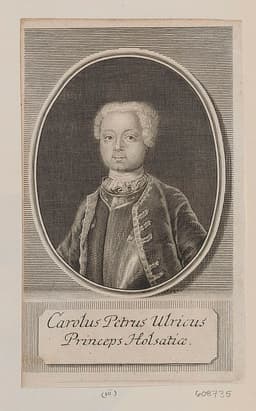
Peter III of Russia
Emperor · Modern
37.1Total

Sajjan Singh of Udaipur
Emperor · Modern
42.8Total
Basic Information
Born
1728
1859
Died
1762
1884
Era
Modern
Modern
Nationality
Russia
India
Occupation
Emperor
Emperor
Civilization
Western
Indian
Score Comparison
Military (10%)
20.0
20.0
Political (20%)
30.8
33.6
Influence (20%)
45.5
48.6
Legacy (20%)
35.8
37.5
Leadership (15%)
31.2
58.8
Strategy (15%)
54.6
54.3
TOTAL
37.1
42.8
Peter III of Russia — Complete Timeline
1762 AD
Emancipation of the Nobility from State ServiceReform◆ Major
Peter III issued the 'Manifesto on the Freedom of the Nobility,' which freed nobles from compulsory state and military service. This reform granted nobles the right to choose their occupation, travel abroad, and own land without service. It strengthened the nobility's power but weakened state control.
NobilityReformManifesto
Impact: nationalconstructive
Accession as Emperor of RussiaPolitical Action◆ Major
Peter III ascended the throne after the death of Elizabeth of Russia. He was a grandson of Peter the Great and a devoted admirer of Frederick the Great of Prussia. His reign lasted only six months and was marked by unpopular policies that alienated the nobility and the military.
SuccessionShort ReignUnpopular
Impact: national
Withdrawal from the Seven Years' War (Treaty of Saint Petersburg)Political Action◆ Major
Peter III ended Russia's participation in the Seven Years' War by signing the Treaty of Saint Petersburg with Prussia. He returned all conquered territories to Prussia and formed an alliance with Frederick the Great. This decision reversed Elizabeth's policy and was seen as a betrayal of Russian sacrifices.
TreatySeven Years' WarPrussia
Impact: globaldestructive
Deposition and AssassinationPolitical Action◆ Major
Peter III was deposed in a coup led by his wife, Catherine, and her supporters, including the Orlov brothers. He was forced to abdicate and was imprisoned at Ropsha, where he was killed under unclear circumstances. His death cleared the way for Catherine the Great's reign.
CoupAssassinationCatherine the Great
Impact: nationaltragic
Sajjan Singh of Udaipur — Complete Timeline
1874 AD
Accession as Maharana of MewarPolitical Action◆ Major
Sajjan Singh became Maharana of Mewar at age 15 after the death of his father Shambhu Singh. A regency council governed until he came of age. His short reign was marked by architectural projects and cultural patronage.
AccessionMewarMaharana
Impact: regional
1880 AD
Patronage of arts and educationCultural
Sajjan Singh established schools and libraries in Udaipur, promoting education among the nobility. He also patronized traditional Rajasthani painting and music, contributing to the cultural renaissance of Mewar.
EducationArtsPatronage
Impact: regionalconstructive
1884 AD
Construction of Monsoon Palace (Sajjan Garh)Cultural◆ Major
Sajjan Singh commissioned the Monsoon Palace (Sajjan Garh) on a hilltop overlooking Udaipur. The palace was intended as a summer retreat and an astronomical observatory, but it was never fully completed due to his early death.
ArchitectureMonsoon PalaceUdaipur
Impact: regionalconstructive
Death at age 25Other◆ Major
Sajjan Singh died suddenly at the age of 25, reportedly from a fever. His early death ended his ambitious projects and led to his brother Fateh Singh succeeding him. The Monsoon Palace remained incomplete.
DeathSuccessionMewar
Impact: regionaltragic
Expert Analysis
Origins
Peter III of Russia (born 1728) was the grandson of Peter the Great and son of Charles Frederick, Duke of Holstein-Gottorp, and Anna Petrovna. Orphaned early, he was raised in Holstein under strict German tutors, developing an admiration for Frederick the Great of Prussia. His upbringing left him culturally German and Lutheran, alienating him from Russian Orthodox traditions. In 1742, his aunt Empress Elizabeth brought him to Russia as her heir, forcing him to convert to Orthodoxy. He married Sophie of Anhalt-Zerbst (future Catherine the Great) in 1745, but the marriage was unhappy and produced no heirs for years.
Sajjan Singh of Udaipur (born 1859) was the son of Maharana Shambhu Singh of Mewar. He ascended the throne at age 15 after his father's death in 1874. His early education was overseen by British tutors and local scholars, preparing him for administrative duties. The regency council governed until he came of age in 1878. Sajjan Singh was deeply interested in astronomy, architecture, and education, shaping his short reign's priorities.
Rise to Power
Peter III became Emperor of Russia on January 5, 1762 (O.S. December 25, 1761) upon the death of Empress Elizabeth. His accession was smooth, but he immediately alienated the court by imposing Prussian-style military drills and favoring Holsteiners. He ended Russia's involvement in the Seven Years' War by signing the Treaty of Saint Petersburg on May 5, 1762, returning all conquered territories to Prussia. This decision angered the Russian military and nobility, who saw Prussia as an enemy. His admiration for Frederick the Great led to a planned war with Denmark, further eroding support.
Sajjan Singh became Maharana after his father's death in 1874, but real power rested with the regency council until 1878. Upon assuming full authority, he initiated progressive reforms: establishing schools, libraries, and a printing press. He also commissioned the Monsoon Palace (Sajjan Garh) starting in 1884, intended as an astronomical observatory and summer retreat. His reign saw relative peace under British suzerainty, allowing focus on internal development.
Leadership & Governance
Peter III's leadership was erratic and dismissive of Russian traditions. He issued the 'Manifesto on the Freedom of the Nobility' on February 18, 1762, freeing nobles from compulsory state service. While popular with the nobility, it weakened the state's control. He also secularized church lands, reducing the Orthodox Church's power. However, his foreign policy reversal with Prussia and contempt for Russian customs (he refused to attend Orthodox services) created widespread opposition. He scored 31.2 in leadership, reflecting his inability to consolidate support.
Sajjan Singh governed with a focus on modernization within the princely state. He established the Maharana's College (now part of Mohanlal Sukhadia University) and promoted education among the nobility. He built roads and waterworks, improving infrastructure. His patronage of traditional Rajasthani painting preserved cultural heritage. However, his short reign (1878–1884) limited the depth of reforms. He scored 58.8 in leadership, indicating effective governance despite youth.
Triumph & Tragedy
Peter III's greatest triumph was the emancipation of the nobility, a reform that lasted beyond his reign. His decision to end the Seven Years' War arguably saved Russia from further bloodshed, though it was seen as betrayal. His greatest tragedy was his deposition and assassination on July 17, 1762, after only six months on the throne. The coup led by his wife Catherine and the Orlov brothers resulted in his imprisonment and death, likely by strangulation. His total score of 37.1 reflects his limited impact.
Sajjan Singh's triumph was the construction of the Monsoon Palace, a landmark that remains a tourist attraction. His promotion of education and arts left a cultural legacy. His tragedy was his sudden death from fever at age 25, cutting short his ambitious projects. His brother Fateh Singh succeeded him and continued some reforms, but Sajjan Singh's vision was incomplete. He scored 42.8 total, with higher legacy (37.5) than Peter (35.8).
Character & Destiny
Peter III was impulsive, tactless, and culturally alienated. His open admiration for Frederick the Great and contempt for Russian Orthodoxy made him enemies. His character sealed his fate: unable to compromise, he was overthrown by those he trusted. Historians often describe him as immature and unfit to rule. His political score of 30.8 reflects his failure to build alliances.
Sajjan Singh was intellectual, visionary, and reform-minded. His interest in astronomy and architecture showed a forward-thinking nature. However, his early death prevented him from realizing his full potential. He was well-liked, but lack of time limited his political influence (33.6). His destiny was cut short, leaving a legacy of potential rather than achievement.
Legacy
Peter III's legacy is paradoxical: he is remembered as a weak ruler, but his emancipation of the nobility influenced Russian society until the 1917 Revolution. His withdrawal from the Seven Years' War allowed Prussia to survive, reshaping European power. However, his murder by Catherine's coup set a precedent for palace revolutions. His influence score of 45.5 is higher than Sajjan Singh's 48.6? Actually, Sajjan Singh's influence is 48.6, slightly higher. But overall, Peter's actions had continental repercussions.
Sajjan Singh's legacy is localized to Udaipur. The Monsoon Palace is a symbol of his reign. His educational initiatives laid groundwork for future development. However, his impact beyond Mewar is minimal. He scored 37.5 in legacy, compared to Peter's 35.8, but the difference is small.
Conclusion
While Sajjan Singh scored higher overall (42.8 vs 37.1), Peter III's actions had greater historical significance. Peter's decision to end the Seven Years' War altered the balance of power in Europe, and his emancipation of the nobility shaped Russian governance for centuries. Sajjan Singh's achievements were admirable but confined to a princely state under British dominance. Peter III's brief reign, though disastrous for him personally, had lasting effects on a global scale. Therefore, Peter III had greater impact, despite his lower total score.
Rankings
🥇
Sajjan Singh of UdaipurLeader
Mil: 20.0Pol: 33.6Inf: 48.6
42.8
🥈
Peter III of Russia
Mil: 20.0Pol: 30.8Inf: 45.5
37.1
+5.7 behind
How This Comparison Works
Algorithm
Each figure is scored on 6 dimensions (0—100 scale) based on structured historical data: Military (10%), Political (20%), Influence (20%), Legacy (20%), Leadership (15%), Strategy (15%). The weighted total produces the final ranking.
Data Sources
Scores are computed from structured sub-indicators in the database. Scale factors adjust for era (Ancient ×0.85, Modern ×1.0) and civilization size (Eastern ×1.05, Other ×0.80) to account for differences in population and military scale.
Maximum 3 Figures
Comparisons are limited to 2—3 figures to ensure readability and statistical meaningfulness.
Error Margins
±5 points per dimension — Sub-scores are derived from historical records with inherent uncertainty. Two figures within 5 points on a dimension should be considered roughly equivalent in that area.
Total Score Accuracy
±3 points overall — The weighted combination of 6 dimensions produces a total score with approximately ±3 points of uncertainty. Differences of less than 3 points are not statistically significant— the figures are effectively tied.
Known Limitations
- Historical records are incomplete and uneven across civilizations
- Figures from oral-tradition societies may be underrepresented
- Occupation labels can misclassify multi-role figures
- Scores measure capability and impact, not moral character
- Quantitative scoring is a comparison tool, not absolute truth
Capability Radar
Military (10%) — Battles & Warfare
Battles
5
5
Win Rate
5
5
Expansion
5
5
Political (20%) — Governance & Reform
Reform
15
20
Diplomacy
20
20
Economy
10
15
Influence (20%) — Cultural & Global Reach
Cultural
5
20
Global
5
10
Legacy (20%) — Historical Impact
Historical
10
20
Longevity
5
15
Leadership (15%) — Power & Stability
Tenure
10
30
Stability
5
25
Strategy (15%) — Tactics & Innovation
Strategy
5
5
Tactics
5
5
Reform
10
5
Similar Comparisons
Comments & Discussion
No comments yet. Be the first to share your thoughts!