Loading...
This comparison has not been analyzed yet.
One-time AI generation (~1 minute). Scores and timeline are already available below.
Philip I of Castile vs Shushan Tigin
Philip I of Castile leads by 1.4 pts · 2 figures compared
…
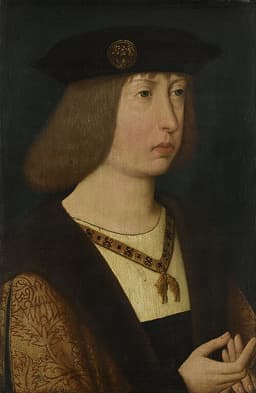
Philip I of Castile
Emperor · Medieval
38.0Total

Shushan Tigin
Emperor · Medieval
36.6Total
Basic Information
Born
1478
1100
Died
1506
1150
Era
Medieval
Medieval
Nationality
Spain
Ghana Empire
Occupation
Emperor
Emperor
Civilization
Western
Other
Score Comparison
Military (10%)
20.0
21.2
Political (20%)
30.8
32.1
Influence (20%)
47.1
47.1
Legacy (20%)
35.8
36.7
Leadership (15%)
34.6
33.6
Strategy (15%)
54.3
36.8
TOTAL
38.0
36.6
Philip I of Castile — Complete Timeline
1496 AD
Marriage to Joanna of CastilePolitical Action◆ Major
Philip I of Castile married Joanna of Castile, the daughter of Ferdinand II of Aragon and Isabella I of Castile. This marriage was part of a double alliance between Spain and the Habsburgs, strengthening ties between the two dynasties and eventually bringing the Spanish throne to the Habsburg family.
Habsburg allianceDynastic marriage
Impact: globalconstructive
1504 AD
Death of Isabella I of CastilePolitical Action◆ Major
Upon the death of Isabella I of Castile, Philip I and Joanna became the nominal rulers of Castile. However, Ferdinand II of Aragon disputed their claim, leading to a power struggle. Philip traveled to Castile to assert his authority, but his reign was brief.
SuccessionPower struggle
Impact: national
1506 AD
Treaty of VillafáfilaPolitical Action◆ Major
Philip I of Castile and Ferdinand II of Aragon signed the Treaty of Villaf
TreatySuccession
Impact: nationalconstructive
Death of Philip IOther
Philip I of Castile died suddenly at the age of 28 in Burgos, possibly from typhoid fever or poisoning. His death left Joanna as the sole ruler of Castile, but her mental instability led to her confinement and the eventual assumption of power by her father Ferdinand II.
DeathSuccession crisis
Impact: nationaltragic
Shushan Tigin — Complete Timeline
1120 AD
Installation as Almoravid governor of GhanaPolitical Action◆ Major
Shushan Tigin was appointed governor of the Ghana Empire by the Almoravid rulers after their conquest. He administered the former imperial capital of Koumbi Saleh and collected tribute from subject peoples.
AlmoravidGovernorGhana Empire
Impact: regional
1130 AD
Suppression of Soninke rebellionWar◆ Major
Shushan Tigin crushed a rebellion by the Soninke people, the original rulers of Ghana, who sought to restore their independence. He used Almoravid cavalry to defeat the rebels and reaffirmed Almoravid control.
RebellionSoninkeAlmoravid
Impact: regionaldestructive
1135 AD
Implementation of Islamic administrationReform◆ Major
Shushan Tigin introduced Islamic administrative practices to the Ghana Empire, including the use of Arabic for official records and the appointment of Muslim judges. This began the Islamization of the region's governance.
IslamizationAdministrationGhana
Impact: regionalconstructive
This comparison has not been analyzed yet.
One-time AI generation (~1 minute). Scores and timeline are already available below.
Rankings
🥇
Philip I of CastileLeader
Mil: 20.0Pol: 30.8Inf: 47.1
38.0
🥈
Shushan Tigin
Mil: 21.2Pol: 32.1Inf: 47.1
36.6
+1.4 behind
How This Comparison Works
Algorithm
Each figure is scored on 6 dimensions (0—100 scale) based on structured historical data: Military (10%), Political (20%), Influence (20%), Legacy (20%), Leadership (15%), Strategy (15%). The weighted total produces the final ranking.
Data Sources
Scores are computed from structured sub-indicators in the database. Scale factors adjust for era (Ancient ×0.85, Modern ×1.0) and civilization size (Eastern ×1.05, Other ×0.80) to account for differences in population and military scale.
Maximum 3 Figures
Comparisons are limited to 2—3 figures to ensure readability and statistical meaningfulness.
Error Margins
±5 points per dimension — Sub-scores are derived from historical records with inherent uncertainty. Two figures within 5 points on a dimension should be considered roughly equivalent in that area.
Total Score Accuracy
±3 points overall — The weighted combination of 6 dimensions produces a total score with approximately ±3 points of uncertainty. Differences of less than 3 points are not statistically significant— the figures are effectively tied.
Known Limitations
- Historical records are incomplete and uneven across civilizations
- Figures from oral-tradition societies may be underrepresented
- Occupation labels can misclassify multi-role figures
- Scores measure capability and impact, not moral character
- Quantitative scoring is a comparison tool, not absolute truth
Capability Radar
Military (10%) — Battles & Warfare
Battles
5
10
Win Rate
5
10
Expansion
5
10
Political (20%) — Governance & Reform
Reform
5
10
Diplomacy
30
10
Economy
10
10
Influence (20%) — Cultural & Global Reach
Cultural
10
10
Global
10
10
Legacy (20%) — Historical Impact
Historical
15
10
Longevity
10
10
Leadership (15%) — Power & Stability
Tenure
10
20
Stability
10
10
Strategy (15%) — Tactics & Innovation
Strategy
5
10
Tactics
5
10
Reform
5
10
Similar Comparisons
Comments & Discussion
No comments yet. Be the first to share your thoughts!