Loading...
Philippe Petain vs Zachary Taylor
Philippe Petain leads by 20.8 pts · 2 figures compared
…

Philippe Petain
General · Modern
68.9Total
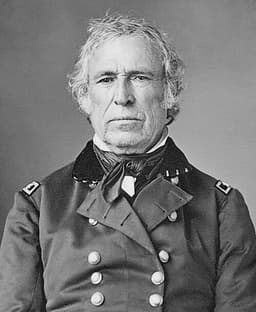
Zachary Taylor
General · Modern
48.1Total
Basic Information
Born
1856
1784
Died
1951
1850
Era
Modern
Modern
Nationality
France
United States
Occupation
General
General
Civilization
Western
Western
Score Comparison
Military (10%)
70.0
63.3
Political (20%)
68.0
29.3
Influence (20%)
82.0
53.3
Legacy (20%)
55.0
44.2
Leadership (15%)
71.0
48.4
Strategy (15%)
68.1
57.5
TOTAL
68.9
48.1
Philippe Petain — Complete Timeline
1916 AD
Battle of VerdunWar
Pétain commanded the French Second Army during the Battle of Verdun, organizing the defense and supply lines. His leadership and the phrase 'They shall not pass' made him a national hero, though the battle was a bloody stalemate.
World War IWestern FrontDefense
Impact: national
1917 AD
Suppressed the 1917 French Army MutiniesPolitical Action◆ Major
After the failed Nivelle Offensive, P
World War IMutinyCommand
Impact: national
1940 AD
Appointed Prime Minister of Vichy FrancePolitical Action
After the French defeat by Germany, P
World War IIVichy FranceCollaboration
Impact: nationaldestructive
Implemented the Vichy Regime's Anti-Semitic LawsPolitical Action◆ Major
Pétain's government enacted the Statut des Juifs, excluding Jews from public life and many professions. This was part of a broader collaboration with Nazi Germany, including the deportation of French Jews to concentration camps.
World War IIAnti-SemitismCollaboration
Impact: nationaldestructive
1945 AD
Tried and Convicted for TreasonPolitical Action◆ Major
After the liberation of France, P
World War IITrialJustice
Impact: national
Zachary Taylor — Complete Timeline
1846 AD
Battle of Palo AltoWar◆ Major
Taylor commanded U.S. forces in the first major battle of the Mexican-American War near present-day Brownsville, Texas. His army defeated Mexican forces under General Mariano Arista, securing the Rio Grande border.
Mexican-American WarBattleMilitary
Impact: regional
1847 AD
Battle of Buena VistaWar◆ Major
Taylor's outnumbered army defeated a larger Mexican force led by Santa Anna at Buena Vista, Coahuila. The victory made Taylor a national hero and boosted his presidential prospects.
Mexican-American WarBattleSanta Anna
Impact: regional
1848 AD
Elected President of the United StatesPolitical Action◆ Major
Taylor won the 1848 presidential election as the Whig candidate, defeating Democrat Lewis Cass and Free Soil candidate Martin Van Buren. His military fame and ambiguous stance on slavery secured victory.
PresidencyElectionWhig Party
Impact: national
1850 AD
Threatened to Veto Compromise of 1850Political Action◆ Major
Taylor opposed the Compromise of 1850, threatening to veto it and even to lead troops against secessionists. His death in July 1850 removed the main obstacle to the compromise's passage.
Compromise of 1850SlaverySecession
Impact: national
Died in OfficeOther◆ Major
Taylor died suddenly on July 9, 1850, after a brief illness likely caused by gastroenteritis. His death elevated Millard Fillmore to the presidency, who then signed the Compromise of 1850.
DeathPresidential Succession
Impact: nationaltragic
Expert Analysis
Origins
Philippe Pétain was born on April 24, 1856, in Cauchy-à-la-Tour, France, into a peasant family. Orphaned at a young age, he entered the military academy Saint-Cyr in 1876. His early career was unremarkable, as he rejected the prevailing offensive doctrine, focusing instead on firepower and defense.
Zachary Taylor was born on November 24, 1784, in Orange County, Virginia, into a planter family. He grew up on the frontier in Kentucky with minimal formal education. He joined the army as a lieutenant in 1808 and spent decades on frontier duty, earning a reputation for toughness and informal command.
Rise to Power
Pétain's rise came during World War I. At age 58, he was a colonel but gained attention for his defensive tactics. In 1916, he was given command at Verdun, where his organization of supply lines and rotation of troops helped hold the line. His phrase 'They shall not pass' became iconic. In 1917, after the French army mutinies, he was appointed Commander-in-Chief and restored order by addressing soldiers' grievances, not by mass executions. By the end of the war, he was a national hero.
Taylor's rise occurred during the Mexican-American War. He commanded U.S. forces at the Battle of Palo Alto (May 8, 1846), the first major engagement, where his use of artillery proved decisive. His greatest victory came at Buena Vista (February 22-23, 1847), where his outnumbered army defeated Santa Anna's larger force. These victories made him a national hero, and the Whig Party nominated him for president in 1848. He won the election without having held prior political office.
Leadership & Governance
Pétain's leadership style was paternalistic and authoritarian. As head of Vichy France, he pursued a 'National Revolution' emphasizing tradition, family, and work. He collaborated with Nazi Germany, implementing anti-Semitic laws like the Statut des Juifs (1940), which excluded Jews from public life. His government also enacted labor conscription for Germany. Pétain believed he was shielding France from worse outcomes, but his policies led to the deportation of 76,000 Jews.
Taylor's leadership was informal and blunt. As president, he opposed the Compromise of 1850, threatening to veto it and even to lead troops against secessionists. He favored admitting California as a free state and opposed the expansion of slavery into new territories. His governance was marked by inexperience and a lack of political allies, but he took a firm stance on preserving the Union.
Triumph & Tragedy
Pétain's greatest triumph was his defense at Verdun, where he scored 78.3 in military leadership. His ability to maintain morale and logistics saved the French army from collapse. However, his collaboration with the Nazis led to his conviction for treason in 1945. He was sentenced to death, commuted to life imprisonment. His legacy is overshadowed by the Vichy regime's atrocities.
Taylor's greatest triumph was his victory at Buena Vista, scoring 63.3 in military influence. He became a national hero and rose to the presidency. His tragedy was his sudden death in office on July 9, 1850, after only 16 months. His death removed the main obstacle to the Compromise of 1850, which he opposed, and allowed the compromise to pass, delaying the Civil War but also strengthening slavery.
Character & Destiny
Pétain was cautious, disciplined, and deeply conservative. His character led him to prioritize order and stability over liberty. In 1940, he saw France's defeat as an opportunity to reshape the nation, but his collaborationist choices destroyed his reputation. Historian Robert Paxton noted his 'defeatism' and 'willingness to accept German domination.'
Taylor was straightforward, unpretentious, and stubborn. Nicknamed 'Old Rough and Ready,' he often wore civilian clothes and avoided military pomp. His lack of political experience and refusal to compromise on the slavery issue created enemies in Congress. His death was likely due to gastroenteritis, but some historians speculate it may have been from contaminated milk or cherries consumed at a Fourth of July celebration.
Legacy
Pétain's legacy is deeply contested in France. He is remembered both as a World War I hero and as a traitor who led Vichy France. His military innovations at Verdun influenced defensive tactics, but his political legacy is overwhelmingly negative. The Vichy regime's collaboration with the Holocaust has been acknowledged by the French state. His score of 55.0 in legacy reflects this duality.
Taylor's legacy is more modest but mostly positive. He is remembered as a war hero who took a strong stance against secession, setting a precedent for presidential authority. His death allowed the Compromise of 1850, which some argue delayed the Civil War, but others say it strengthened the institution of slavery. His legacy score of 44.2 reflects his brief presidency and mixed outcomes.
Conclusion
While both men were war heroes who rose to political leadership, their impacts diverge sharply. Pétain's influence was greater in scope and duration, with a total score of 68.9 vs. Taylor's 48.1. Pétain shaped France's military tactics and its political fate during a critical period, even though his choices were ultimately disastrous. Taylor's military achievements were significant but temporary, and his presidency was cut short. Pétain's score in influence (82.0) dwarfs Taylor's (53.3), reflecting his lasting impact on French history. However, in terms of moral legacy, Taylor's defense of the Union stands in stark contrast to Pétain's collaboration. Nonetheless, measured by historical impact, Pétain had the greater effect on world events, for better or worse.
Rankings
🥇
Philippe PetainLeader
Mil: 70.0Pol: 68.0Inf: 82.0
68.9
🥈
Zachary Taylor
Mil: 63.3Pol: 29.3Inf: 53.3
48.1
+20.8 behind
How This Comparison Works
Algorithm
Each figure is scored on 6 dimensions (0—100 scale) based on structured historical data: Military (10%), Political (20%), Influence (20%), Legacy (20%), Leadership (15%), Strategy (15%). The weighted total produces the final ranking.
Data Sources
Scores are computed from structured sub-indicators in the database. Scale factors adjust for era (Ancient ×0.85, Modern ×1.0) and civilization size (Eastern ×1.05, Other ×0.80) to account for differences in population and military scale.
Maximum 3 Figures
Comparisons are limited to 2—3 figures to ensure readability and statistical meaningfulness.
Error Margins
±5 points per dimension — Sub-scores are derived from historical records with inherent uncertainty. Two figures within 5 points on a dimension should be considered roughly equivalent in that area.
Total Score Accuracy
±3 points overall — The weighted combination of 6 dimensions produces a total score with approximately ±3 points of uncertainty. Differences of less than 3 points are not statistically significant— the figures are effectively tied.
Known Limitations
- Historical records are incomplete and uneven across civilizations
- Figures from oral-tradition societies may be underrepresented
- Occupation labels can misclassify multi-role figures
- Scores measure capability and impact, not moral character
- Quantitative scoring is a comparison tool, not absolute truth
Capability Radar
Military (10%) — Battles & Warfare
Battles
75
65
Win Rate
70
70
Expansion
20
55
Political (20%) — Governance & Reform
Reform
40
10
Diplomacy
55
20
Economy
30
10
Influence (20%) — Cultural & Global Reach
Cultural
50
30
Global
60
20
Legacy (20%) — Historical Impact
Historical
70
40
Longevity
55
25
Leadership (15%) — Power & Stability
Tenure
65
15
Stability
25
25
Strategy (15%) — Tactics & Innovation
Strategy
85
65
Tactics
80
60
Reform
60
20
Similar Comparisons
Comments & Discussion
No comments yet. Be the first to share your thoughts!