Loading...
Postumus vs Zeno
Postumus leads by 9.3 pts · 2 figures compared
…
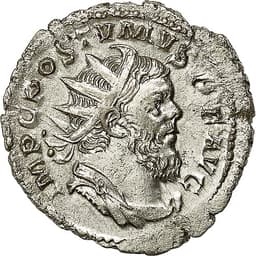
Postumus
Emperor · Ancient
55.5Total

Zeno
Emperor · Ancient
46.2Total
Basic Information
Born
220
425
Died
269
491
Era
Ancient
Ancient
Nationality
Gallic Empire
Byzantine Empire
Occupation
Emperor
Emperor
Civilization
Western
Western
Score Comparison
Military (10%)
60.0
50.0
Political (20%)
68.0
35.1
Influence (20%)
48.6
51.0
Legacy (20%)
42.5
43.3
Leadership (15%)
70.0
58.8
Strategy (15%)
60.0
35.7
TOTAL
55.5
46.2
Postumus — Complete Timeline
260 AD
Proclaimed emperor in Gaul after Valerian's capturePolitical Action
Following the capture of Emperor Valerian by the Sassanids, Postumus was proclaimed emperor by his troops in Gaul. He established the Gallic Empire, a breakaway state comprising Gaul, Britain, and Hispania, with its capital at Colonia Agrippina.
Gallic EmpireUsurpationCrisis of the Third Century
Impact: regional
261 AD
Defeated Gallienus at the Battle of MursaWar◆ Major
Postumus repelled an invasion by Emperor Gallienus, defeating him at the Battle of Mursa. This victory secured the Gallic Empire's independence and forced Gallienus to abandon attempts to reconquer the western provinces.
BattleGallic EmpireRoman Civil War
Impact: regional
269 AD
Stabilized the Gallic Empire for nine yearsPolitical Action◆ Major
Postumus successfully defended the Gallic Empire against both internal usurpers and external Germanic invasions for nine years. His reign provided stability to the western provinces during the Crisis of the Third Century, with effective administration and coinage.
Gallic EmpireStabilityAdministration
Impact: regionalconstructive
Killed by his own troops after refusing to sack MainzPolitical Action◆ Major
After defeating the usurper Laelianus at Mainz, Postumus refused to allow his troops to sack the city. His soldiers mutinied and killed him, ending his reign. His death led to a period of instability in the Gallic Empire.
MutinyDeathGallic Empire
Impact: regionaltragic
Zeno — Complete Timeline
476 AD
Failed to prevent the fall of the Western Roman EmpireWar
During Zeno's reign, the Western Roman Emperor Romulus Augustulus was deposed by Odoacer. Zeno recognized Odoacer as patrician but refused to recognize a new Western emperor, effectively accepting the end of the Western Roman Empire as a separate entity.
Fall of RomeLate AntiquityPolitical Change
Impact: globaltragic
Ended the reign of BasiliscusPolitical Action◆ Major
Zeno, who had been forced to flee Constantinople by the usurper Basiliscus, returned with an army of Isaurians and regained the throne. Basiliscus and his family were captured and executed, restoring Zeno's rule.
UsurpationCivil WarByzantine Empire
Impact: national
482 AD
Issued the HenotikonPolitical Action◆ Major
Emperor Zeno issued the Henotikon, an edict intended to reconcile the Chalcedonian and Miaphysite factions within the Christian church. The edict attempted to find a compromise but ultimately failed to heal the schism, alienating both sides and causing the Acacian Schism with the Papacy.
Religious PolicyChurch SchismByzantine Empire
Impact: regional
488 AD
Negotiated with Theodoric the GreatPolitical Action◆ Major
Zeno commissioned the Ostrogothic king Theodoric to invade Italy and overthrow the barbarian ruler Odoacer. This agreement removed a potential threat to the Eastern Empire and established Theodoric as the ruler of Italy, nominally as Zeno's viceroy.
Barbarian KingdomsOstrogothsItaly
Impact: regional
Expert Analysis
Origins
Postumus was born around 210 AD in Gaul, likely of humble origins, possibly a Batavian officer. He rose through the military ranks under Emperor Valerian, serving as a military commander on the Rhine frontier. His early career was shaped by the crisis of the third century, with frequent barbarian incursions and internal revolts. Zeno, originally named Tarasis, was born around 425 AD in Isauria, a rugged region of Anatolia. He was of Isaurian origin, a group often viewed as uncivilized by the Byzantine elite. He became a commander of the Isaurian guard under Emperor Leo I and married Leo's daughter Ariadne, securing his position at court. His background was thus rooted in military service and court intrigue.
Rise to Power
Postumus was proclaimed emperor by his troops in 260 AD after the capture of Valerian by the Sassanids. He quickly gained control of Gaul, Britain, and Spain, establishing the Gallic Empire. His rise was legitimized by his military success against Germanic tribes and his ability to defend the provinces neglected by the central Roman government. In 263 AD, he defeated Emperor Gallienus at the Battle of Mursa, securing his independence. Zeno's rise was more precarious. He became co-emperor with his son Leo II in 474 AD, but after Leo II's death, he ruled alone. He faced immediate opposition from Verina, his mother-in-law, and the usurper Basiliscus, who forced him to flee Constantinople in 475 AD. Zeno regained the throne in 476 AD with the help of his Isaurian troops and by negotiating with the Ostrogothic king Theodoric Strabo.
Leadership & Governance
Postumus governed the Gallic Empire with a focus on stability and defense. He maintained the Roman administrative system, minted his own coins, and appointed a senate in Trier. His leadership was pragmatic: he secured the Rhine frontier and suppressed internal revolts, such as that of Laelianus in 269 AD. However, his refusal to allow his troops to sack Mainz after the siege led to his mutiny and death. Zeno's governance was marked by religious and diplomatic maneuvering. He issued the Henotikon in 482 AD, an attempt to reconcile the Chalcedonian and Miaphysite factions, but it failed to unify the church and alienated both sides. Politically, he scored 35.1, reflecting his inability to control the empire's factions. He relied on Isaurian generals and negotiated with Theodoric the Great, sending him to Italy to remove Odoacer, which ultimately led to the establishment of the Ostrogothic Kingdom.
Triumph & Tragedy
Postumus's greatest success was creating a stable Gallic Empire that lasted nine years, providing a haven from the chaos of the third century. He scored 60.0 in military and 70.0 in leadership. His tragedy was his death at the hands of his own soldiers after a minor dispute, ending his reign abruptly. Zeno's triumph was regaining his throne after Basiliscus's usurpation and successfully managing the threat of Theodoric, who was sent to Italy. His tragedy was his failure to prevent the fall of the Western Roman Empire in 476 AD; he recognized Odoacer as patrician but could not restore imperial authority. He scored 50.0 in military, reflecting his reliance on Isaurian and Gothic forces.
Character & Destiny
Postumus was a capable and principled leader, but his strict discipline alienated his troops. His refusal to allow sacking demonstrated integrity but cost him his life. His character was that of a soldier-emperor who prioritized law and order. Zeno was a cunning politician, but his Isaurian background made him unpopular. He was often seen as an outsider, and his reign was plagued by conspiracies. His political score of 35.1 reflects his weak control. His destiny was to be a transitional figure, bridging the end of the Western empire and the consolidation of the Eastern.
Legacy
Postumus's legacy is as the founder of the Gallic Empire, a short-lived state that foreshadowed later medieval separatism. He scored 48.6 in influence and 42.5 in legacy. The Gallic Empire collapsed soon after his death, but his reign showed that the Roman provinces could function independently. Zeno's legacy is more substantial: his reign marked the formal end of the Western Roman Empire, and his dealings with Theodoric set the stage for the Ostrogothic kingdom in Italy. He scored 51.0 in influence and 43.3 in legacy. His Henotikon, though unsuccessful, was an early attempt at church unity.
Conclusion
Postumus had a higher total score (55.5 vs 46.2) and was more effective in leadership and military matters. He created a stable breakaway empire through sheer competence, while Zeno presided over the collapse of the West and struggled with internal divisions. Postumus's impact was more immediate and tangible, even if his realm was short-lived. Zeno's longer-term influence on church history and the Gothic settlement is notable, but his political weakness undermines his effectiveness. Thus, Postumus had greater impact as a ruler who successfully governed a large territory for nearly a decade, whereas Zeno's reign was defined by what he failed to prevent.
Rankings
🥇
PostumusLeader
Mil: 60.0Pol: 68.0Inf: 48.6
55.5
🥈
Zeno
Mil: 50.0Pol: 35.1Inf: 51.0
46.2
+9.3 behind
How This Comparison Works
Algorithm
Each figure is scored on 6 dimensions (0—100 scale) based on structured historical data: Military (10%), Political (20%), Influence (20%), Legacy (20%), Leadership (15%), Strategy (15%). The weighted total produces the final ranking.
Data Sources
Scores are computed from structured sub-indicators in the database. Scale factors adjust for era (Ancient ×0.85, Modern ×1.0) and civilization size (Eastern ×1.05, Other ×0.80) to account for differences in population and military scale.
Maximum 3 Figures
Comparisons are limited to 2—3 figures to ensure readability and statistical meaningfulness.
Error Margins
±5 points per dimension — Sub-scores are derived from historical records with inherent uncertainty. Two figures within 5 points on a dimension should be considered roughly equivalent in that area.
Total Score Accuracy
±3 points overall — The weighted combination of 6 dimensions produces a total score with approximately ±3 points of uncertainty. Differences of less than 3 points are not statistically significant— the figures are effectively tied.
Known Limitations
- Historical records are incomplete and uneven across civilizations
- Figures from oral-tradition societies may be underrepresented
- Occupation labels can misclassify multi-role figures
- Scores measure capability and impact, not moral character
- Quantitative scoring is a comparison tool, not absolute truth
Capability Radar
Military (10%) — Battles & Warfare
Battles
55
20
Win Rate
60
25
Expansion
45
5
Political (20%) — Governance & Reform
Reform
40
30
Diplomacy
45
40
Economy
50
20
Influence (20%) — Cultural & Global Reach
Cultural
30
20
Global
20
25
Legacy (20%) — Historical Impact
Historical
35
40
Longevity
30
30
Leadership (15%) — Power & Stability
Tenure
60
60
Stability
55
15
Strategy (15%) — Tactics & Innovation
Strategy
55
20
Tactics
50
15
Reform
30
10
Similar Comparisons
Comments & Discussion
No comments yet. Be the first to share your thoughts!