Loading...
Constantius III vs Zeno
Constantius III leads by 2.8 pts · 2 figures compared
…
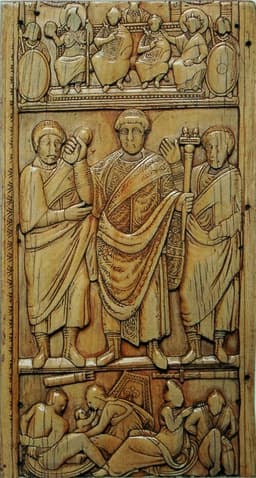
Constantius III
Emperor · Ancient
49.0Total

Zeno
Emperor · Ancient
46.2Total
Basic Information
Born
370
425
Died
421
491
Era
Ancient
Ancient
Nationality
Western Roman Empire
Byzantine Empire
Occupation
Emperor
Emperor
Civilization
Western
Western
Score Comparison
Military (10%)
70.0
50.0
Political (20%)
43.7
35.1
Influence (20%)
47.1
51.0
Legacy (20%)
39.2
43.3
Leadership (15%)
48.4
58.8
Strategy (15%)
66.3
35.7
TOTAL
49.0
46.2
Constantius III — Complete Timeline
417 AD
Married Galla PlacidiaPolitical Action◆ Major
Constantius, a Roman general, married Galla Placidia, the half-sister of Emperor Honorius. This marriage strengthened his political position and made him a key figure in the Western Roman court.
MarriageRoman EmpireDynasty
Impact: nationalconstructive
421 AD
Appointed Co-Emperor as Constantius IIIPolitical Action◆ Major
Constantius was appointed co-emperor of the Western Roman Empire by Honorius, ruling as Constantius III. His reign lasted only seven months before he died of illness, but he was the de facto ruler of the West for years prior.
CoronationRoman EmpireCo-Emperor
Impact: national
Zeno — Complete Timeline
476 AD
Failed to prevent the fall of the Western Roman EmpireWar
During Zeno's reign, the Western Roman Emperor Romulus Augustulus was deposed by Odoacer. Zeno recognized Odoacer as patrician but refused to recognize a new Western emperor, effectively accepting the end of the Western Roman Empire as a separate entity.
Fall of RomeLate AntiquityPolitical Change
Impact: globaltragic
Ended the reign of BasiliscusPolitical Action◆ Major
Zeno, who had been forced to flee Constantinople by the usurper Basiliscus, returned with an army of Isaurians and regained the throne. Basiliscus and his family were captured and executed, restoring Zeno's rule.
UsurpationCivil WarByzantine Empire
Impact: national
482 AD
Issued the HenotikonPolitical Action◆ Major
Emperor Zeno issued the Henotikon, an edict intended to reconcile the Chalcedonian and Miaphysite factions within the Christian church. The edict attempted to find a compromise but ultimately failed to heal the schism, alienating both sides and causing the Acacian Schism with the Papacy.
Religious PolicyChurch SchismByzantine Empire
Impact: regional
488 AD
Negotiated with Theodoric the GreatPolitical Action◆ Major
Zeno commissioned the Ostrogothic king Theodoric to invade Italy and overthrow the barbarian ruler Odoacer. This agreement removed a potential threat to the Eastern Empire and established Theodoric as the ruler of Italy, nominally as Zeno's viceroy.
Barbarian KingdomsOstrogothsItaly
Impact: regional
Expert Analysis
Origins
Constantius III, born in Naissus (modern Niš, Serbia) around 370 AD, rose from a military background in the Western Roman Empire. Little is known of his early life, but he became a trusted general under Emperor Honorius. His marriage to Galla Placidia, Honorius's half-sister, in 417 AD cemented his political ties.
Zeno, born Tarasis around 425 AD in Rusumblada, Isauria (southern Anatolia), was of Isaurian origin—a group viewed as semi-barbarous by Constantinople. His name change to Zeno reflected Hellenization. He rose through court connections, serving as a commander under Emperor Leo I.
Rise to Power
Constantius rose by defeating the Visigoths and usurpers. In 411 AD, he suppressed the usurper Constantine III, and in 413 AD, he defeated the Visigothic king Athaulf, recovering Galla Placidia. These victories made him the power behind Honorius. He became co-emperor on February 8, 421 AD, ruling as Constantius III for only seven months until his death on September 2, 421 AD.
Zeno's rise involved navigating court intrigue. He married Ariadne, daughter of Emperor Leo I, in 466 AD, strengthening his position. He became emperor in 474 AD after Leo I's death. However, he was forced to flee Constantinople in 475 AD when his mother-in-law Verina supported the usurper Basiliscus. Zeno returned in 476 AD with Isaurian troops, regaining the throne after Basiliscus's surrender.
Leadership & Governance
Constantius III, with a military score of 70.0 and leadership of 48.4, focused on military consolidation. He stabilized the Western Empire by defeating barbarian threats and negotiating with Visigoths. His governance was short-lived, limiting reforms. He married Galla Placidia to secure his position, but his rule depended on Honorius's favor.
Zeno, with a political score of 35.1 and leadership of 58.8, faced a crumbling Western Empire. He issued the Henotikon in 482 AD, an edict attempting to reconcile Chalcedonian and Miaphysite Christians, which failed and caused the Acacian Schism. He also negotiated with Theodoric the Great, sending him to Italy in 488 AD to overthrow Odoacer, effectively removing a Gothic threat from the East. His governance was reactive, focusing on survival.
Triumph & Tragedy
Constantius's greatest success was his military campaigns, scoring 70.0 in military, which temporarily restored order in the West. His marriage to Galla Placidia produced Valentinian III, future emperor. His tragedy was his brief reign—only seven months—preventing lasting impact. He died of natural causes, but his legacy was overshadowed by the Western Empire's decline.
Zeno's triumph was his survival and the preservation of the Eastern Empire. He ended the reign of Basiliscus (476 AD) and managed the Ostrogoths. His Henotikon, however, was a failure, deepening religious divisions. He also failed to prevent the Western Empire's fall in 476 AD, recognizing Odoacer but refusing to accept another emperor. His reign saw the loss of the West, though he maintained Eastern stability.
Character & Destiny
Constantius was a capable general but a politician with score 43.7. His decision to marry Galla Placidia was strategic but tied him to Honorius's weak rule. His death soon after becoming emperor suggests perhaps overexertion or illness. He remains a figure of unrealized potential.
Zeno, with strategy score 35.7, was cautious and manipulative. He used Isaurian troops and diplomacy to survive. His character was pragmatic, often sacrificing principles for stability. His Isaurian background made him unpopular, but he held power for 17 years despite revolts. His destiny was to oversee the West's fall while preserving the East.
Legacy
Constantius III's legacy is minimal. He is remembered as a general who briefly co-ruled and fathered Valentinian III. His influence score of 47.1 and legacy of 39.2 reflect this. His military achievements were overshadowed by the Western Empire's collapse.
Zeno's legacy is more significant. He maintained the Eastern Roman Empire during a crisis. His Henotikon influenced church relations for decades. By sending Theodoric to Italy, he indirectly shaped the Ostrogothic Kingdom. His legacy score of 43.3 and influence of 51.0 show greater impact. He is a key figure in the transition from the Roman to Byzantine world.
Conclusion
Zeno had a greater impact than Constantius III. Despite Constantius's higher total score (49.0 vs. 46.2), Zeno's reign lasted longer and shaped Eastern Roman policy. Constantius's brief rule prevented lasting change, while Zeno navigated the Western Empire's fall, issued the Henotikon, and managed barbarian migrations. Zeno's legacy score of 43.3 surpasses Constantius's 39.2, and his influence of 51.0 exceeds Constantius's 47.1. The score gap of 2.8 points favoring Constantius is misleading; Zeno's actions had more enduring consequences. Thus, Zeno is the more significant historical figure.
Rankings
🥇
Constantius IIILeader
Mil: 70.0Pol: 43.7Inf: 47.1
49.0
🥈
Zeno
Mil: 50.0Pol: 35.1Inf: 51.0
46.2
+2.8 behind
How This Comparison Works
Algorithm
Each figure is scored on 6 dimensions (0—100 scale) based on structured historical data: Military (10%), Political (20%), Influence (20%), Legacy (20%), Leadership (15%), Strategy (15%). The weighted total produces the final ranking.
Data Sources
Scores are computed from structured sub-indicators in the database. Scale factors adjust for era (Ancient ×0.85, Modern ×1.0) and civilization size (Eastern ×1.05, Other ×0.80) to account for differences in population and military scale.
Maximum 3 Figures
Comparisons are limited to 2—3 figures to ensure readability and statistical meaningfulness.
Error Margins
±5 points per dimension — Sub-scores are derived from historical records with inherent uncertainty. Two figures within 5 points on a dimension should be considered roughly equivalent in that area.
Total Score Accuracy
±3 points overall — The weighted combination of 6 dimensions produces a total score with approximately ±3 points of uncertainty. Differences of less than 3 points are not statistically significant— the figures are effectively tied.
Known Limitations
- Historical records are incomplete and uneven across civilizations
- Figures from oral-tradition societies may be underrepresented
- Occupation labels can misclassify multi-role figures
- Scores measure capability and impact, not moral character
- Quantitative scoring is a comparison tool, not absolute truth
Capability Radar
Military (10%) — Battles & Warfare
Battles
55
20
Win Rate
60
25
Expansion
50
5
Political (20%) — Governance & Reform
Reform
30
30
Diplomacy
55
40
Economy
35
20
Influence (20%) — Cultural & Global Reach
Cultural
25
20
Global
15
25
Legacy (20%) — Historical Impact
Historical
35
40
Longevity
20
30
Leadership (15%) — Power & Stability
Tenure
20
60
Stability
40
15
Strategy (15%) — Tactics & Innovation
Strategy
70
20
Tactics
65
15
Reform
40
10
Similar Comparisons
Comments & Discussion
No comments yet. Be the first to share your thoughts!