Loading...
Ptolemy IX Soter II vs Vitellius
Ptolemy IX Soter II leads by 0.9 pts · 2 figures compared
…
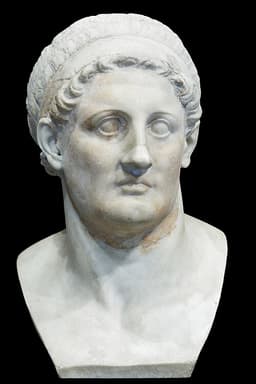
Ptolemy IX Soter II
Emperor · Ancient
40.6Total

Vitellius
Emperor · Ancient
39.7Total
Basic Information
Born
-142
15
Died
-80
69
Era
Ancient
Ancient
Nationality
Ptolemaic Kingdom
Roman Empire
Occupation
Emperor
Emperor
Civilization
Middle Eastern
Western
Score Comparison
Military (10%)
45.0
45.0
Political (20%)
27.9
39.4
Influence (20%)
46.3
42.4
Legacy (20%)
39.2
32.5
Leadership (15%)
45.0
45.0
Strategy (15%)
38.3
38.3
TOTAL
40.6
39.7
Ptolemy IX Soter II — Complete Timeline
116 BC
First Reign as King of EgyptPolitical Action◆ Major
Ptolemy IX ascended to the throne after the death of Ptolemy VIII, ruling jointly with his mother Cleopatra III. His reign was marked by conflict with his mother, who favored his brother Ptolemy X.
AccessionCo-RulershipDynastic Conflict
Impact: national
107 BC
Expulsion by Cleopatra IIIPolitical Action◆ Major
Cleopatra III forced Ptolemy IX to flee Egypt, replacing him with his brother Ptolemy X. Ptolemy IX went to Cyprus, where he ruled as a client king, but continued to plot his return.
ExileDynastic IntrigueCyprus
Impact: nationaldestructive
88 BC
Second Reign as King of EgyptPolitical Action◆ Major
After Ptolemy X's death, Ptolemy IX returned to Egypt and reclaimed the throne. His second reign was short, lasting only until his death in 80 BC, but he managed to restore some stability.
RestorationSecond ReignStability
Impact: nationalconstructive
Vitellius — Complete Timeline
69 AD
Battle of BedriacumWar◆ Major
Vitellius's forces defeated Otho's army at the First Battle of Bedriacum. The victory allowed Vitellius to enter Rome and be recognized as emperor by the Senate. His reign was marked by lavish spending and unpopularity.
Civil WarBattleVictory
Impact: national
Proclamation as EmperorPolitical Action◆ Major
Vitellius was proclaimed emperor by his troops in Germania Inferior after the death of Galba. He was the governor of the province and had the support of the Rhine legions. His claim was challenged by Otho, leading to civil war.
Year of the Four EmperorsProclamationRhine Legions
Impact: national
Death of VitelliusPolitical Action◆ Major
Vitellius was captured and killed by Vespasian's supporters in Rome. He was dragged through the streets and executed, and his body was thrown into the Tiber. His death ended the Year of the Four Emperors and established the Flavian dynasty.
ExecutionYear of the Four EmperorsFlavian Dynasty
Impact: nationaltragic
Expert Analysis
Origins
Ptolemy IX Soter II, nicknamed Lathyros (chickpea), was born around 143 BC into the Ptolemaic dynasty, the ruling Greek family of Egypt. He was the eldest son of Ptolemy VIII Physcon and Cleopatra III. His early life was steeped in the violent family intrigues that characterized the late Ptolemaic period. He received a Greek education and was groomed for rule from a young age, but his path was complicated by his mother's ambition.
Aulus Vitellius was born in AD 15 into a prominent Roman family. His father, Lucius Vitellius, was a consul and governor of Syria under Tiberius. Vitellius grew up in the imperial court, enjoying the privileges of senatorial rank. His early career included serving as a consul in AD 48 and later as governor of Africa. His appointment as governor of Germania Inferior in AD 68 set the stage for his imperial bid.
Rise to Power
Ptolemy IX first became king of Egypt in 116 BC upon the death of his father Ptolemy VIII, ruling jointly with his mother Cleopatra III. However, Cleopatra III preferred his younger brother Ptolemy X, and in 107 BC she forced Ptolemy IX to flee to Cyprus. There he ruled as a client king under his mother's suzerainty, biding his time. After Ptolemy X's death in 88 BC, Ptolemy IX returned to Egypt and reclaimed the throne, ruling until his death in 80 BC.
Vitellius rose to power during the chaos of AD 69, the Year of the Four Emperors. After the death of Galba, Vitellius was proclaimed emperor by his legions in Germania Inferior on January 2, AD 69. His forces, led by his generals Caecina and Valens, marched on Italy and defeated Otho's army at the First Battle of Bedriacum in April AD 69. Vitellius entered Rome and was recognized as emperor by the Senate.
Leadership & Governance
Ptolemy IX's leadership was marked by conflict with his mother and brother, which weakened the Ptolemaic state. During his first reign, he attempted to assert independence but was outmaneuvered by Cleopatra III. His second reign was short and focused on consolidating power, but he faced internal unrest and economic decline. He relied on mercenaries and was unable to stem the growing influence of Rome. His political score of 27.9 reflects his struggles.
Vitellius, as emperor, was known for his lavish banquets and cruelty. He executed political rivals and wasted state funds on feasts, earning a reputation for gluttony. He failed to secure the loyalty of the legions in the east, where Vespasian was proclaimed emperor. His leadership score of 45.0 is balanced by poor political decisions, scoring 39.4. He attempted to abdicate in the face of Vespasian's advance but was prevented by his supporters.
Triumph & Tragedy
Ptolemy IX's greatest success was reclaiming the throne after being exiled, demonstrating resilience. He maintained Ptolemaic rule in Egypt despite internal strife. However, his reign was overshadowed by the loss of Cyrenaica and the growing power of Rome. His inability to control his mother and brother led to a fragmented kingdom. His legacy score of 39.2 reflects his limited impact.
Vitellius's triumph was his rapid rise from governor to emperor, defeating Otho at Bedriacum. He briefly controlled the Roman Empire. But his tragedy was his short, disastrous reign of only eight months. He was captured and executed by Vespasian's forces in December AD 69, his body thrown into the Tiber. His total score of 39.7 is slightly lower than Ptolemy IX's 40.6.
Character & Destiny
Ptolemy IX was cautious and pragmatic, but his dependency on his mother and later his brother's machinations revealed a lack of political cunning. He scored 45.0 in leadership and 38.3 in strategy. His destiny was shaped by the toxic family dynamics of the Ptolemies, which prevented stable rule.
Vitellius was indecisive and prone to excess. His character—lazy, gluttonous, and cruel—alienated many. He scored 45.0 in leadership but only 39.4 in politics. His destiny was sealed by his inability to secure the loyalty of the eastern legions and his poor governance.
Legacy
Ptolemy IX's legacy is minor; he is a footnote in the decline of Ptolemaic Egypt. His reign saw no major reforms or achievements. The dynasty continued to decline until Cleopatra VII's final act. His influence score of 46.3 is modest.
Vitellius is remembered as one of the worst Roman emperors, a symbol of the chaos of AD 69. His short reign did not establish any lasting institutions. His legacy score of 32.5 is the lowest among the Year of the Four Emperors.
Conclusion
Ptolemy IX Soter II scored 40.6 overall, slightly higher than Vitellius's 39.7. While neither figure had a transformative impact, Ptolemy IX's two reigns, however troubled, maintained Ptolemaic rule for a few more decades. Vitellius's rule was a catastrophic failure that ended in his death and the rise of the Flavian dynasty. Therefore, Ptolemy IX had a marginally greater impact on history, as he sustained a kingdom, whereas Vitellius only accelerated Rome's instability.
Rankings
🥇
Ptolemy IX Soter IILeader
Mil: 45.0Pol: 27.9Inf: 46.3
40.6
🥈
Vitellius
Mil: 45.0Pol: 39.4Inf: 42.4
39.7
+0.9 behind
How This Comparison Works
Algorithm
Each figure is scored on 6 dimensions (0—100 scale) based on structured historical data: Military (10%), Political (20%), Influence (20%), Legacy (20%), Leadership (15%), Strategy (15%). The weighted total produces the final ranking.
Data Sources
Scores are computed from structured sub-indicators in the database. Scale factors adjust for era (Ancient ×0.85, Modern ×1.0) and civilization size (Eastern ×1.05, Other ×0.80) to account for differences in population and military scale.
Maximum 3 Figures
Comparisons are limited to 2—3 figures to ensure readability and statistical meaningfulness.
Error Margins
±5 points per dimension — Sub-scores are derived from historical records with inherent uncertainty. Two figures within 5 points on a dimension should be considered roughly equivalent in that area.
Total Score Accuracy
±3 points overall — The weighted combination of 6 dimensions produces a total score with approximately ±3 points of uncertainty. Differences of less than 3 points are not statistically significant— the figures are effectively tied.
Known Limitations
- Historical records are incomplete and uneven across civilizations
- Figures from oral-tradition societies may be underrepresented
- Occupation labels can misclassify multi-role figures
- Scores measure capability and impact, not moral character
- Quantitative scoring is a comparison tool, not absolute truth
Capability Radar
Military (10%) — Battles & Warfare
Battles
30
10
Win Rate
35
5
Expansion
10
0
Political (20%) — Governance & Reform
Reform
15
0
Diplomacy
30
5
Economy
20
0
Influence (20%) — Cultural & Global Reach
Cultural
20
5
Global
15
5
Legacy (20%) — Historical Impact
Historical
25
10
Longevity
20
5
Leadership (15%) — Power & Stability
Tenure
40
5
Stability
15
0
Strategy (15%) — Tactics & Innovation
Strategy
25
5
Tactics
30
10
Reform
10
0
Similar Comparisons
Comments & Discussion
No comments yet. Be the first to share your thoughts!